Showing posts with label Baidu. Show all posts

Wednesday, May 12, 2021

Baidu Introduces Driverless E-Hailing Service In Beijing

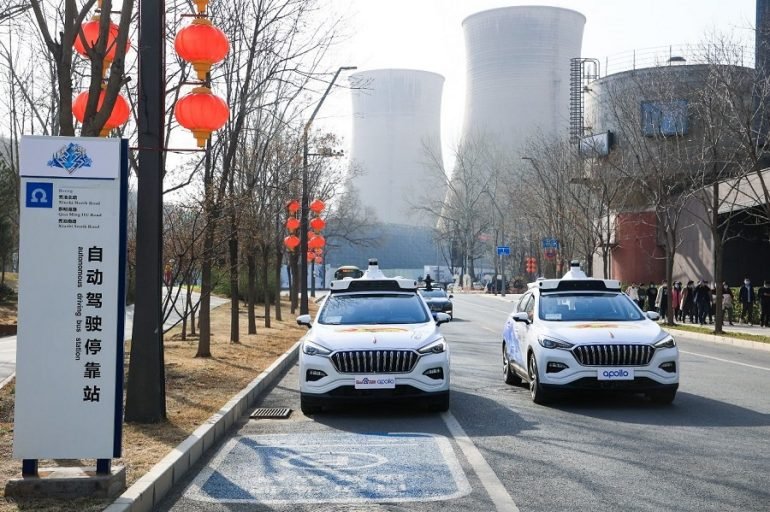
Chinese search giant Baidu launched what it claims to be a fully driverless e-hailing service in Beijing yesterday – the first of its kind in China.

The company said the Apollo Go Robotaxi service would be available in the capital’s Shougang Park – one of the venues of the 2022 Beijing Winter Olympics – where it’ll be ferrying visitors at the games. Apollo is Baidu’s AI-powered autonomous driving platform.

People can call for the robotaxi service by using the Apollo Go app. It has features like virtual reality navigation and remote car honking to help users locate the car. To unlock the car’s doors, users have to scan a QR code and health code on the vehicle for identity verification and COVID-19 prevention reasons.

Once they’re on board and the “Start the Journey” button is pressed, the system ensures that seat belts are fastened and doors are closed before beginning the trip. What happens in an emergency? Baidu said its 5G Remote Driving Service will be present at all times, allowing human operators to intervene if necessary.

The search giant said the robotaxi service was launched “only after conducting countless scalable driverless tests in many cities over a long period of time.” The company plans to introduce the service in more cities in the future, promoting it as a way of alleviating traffic congestion and helping China achieve its climate goals.

Sunday, May 2, 2021

Baidu And Geely’s Jidu Auto To Pour RM31.6 Billion Into Developing Smart Cars

Jidu Auto, the electric vehicle (EV) joint venture between Baidu and Geely, said it planned to invest 50 billion yuan (~RM31.6 billion) in making smart cars over the coming five years.

CEO Xia Yiping also told Reuters that the company’s first EV would look like a “robot” and would target young people, noting that Jidu would examine big market data before finalising the model. Previously, it was reported that the company would be working on an “intelligent” vehicle with autonomous driving technology.

“It will make you feel like it’s a robot that can communicate with you with emotions,” said Xia. As reported earlier, Jidu is looking to launch its first EV in three years, but its CEO said the company would also be trying for a shorter time frame.

According to him, the firm wants to introduce a new EV model every one or one-and-a-half years following its first launch. It also intends to bring aboard 2,500 to 3,000 new employees over two to three years, including 400 to 500 software engineers.

Tech companies inside and outside of China have been tripping over themselves to enter the booming EV market. Even Thailand is planning to sell only electric vehicles by the year 2035.

Friday, February 19, 2021

Baidu Has Picked CEO And Brand Name For Joint Electric Car Company With Geely


Baidu CEO Robin Li announced that the Chinese search giant had settled on a CEO and brand name for the electric car company it recently formed with Geely. He said this during Baidu’s latest earnings call but didn’t reveal the name of the CEO or the name of the new company.

However, CNBC, citing a source, claimed that the man picked for CEO is Xia Yiping, a co-founder of Mobike – a bicycle-sharing start-up. His LinkedIn profile indicated that he worked for Fiat Chrysler and Ford before co-founding Mobike which was bought over by the Chinese food delivery firm Meituan in 2018. However, Baidu declined to comment when it was contacted by CNBC.

In its electric vehicle venture with Geely, the majority shareholder is Baidu and Li has previously described the company as combining Baidu’s expertise in autonomous driving with Geely’s expertise in the automotive industry. But when the venture was announced, it wasn’t clear if self-driving cars were on its roadmap.


Li put that to rest during the aforementioned earnings call, saying that the company envisioned an “intelligent” vehicle with autonomous driving technology, the South China Morning Post reported. He said the new EV company aimed to launch its first vehicle in about three years.

The electric car initiative is part of Baidu’s big push to diversify away from its core advertising business. Baidu is already looking to enter the chip-making business through a new AI semiconductor company.

Monday, February 15, 2021

Baidu Seeking To Raise Funds To Set Up AI Chip Company


Chinese search giant Baidu is engaging in discussions to raise funds for an artificial intelligence semiconductor company, a knowledgeable source told CNBC. The move is part of an effort to diversify away from Baidu’s core advertising business, as well as address the ongoing global chip shortage afflicting multiple industries.

CNBC’s source said that the new chip company would be a Baidu subsidiary. Venture capital firms GGV and IDG Capital are having early stage talks to enter as inventors, but Baidu would likely be the majority shareholder, the source said. CNBC noted that both venture capital outfits have extensive investments in China.

The fruits of Baidu’s diversification push have begun to bear, with ad-related revenue dropping from 80% of total revenue in 2018 to 71% in the third quarter of 2020, CNBC said. Baidu also recently dipped its feet in the automotive market, linking arms with Geely to start an electric car company.


Venturing into the chip-making business could also be a boon to Apollo, Baidu’s AI-powered autonomous driving platform. Furthermore, industries across the world, including the automotive business, have been hit hard by a pandemic-induced chip shortage – so, demand is no question.

China, in particular, has a pressing need for chips, owing to US sanctions enacted by the Trump administration that effectively strangled chip supply to the country. Beijing has since doubled its efforts to shore up the domestic chip-making industry.

Thursday, January 14, 2021

US Backs Off Banning Investments in Alibaba, Tencent And Baidu


US government officials backed off a plan to ban American investment in Chinese tech conglomerates Alibaba, Tencent, and Baidu after disagreements emerged within the Trump administration. But as his presidency winds down and under siege from impeachment, President Trump signed an executive order to enhance a ban on US investments in companies allegedly linked to China’s military.

Some US officials pushed for Alibaba, Tencent, and Baidu to be added to an investment blacklist on the account of (allegedly) aiding China’s military, intelligence, and security apparatuses. But sources told Reuters that Treasury Secretary Steven Mnuchin opposed the idea and eventually prevailed over his administration colleagues.

According to the Wall Street Journal (WSJ), Mnuchin and his team feared widespread selloffs and economic fallout had the plan gone through. The firms in question are dauntingly enormous, having tremendous pull across markets. As Bloomberg noted, the combined market value of Alibaba and Tencent exceed US$1 trillion – almost twice the size of Spain’s stock market.


Regardless, President Trump seemed determined to secure his tough-on-China legacy, clarifying and toughening a previous executive order on investments. In addition to being barred from buying securities in companies linked to China’s military, US investors must now get rid of all their holdings in those companies by 11 November this year.

Alibaba, Tencent, and Baidu may have dodged the bullet (for now), but the Trump administration is set to add nine other Chinese firms to its investment blacklist, sources told the WSJ. Top Chinese chipmaker SMIC and oil giant CNOOC were blacklisted just last month. US-China industrial relations should improve under the Biden administration, but by how much is another question.

Geely Makes Push Into Electric Vehicle Market With Foxconn and Baidu


Chinese carmaker Geely, widely credited for reviving Proton’s fortunes, is making an aggressive push into the electric vehicle market, signing separate deals with Taiwanese electronics manufacturer Foxconn and Chinese search giant Baidu.

Geely’s partnership with Foxconn, well-known as a major Apple supplier, would involve them providing contract manufacturing for other carmakers. According to Reuters, the companies would each have a 50% stake in a venture that will also provide automakers with consulting services on electric vehicle (EV) technologies. News reports indicate that Apple itself is likely to launch a self-driving electric vehicle by 2024.


Earlier in the week, Geely announced that it was linking up with Baidu to design and manufacture electric vehicles. Industry observers view the partnership as an effort to challenge US carmaker Tesla’s current global dominance in the electric vehicle market.

“We believe that by combining Baidu’s expertise in smart transportation, connected vehicles and autonomous driving with Geely’s expertise as a leading automobile and EV manufacturer, the new partnership will pave the way for future passenger vehicles,” said Baidu CEO Robin Li, according to the BBC.

Bloomberg, citing a source knowledgeable on the matter, reported that Baidu would hold a majority stake in the new electric car company. Bloomberg’s source further said that the pact was aimed at pushing Apollo’s adoption in more vehicles. Apollo is Baidu’s AI-powered autonomous driving platform. However, the Bloomberg report did note that it was unclear if self-driving cars were on the partnership’s roadmap.


The reason behind Geely’s spate of deals may simply have to do with pragmatism. Sources told Reuters that Geely wants to make better use of the production capacity of its factories in China. Geely Automobile, its main listed company, can churn out over 2 million vehicles a year, but only sold about 1.32 million last year.

Geely is better known in Malaysia as national carmaker Proton’s strategic partner, having acquired a 49.9% stake in the latter in 2017. Since then, Proton sales and revenue have seen a tremendous turnaround, breaking with years of steep losses. The carmaker hit a 8-year sales high just in July last year.

Xiaomi Shows Off Physical Concept Of Vision Gran Turismo

At the very tail end of last month, Xiaomi unveiled the Vision Gran Turismo. The car was revealed as a digital hypercar, and one that’s made...