Showing posts with label to. Show all posts

Wednesday, November 29, 2023

Google Drive Files Gone Missing Due To a Bug In The Desktop App


Google Drive is one of the best cloud storage options available and is open to the public. However, according to a trending support thread on Google’s support forums, users have reported that some of their files have started to disappear from the service in recent months. Furthermore, since none of these files were deleted manually, they don’t appear in the platform’s recycling bin feature and thus cannot be recovered (so far).

Early on in the investigation, many speculated that the files vanished due to a hacker attack, but this isn’t the case. According to a thorough investigation, it has been concluded that the issue stems from the Google Drive app for desktop, which affects users regardless of whether their system is Windows or Mac. With that said, users on the browser variation of the service can rest easy.


It was also discovered that the bug would eliminate the data from the account, almost reverting the account back to a state before that data was made. Unfortunately, there’s no explanation for it so far, but Google has confirmed that this problem is related to a syncing issue seen in the recently rolled-out v84.0.0.0 through 84.0.4.0 of Drive.


Although this issue affects – as Google puts it – a “limited subset of Drive for desktop users,” it is recommended to backup all important files and documentation. Furthermore, the company has warned users to avoid disconnecting their Google account from the Drive on desktop, and that they should not tamper with the “DriveFS” folder that’s locally found on their machines in any way, shape, or form.

Chinese Companies Are Dismantling RTX 4090 Cards To Circumvent US Ban


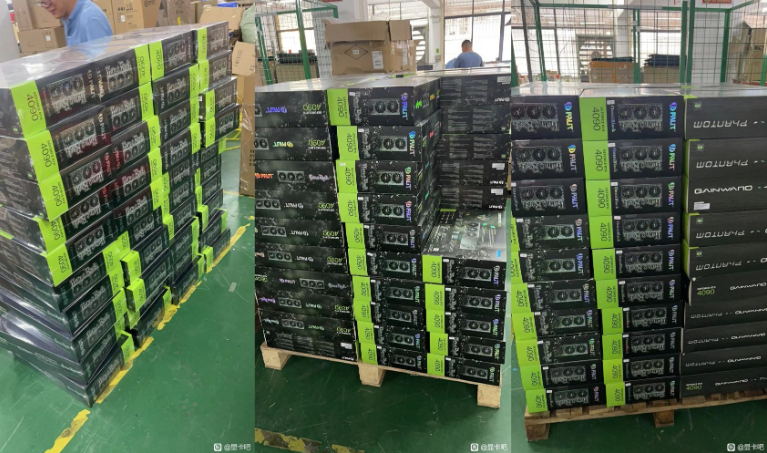
Ever since the US ban that prohibits China from receiving anymore of NVIDIA’s GeForce RTX 4090 GPU, among other things, went into effect earlier this month, many Chinese companies have had no choice but get creative in the way they can sell the card. One such method involves them removing manufacturers’ cooler from the card and slapping on a blower-style cooler on it.

Of course, the dismantling process of these RTX 4090 is obviously a little more complicated than that; these companies are reportedly dismantling the GPU at scale, meaning that they are disassembling the GPU core from the PCB en masse, attaching them to different cards, and then slapped with blower-style coolers. Once completed, the new cards are then labelled as “AI Cards” to suggest that they are designed to be used in AI language model training.


As a quick reminder, the US export bans specifically forbids the distribution and sale of the AD102 GPU, which is part and parcel of the RTX 4090. Prior to the ban, NVIDIA had actually managed to rush a large-scale order of GPUs to its AIB partners in China. In anticipation of the ban, Chinese companies had also made a somewhat smart decision to stockpile as many GPUs as physically possible.

Several of the photographs that were taken in one of this “AI Cards” disassembly lines include RTX 4090s procured from brands such as ASUS, PNY, Colorful, Palit, and Zotac. This is undoubtedly an infuriating scenario for gamers that may have been looking forward to procuring said card in China.


Even after stripping the precious RTX 4090’s AD102 GPU from their original PCBs, these Chinese companies don’t appear to waste anything either. Supposedly, they resell the leftover components and naked PCBs as spare parts, which would be beneficial to individuals looking to just upgrade their coolers. For others, they serve as a morbid reminder of where said components originated from.

The unfortunate reality to this hoarding of the RTX 4090 is that, as it stands right now, what these Chinese companies are doing isn’t “technically” against the law in their own country. Further, it has become evident that virtually none of NVIDIA’s board partners actually put fail safes in place to prevent incidents such as this to take place. Worst, NVIDIA itself has a share of the blame for this, by virtue of the GPU brand having created the environment in which these unscrupulous characters are allowed to exist.

Tuesday, July 25, 2023

Elon Musk Is Renaming Twitter Simply To “X”


Ever since Elon Musk, the owner of Tesla and Space X, acquired Twitter, it feels like the social media platform has been nothing but a big digital testing ground for his ideas and potential features. This round, though, he’s decidedly had enough of the platform name and is renaming it, simply to X.

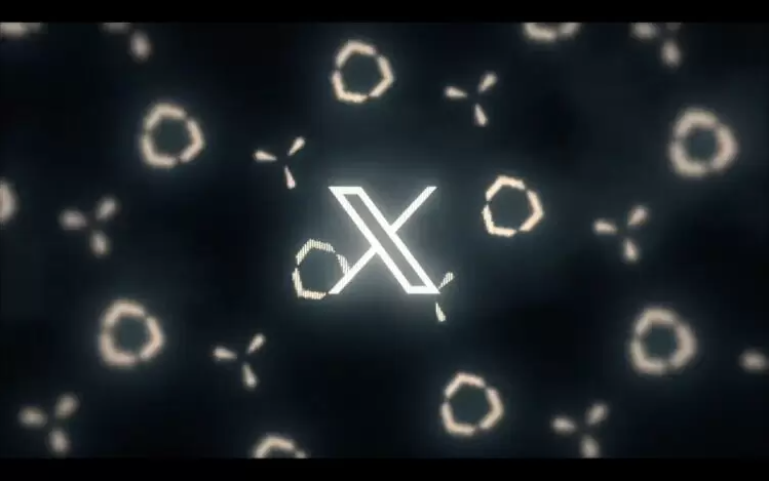
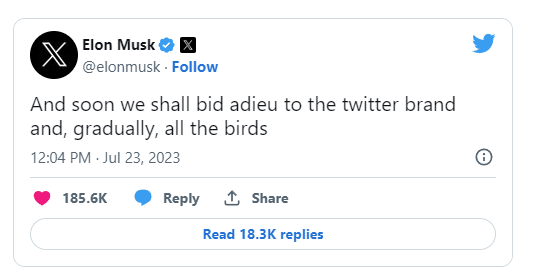
In a tweet via his official account, Musk posted the message “And soon we shall bid adieu to the brand and, gradually, all the birds”. And for those that aren’t convinced that the founder of Tesla isn’t going through with it, he’s already replaced his profile picture with a stylised image of the letter X, as well as pinned a 3-second clip of the social network’s new namesake on his main page. Oh, and he reportedly also sent out an email to staff, the contents of which stated “this will be the last email that I will ever send from a Twitter email address”.

It’s no secret that Musk has long been a fan of the “X” branding. From the Tesla Model X to SpaceX, his latest venture into AI is a company named xAI. As to why the rebranding to a single alphabet, Musk says that he has envisioned the platform becoming an “everything app” but didn’t provide further details on that. Some believe that he could be referring to the popular China-made app, WeChat, and how it is used as a gateway for shopping and payments, along with social media.


That being said, it can also be argued that Musk’s decision to rebrand Twitter to X is a dangerous move; the social network has already lost more than half its ad revenue since November last year, due to the changes in which content is moderated on the site. Of course, it can also be said that the rebranding is the man’s way to cut off ties with the platform’s former leadership, along with all the decisions they had made before his arrival.

Friday, April 14, 2023

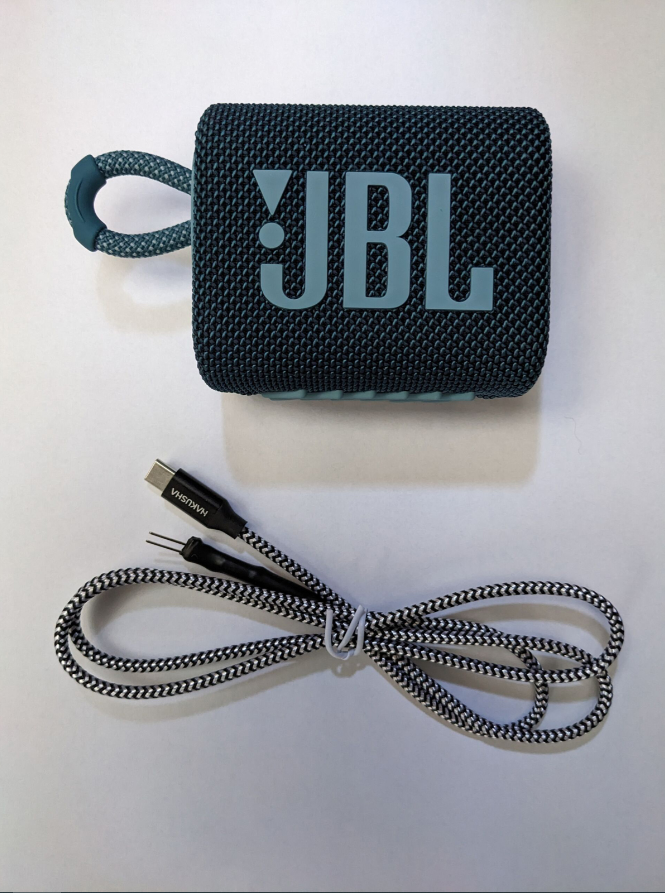
Thieves Discovered Using Hacking Tool Disguised As A JBL Portable Speaker To Steal Cars


A new form of carjacking has been discovered by UK-based automotive cybersecurity researcher Ian Tabor, which allows thieves to break into keyless vehicles using a special hacking tool to spoof the security system. One particular version of this device, he noted, could appear as a seemingly harmless portable speaker from JBL.

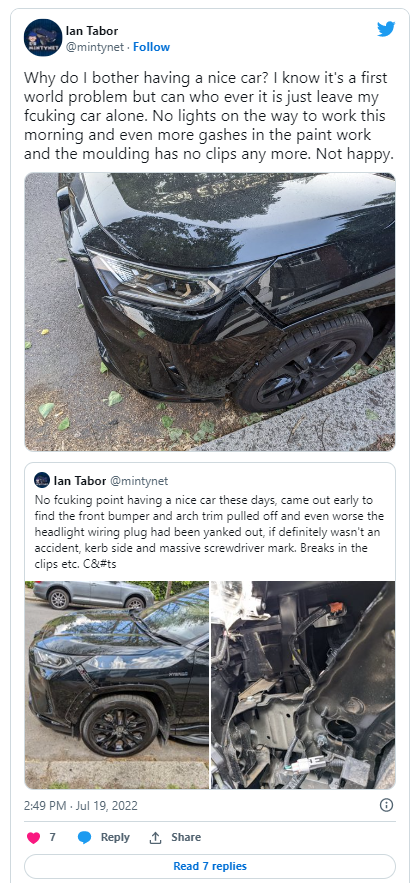
What led to Tabor researching the matter was actually caused by his own experience of losing his Toyota RAV4 last year. The first few attempts of the theft were even documented by the researcher on Twitter, where he assumed that these were merely acts of senseless vandalism on his car. More specifically, Tabor tweeted that vandals have torn off its front left-side bumper and partially dismantled the headlight not once but twice in three months. 


The third time, unfortunately, was the charm for the thieves as the RAV4 went missing a few days after the second attempt. This incident prompted Tabor to investigate how his car was stolen, together with fellow automotive security expert Dr. Ken Tindell. Their findings have been published as a detailed report via the latter’s Canis Automotive Labs blog on Github.

In their research, it is discovered that the carjackers are using a new and sophisticated approach called CAN (Controller Area Network) Injection, which exploits a newly found vulnerability in 2021 Toyota RAV4 vehicles dubbed as CVE-2023-29389. This particular flaw automatically trusts messages from other ECUs (electronic control units), allowing physically proximate attackers to drive a vehicle by accessing its CAN bus and then sending a forged key validation message. However, thieves are first required to pull away the bumper in order to expose the car’s headlight connector to access the ECU, hence the presumed vandalism attempts.


What’s even more concerning is that such methods, which have been documented on video by the way (shown above), would reportedly take only two minutes to break into keyless vehicles. Upon further digging on Youtube, crime forums and even the dark web, Tabor discovered that thieves have been using CAN Injection tools that are sold online as emergency start devices. These are originally intended for use by owners or automotive professionals when a car’s key fob is lost, stolen, or otherwise unavailable.

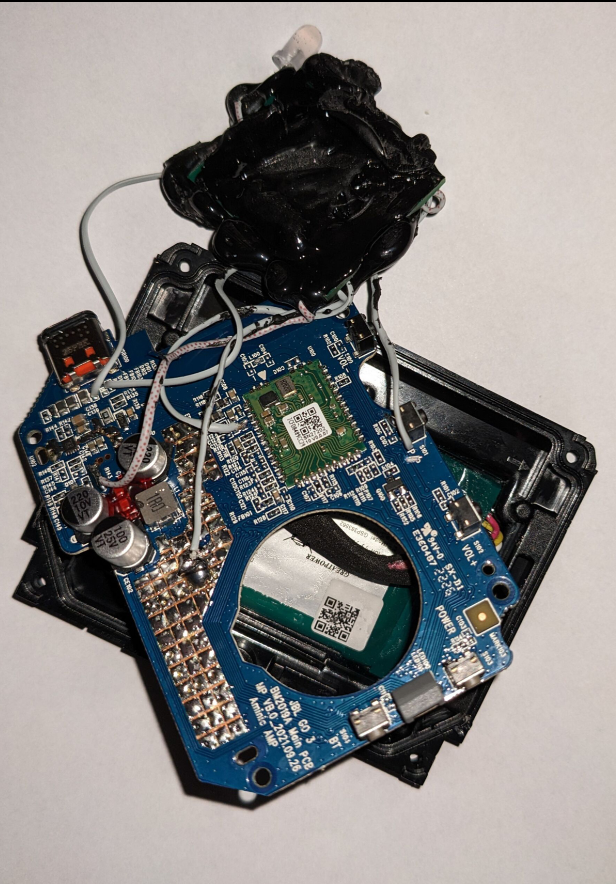
As mentioned earlier, one version of this hacking tool, which both security experts purchased for reverse engineering purposes, came in the form of a fake JBL portable speaker – a disguise that can easily fool any unsuspecting individual or authority if uninspected. Our own research has found that other similar tools are also available as generic key fobs and, of all things, a certain retro handset. Of course, we won’t link our discoveries here due to obvious reasons, and we do not condone the use of such equipment.


According to Tindell, pressing the play button on the fake JBL portable speaker will trigger it to send out a CAN message burst that instructs the targeted vehicle’s ECU to unlock its doors. Of course, with the car believing that the false key is valid, thieves are also given access to its Push Start function and are able to drive off.

While the attack was successfully replicated on a Toyota RAV4, it is still possible that something similar could occur on other vehicles using the same technology and architecture. Tabor and Tindell have alerted Toyota regarding the vulnerability, but have yet to receive any acknowledgement or response from the automaker.

US Government Traces Pentagon Leak To Member Of Air Force National Guard


The US Federal Bureau of Investigation (FBI) has traced the source that leaked highly classified documents from the Pentagon back to an Air National Guardsman. 21-year-old Jack Douglas Teixeira, who is a member of the US Air Force National Guard, was arrested in the state of Massachusetts earlier today.

US Attorney General Merrick Garland confirmed the arrest and said that Teixeira was currently being held “in connection with an investigation into alleged unauthorised removal, retention, and transmission of classified national defense information”. During the investigation, it was surmised by the Washington Post that whoever leaked the documents was, in all possibility, someone of the suspect’s age, an American that grew up with gaming and guns in their life, and most importantly, would be a soldier within a military branch.


The investigation is still ongoing but US officials found that Teixeira also controlled a Discord server, through which he leaked the classified documents, all just so that he could get the one thing a person his age would do: he wanted to impress his friends. His channel wasn’t as big, with only 25 members in total, but the problem was that it included individuals that hailed from Europe, Asia, and South America. Unsurprisingly, once the authenticity of said documents were verified by other sources, they began spreading like wildfire, leading to the current predicament the US government is in right now.

As we reported yesterday, Teixeira’s leaking of US Pentagon documents is also the most potentially devastating, and could even be more impactful than those leaked by Edward Snowden back in 2013. Alleged content from the highly classified documents reportedly included references to Russian and Chinese activities, and about how the current war in Ukraine has drawn the latter country into helping the former. Not only that, but the leaked documents also seemingly point to the US spying on allied countries, including South Korea and Israel. Among other things.


Another matter that the US government will most certainly be asking, in light of Teixeira’s arrest, is how exactly a low-ranking Air Force National Guardsman even managed to get his hands on documents, some likely modified down the line, that was clearly not for his eyes.

Thursday, February 9, 2023

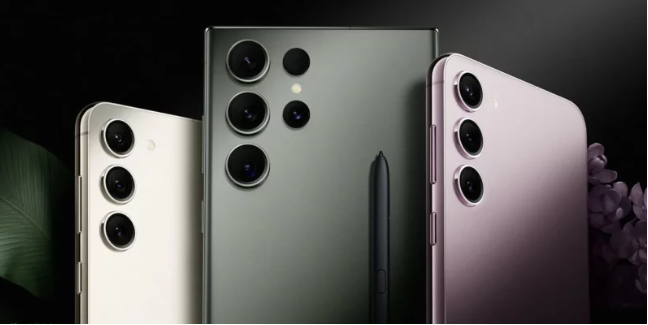
Bloatware pushes the Galaxy S23 Android OS to an incredible 60GB


As a smartphone operating system, Android strives to be a lightweight OS so it can run on a variety of hardware. The first version of the OS had to squeeze into the T-Mobile G1, with only a measly 256MB of internal storage for Android and all your apps, and ever since then, the idea has been to use as few resources as possible. Unless you have the latest Samsung phone, where Android somehow takes up an incredible 60GB of storage.

Yes, the Galaxy S23 is slowly trickling out to the masses, and, as Esper's senior technical editor Mishaal Rahman highlights in a storage space survey, Samsung's new phone is way out of line with most of the ecosystem. Several users report the phone uses around 60GB for the system partition right out of the box. If you have a 128GB phone, that's nearly half your storage for the Android OS and packed-in apps. That's four times the size of the normal Pixel 7 Pro system partition, which is 15GB. It's the size of two Windows 11 installs, side by side. What could Samsung possibly be putting in there?!

We can take a few guesses as to why things are so big. First, Samsung is notorious for having a shoddy software division that pumps out low-quality code. The company tends to change everything in Android just for change's sake, and it's hard to imagine those changes are very good. Second, Samsung may want to give the appearance of having its own non-Google ecosystem, and to do that, it clones every Google app that comes with its devices. Samsung is contractually obligated to include the Google apps, so you get both the Google and Samsung versions. That means two app stores, two browsers, two voice assistants, two text messaging apps, two keyboard apps, and on and on. These all get added to the system partition and often aren't removable.
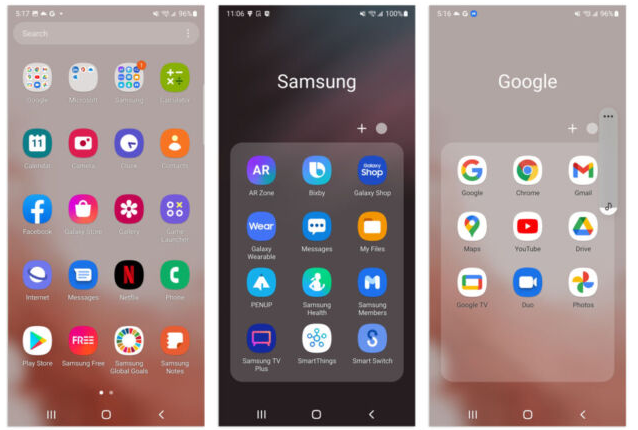


Unlike the clean OSes you'd get from Google or Apple, Samsung sells space in its devices to the highest bidder via pre-installed crapware. A company like Facebook will buy a spot on Samsung's system partition, where it can get more intrusive system permissions that aren't granted to app store apps, letting it more effectively spy on users. You'll also usually find Netflix, Microsoft Office, Spotify, Linkedin, and who knows what else. Another round of crapware will also be included if you buy a phone from a carrier, i.e., all the Verizon apps and whatever space they want to sell to third parties. The average amount users are reporting is 60GB, but crapware deals change across carriers and countries, so it will be different for everyone.

Just on the surface, Samsung's 60GB system partition looks bad compared to the Pixel 7's 15GB, but it's actually worse than those two raw numbers. Samsung isn't even using one of the big, storage-hungry Android features that you would normally get on Pixel 7: A/B system partitions. The Pixel 7 (and most other flagships) can actually have two copies of the operating system, one that is online and being used, and another that is offline and sitting in the background. When an OS update gets downloaded, a Samsung phone, with only one copy of the OS, will have to reboot and have as much as 30 minutes of downtime. A Pixel phone, with two copies of the OS, will just keep running and update the second offline OS in the background. Then, when the update is done, it will just do a normal 30-second reboot, and the device will swap operating systems, moving over to the OS copy that was just updated in the background. The dual OS system also gives a phone a backup if something goes wrong. If that new, updated OS boot fails, Android will switch back to the old OS and try the update again.

This A/B partition feature launched in Android with version 7.0—so it's seven years old—but Samsung is the only major OEM to not use it. Google threatened to make it mandatory several times in the past, but it keeps losing its resolve. Naturally, two copies of the OS will increase storage demands somewhat, but today it's a lot smaller than it used to be. The feature previously involved keeping two copies of the OS around all the time, but today, with "virtual A/B partitions," you normally have one copy of the OS, and when an update arrives, a second copy of the OS is created, updated in the background, and swapped, too. Upon successful boot, the old copy is discarded. That means you only need a chunk of free storage during the update process. Google has a detailed breakdown of how the feature will affect storage, and it lists 4.5GB for the main OS (a Pixel's additional space is for packed-in Google apps), and while the space used for that would normally double during the update, with compression it's only an extra 2.1GB.

That's on a Pixel, though. Samsung's operating system is such a mess, it doesn't seem like it will ever be able to adopt a feature like A/B partitions. The system partition can grow over time, so that 60GB is will only get bigger as the updates roll in. As always, Samsung is happy to throw more hardware at the problem, and while the base model of 128GB might start to feel cramped, the Galaxy S23 Ultra has plenty of room for crapware, with sizes up to 1TB.

Monday, December 19, 2022

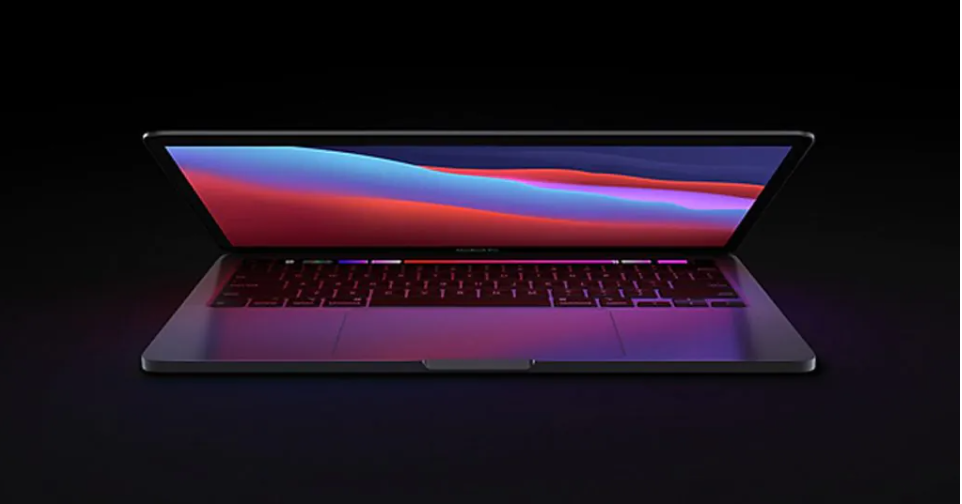
Apple Reportedly Plans To Launch Updated MacBook Pro Lineup In Early 2023


Apple is expected to launch several new MacBook Pros and other Mac products with updated internals next year, along with a few external monitors in the works. This comes as the company seems to be failing to meet its 2022 deadline of completely transitioning its lineup of products away from Intel to its in-house Apple Silicon.

Reliable Apple leaker, Bloomberg’s Mark Gurman, claims that Apple will launch updated 14-inch and 16-inch MacBook Pros early next year, offering the highly-anticipated M2 Pro and M2 Max chipsets. Reports from earlier this month also hint at the updated models getting faster LPDDR5X RAM that would provide more bandwidth and consume less power.


Apple still only sells an Intel-powered high-end version of the Mac mini but that will apparently change soon as the tech giant reportedly plans to replace it with an M2 Pro-powered offering. The Mac Pro is expected to receive its long-delayed Apple Silicon treatment with a high-powered chip that Gurman speculates will be the M2 Ultra.

The report claims that the M2 Ultra is set to be equipped with up to 24 CPU cores, 76 graphics cores, and will be able to be configured with up to a whopping 192GB of memory. A higher-end variant dubbed the M2 Extreme would have offered double the amount of CPU and GPU cores, but Gurman says that this was scrapped because of the cost and complexity of fusing four M2 Max chips together, which would have apparently priced the Mac Pro at a minimum of US$10000 (~RM44220).


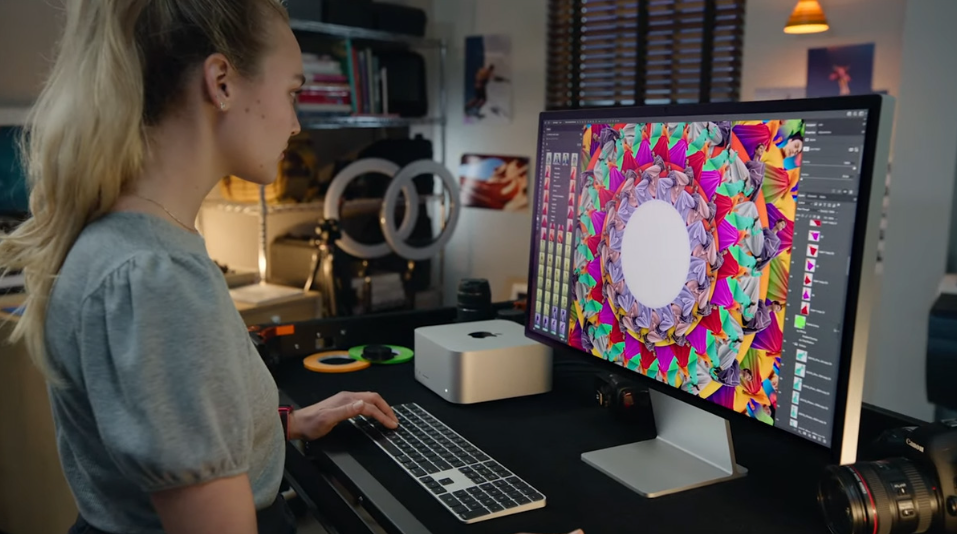
In related news, the Cupertino-based company is purportedly working on several new external monitors as an update to the Pro Display XDR. Just like this year’s Studio Display, the new monitors will be powered by Apple Silicon to use fewer resources from the attached machine.

The US$2 trillion (~RM8.84 trillion) firm is predicted to shift its Mac Pro assembly from Texas to Vietnam. It was forced to do the assembly in the US after political pressure from the Trump administration but with the new government, Apple can move its production back to Asia.

Thursday, December 15, 2022

Intel 13th Gen Non-K CPUs Supposedly Up To 64 Percent Faster Than Previous Generation

Intel’s 13th Gen Raptor Lake CPUs and their performance shows how the chipmaker was able to retake the lead from AMD’s current Ryzen 7000 Series, in just one generation. Recently, a new leak seems to suggest that the brand’s non-K desktop CPU lineup is prepared to do the same, only this time, it’s against its predecessor.

The leak in question comes from a Twitter user who goes by the handle chi11eddog (@g01d3nm4ng0), and technically contains the performance metrics of the non-K 13th Gen CPUs. Specifically, they are graphs from Cinebench R23’s single-core and multi-core tests and more to the point, the tests were conducted on a total of five CPUs.


The non-K 13th Gen CPUs on the list are the 13900, 13700, 13600, 13500, and the 13400, which are essentially every CPU under the Core i9, i7, and i5 SKUs. On the multi-core test, the 13th Gen processors clearly have an edge over their 12th Gen Alder predecessors. The 13500, specifically, shows a performance improvement of up to 64% on the test, with the 2nd highest-performing CPU being the 13600.

On the single-core test, the 13th Gen’s 13900 was very clearly the CPU that has the most gains, with a 10% increase in performance over the last generation’s 12th Gen 12900. Overall, the worst-performing CPU on this list is the 12500, but that being said, it is still relatively decent. However, the 13900 of Intel’s 13th Gen Raptor Lake is expected to run 500MHz faster than the 12900 and also has eight more E-Cores than its predecessors. So, it really doesn’t come as a surprise that it would perform significantly better on the multi-core tests too.

As for when we can expect to see all five of these CPUs, Intel is expected to the launch its non-K 13th Gen Raptor Lake CPUs on 3 January, which is also when CES 2023 kicks off in Las Vegas. What makes them all that more appealing is that, while not overclockable, they all have a default TDP of 65W, nearly half of what their K-powered counterparts draw. At the same time, the chipmaker is also expected to announced its new B760 motherboard series.

Gatita Yan Allegedly Gets Invited To DJ at Jackson Wang’s Party, Later Rejects to Keep BF Happy


By now, most Malaysians are familiar with this Insta famous influencer/YouTuber Gatita Yan. Not long ago, she announced that just like Ms. Pui Yi, she will also start a new career path which is being a DJ.

Just yesterday, Gatita announced on her Instagram story that she will be attending Jackson Wang’s after party at a club in Solaris. In her story, she mentioned that she was “invited” to be the DJ for his after party.

“I’ve been practicing for so long. I’ve never practiced this long for a show before, I’m so grateful that I was invited to be a part of Jackson Wang’s after party DJ. I have so much gratitude”, she said.

Hours after she posted the story, she then posted another story saying that she’s getting a lot of hate for the announcement she made.

“Since there are so many people who have been commenting on this issue and making it a big deal, the hate has spread to the point where even my Middle Eastern boyfriend has heard about it”, she added.


She then revealed that her Middle Eastern boyfriend is not in the entertainment/media industry and couldn’t stand the fact that she is receiving this much hate and backlash from netizens.

She then ended her Instagram story saying,

“I don’t want my boyfriend to be upset over this matter and I’ve decided to cancel the DJ show.”

Following that, many netizens were quick to call her out and speculated that this was all a “one-woman show”.

“It’s so sad to see you become someone so desperate and sad. There’s nothing real about you or this matter.”

“She’s so good at putting up a show.”

“I believe a lot of DJs out there are treating as a joke and laughing about it.”

What do you think of this issue? Let us know in the comments below.

Saturday, August 27, 2022

Quest VR Headsets To No Longer Require A Facebook Account For Login


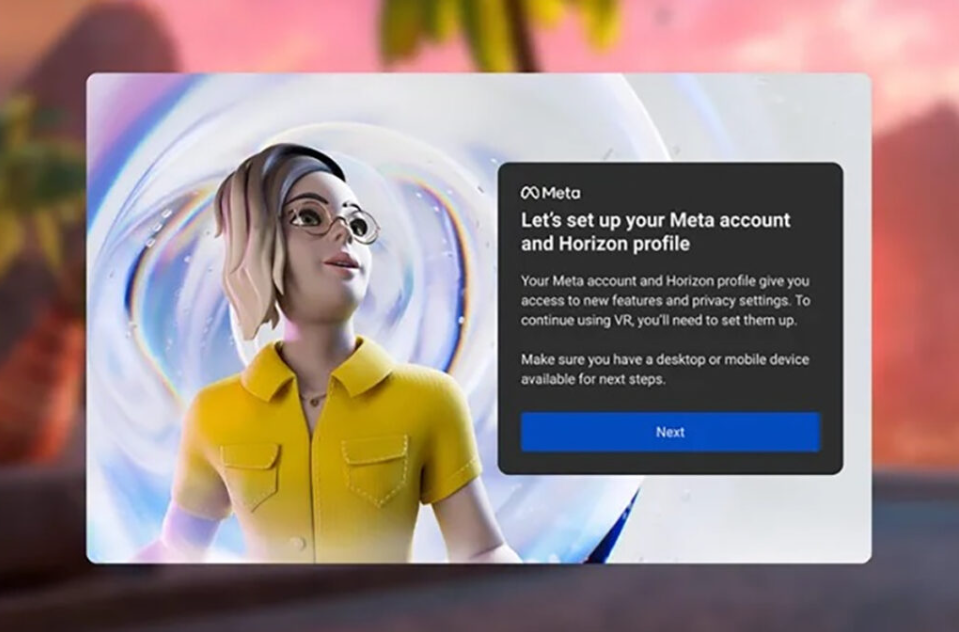
Meta has recently announced that a Facebook account is no longer needed for Quest VR headset logins. Instead, owners are now required to create a new Meta account and a Meta Horizon profile in order to fully utilise the virtual reality headgear – both of which are currently being rolled out on a gradual basis across the globe.

As some may recall, this isn’t the first time Meta has shifted the login policy for its headsets. Prior to this, the company discontinued the original Oculus accounts in 2020, requiring users to log in to their Quest VR devices with a Facebook account instead. The move proved to be unpopular, with existing headset owners – those with and without an existing Facebook account –  raising privacy concerns due to the tech giant’s well-known (but infamous) track record on the subject.


This supposed U-turn may seem like an attempt to quell users of any fears related to the stigma that Meta possesses. However, all this does is raise even more eyebrows at best, as you’re still required to register with the company anyway – this time around with another account made directly under the brand itself, which is undeniably redundant.

Despite all this, Meta is adamant that this move is the best course of action moving forward. “Our new Meta account structure gives you more flexibility and control, letting you choose how you do and don’t show up—and whether Facebook and / or Instagram is part of your experience in VR and other surfaces where you use your Meta Horizon profile,” the social media conglomerate said in its recent blog post.


If you’re cool with this (not like we’re given much of a choice to begin with), you can create a new account through the Meta mobile app using an email address, Facebook account, or Instagram account. Once it is created, all that’s left is to set up a linked Meta Horizon social profile for your Quest VR headset. Additionally, you can also choose to remove your Facebook profile from your newly created Meta account afterwards.

1 in 4 Gen Z-ers plan to become social media influencers


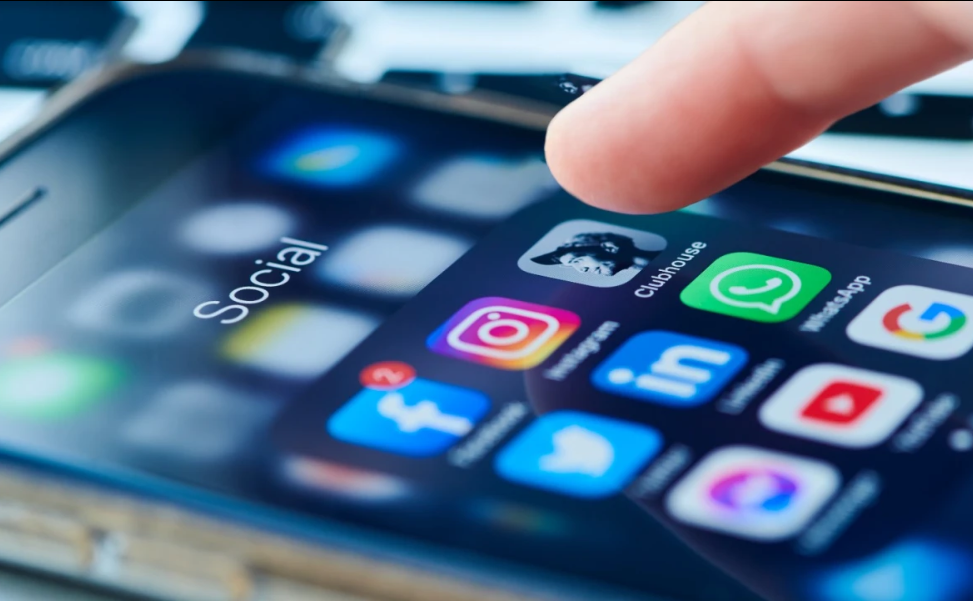
With the rising popularity of social media came the fame and fortune of young social media influencers such as Addison Rae, Charli D’Amelio and James Charles.

Now, new survey results from HigherVisibilty show 1 in 4 members of Gen Z want to emulate these celebrities, who make millions of dollars through brand sponsorships and advertisements but are also subject to intense public scrutiny on- and off-line. Sixteen percent of those surveyed said they would pay money to become an influencer.

A total of 1,000 individuals in the United States between the ages 16 and 25 completed the survey in July 2022.

Results varied slightly by region. More than 40 percent of respondents in the West said they want to become a social media influencer, compared with 33 percent in the Midwest, 36 percent in the South and 39 percent in the Northeast.

Broken down further, data showed “41% of New York Gen Zs intend on becoming an influencer in the future, whilst 30% from [Los Angeles] also feel the same way.”

According to authors, “just 7.13% of Gen Z responded that they would not want to be a social media Influencer.”

Social media influencers can find audiences on a variety of platforms like Instagram, TikTok and YouTube. The rise of the industry was so strong that in 2020 creators launched the American Influencer Council.

More famous celebrities can even make up to $1 million for posting a single sponsored image or video on Instagram.

When queried, the majority of respondents guessed the average yearly income of an influencer was between $75,001 – $100,000, and many pointed to free products, earnings and meeting other influencers as the top perks of the profession.

Over a quarter of individuals also said they regularly post on social media with the intent to gain followers, while 35 percent of men report caring about their follower account compared with 31 percent of women.

Notably, the survey revealed more men, at 20 percent, than women, 13 percent, feel being an influencer is the only career option for them, and 49 percent of males said they consider the path a “good career choice.” Almost one in five Gen Z members said they would quit their job to become a social media influencer compared with over 12 percent who said they’d quit college to do so.

A quarter of respondents also think there should be social media influencer training in high school.

When it comes to parents’ responses, more 20 percent of individuals felt older generations didn’t understand social media influencing, and only 8 percent reported their parents like them using social media

Xiaomi Shows Off Physical Concept Of Vision Gran Turismo

At the very tail end of last month, Xiaomi unveiled the Vision Gran Turismo. The car was revealed as a digital hypercar, and one that’s made...