Showing posts with label US. Show all posts

Wednesday, November 29, 2023

Chinese Companies Are Dismantling RTX 4090 Cards To Circumvent US Ban


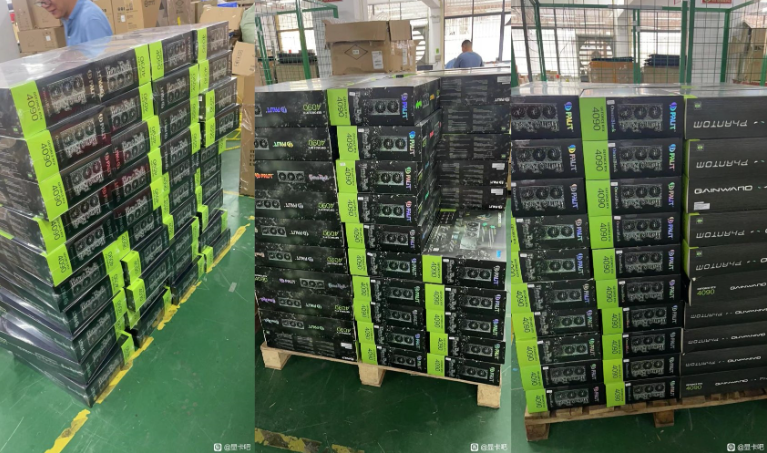
Ever since the US ban that prohibits China from receiving anymore of NVIDIA’s GeForce RTX 4090 GPU, among other things, went into effect earlier this month, many Chinese companies have had no choice but get creative in the way they can sell the card. One such method involves them removing manufacturers’ cooler from the card and slapping on a blower-style cooler on it.

Of course, the dismantling process of these RTX 4090 is obviously a little more complicated than that; these companies are reportedly dismantling the GPU at scale, meaning that they are disassembling the GPU core from the PCB en masse, attaching them to different cards, and then slapped with blower-style coolers. Once completed, the new cards are then labelled as “AI Cards” to suggest that they are designed to be used in AI language model training.


As a quick reminder, the US export bans specifically forbids the distribution and sale of the AD102 GPU, which is part and parcel of the RTX 4090. Prior to the ban, NVIDIA had actually managed to rush a large-scale order of GPUs to its AIB partners in China. In anticipation of the ban, Chinese companies had also made a somewhat smart decision to stockpile as many GPUs as physically possible.

Several of the photographs that were taken in one of this “AI Cards” disassembly lines include RTX 4090s procured from brands such as ASUS, PNY, Colorful, Palit, and Zotac. This is undoubtedly an infuriating scenario for gamers that may have been looking forward to procuring said card in China.


Even after stripping the precious RTX 4090’s AD102 GPU from their original PCBs, these Chinese companies don’t appear to waste anything either. Supposedly, they resell the leftover components and naked PCBs as spare parts, which would be beneficial to individuals looking to just upgrade their coolers. For others, they serve as a morbid reminder of where said components originated from.

The unfortunate reality to this hoarding of the RTX 4090 is that, as it stands right now, what these Chinese companies are doing isn’t “technically” against the law in their own country. Further, it has become evident that virtually none of NVIDIA’s board partners actually put fail safes in place to prevent incidents such as this to take place. Worst, NVIDIA itself has a share of the blame for this, by virtue of the GPU brand having created the environment in which these unscrupulous characters are allowed to exist.

Friday, April 14, 2023

US Government Traces Pentagon Leak To Member Of Air Force National Guard


The US Federal Bureau of Investigation (FBI) has traced the source that leaked highly classified documents from the Pentagon back to an Air National Guardsman. 21-year-old Jack Douglas Teixeira, who is a member of the US Air Force National Guard, was arrested in the state of Massachusetts earlier today.

US Attorney General Merrick Garland confirmed the arrest and said that Teixeira was currently being held “in connection with an investigation into alleged unauthorised removal, retention, and transmission of classified national defense information”. During the investigation, it was surmised by the Washington Post that whoever leaked the documents was, in all possibility, someone of the suspect’s age, an American that grew up with gaming and guns in their life, and most importantly, would be a soldier within a military branch.


The investigation is still ongoing but US officials found that Teixeira also controlled a Discord server, through which he leaked the classified documents, all just so that he could get the one thing a person his age would do: he wanted to impress his friends. His channel wasn’t as big, with only 25 members in total, but the problem was that it included individuals that hailed from Europe, Asia, and South America. Unsurprisingly, once the authenticity of said documents were verified by other sources, they began spreading like wildfire, leading to the current predicament the US government is in right now.

As we reported yesterday, Teixeira’s leaking of US Pentagon documents is also the most potentially devastating, and could even be more impactful than those leaked by Edward Snowden back in 2013. Alleged content from the highly classified documents reportedly included references to Russian and Chinese activities, and about how the current war in Ukraine has drawn the latter country into helping the former. Not only that, but the leaked documents also seemingly point to the US spying on allied countries, including South Korea and Israel. Among other things.


Another matter that the US government will most certainly be asking, in light of Teixeira’s arrest, is how exactly a low-ranking Air Force National Guardsman even managed to get his hands on documents, some likely modified down the line, that was clearly not for his eyes.

Saturday, December 17, 2022

US Court Charges Eight “Influencers” Over 12 Fraud Cases Worth US$114 Million


Eight individuals who portrayed themselves as social media influencers in the US were recently charged with 12 counts of fraud by the US Department of Justice (DOJ) and Securities and Exchange Commission (SEC). The suspects and scammer group are said to have conspired to run a pump-and-dump scheme, where they would target companies and purchase thousands of dollars in stock, and then scam people by selling them as “hot tickets” on their respective social media accounts.

Collectively, the 8-member scammer group had around 1.5 million followers on Twitter, but they also had a server on Discord called “Atlas Trading”. In order to lend credibility to their schemes, the group also claimed to be Wall Street experts on a trading podcast called “Pennies: Going in Raw”, hosted by two of the scammer group’s cohorts, Daniel Knight and Mitchell Hennessey.


It should be noted that the scammer group believed that their conversations on Discord were private, but investigators had reportedly recorded their discussions or retrieved transcripts of them. Naturally, it doesn’t help their case that the documents contain really damning statements, several of which have members of the group outrightly acknowledging that what they’re doing could and will get them into hot water with the law.

One member of the scammer group, Knight, practically admitted that what his group did was akin to robbing folks; during a Discord chat, when the participants were discussing targetting a company called GTT Communications and buying its stocks “in the right way”, Knight simply responded with the followed reply:

“The f**king right way? We’re robbing f**king idiots of their money.”

Both the US DOJ and SEC state that in the two years that the scammer group was in business, it collected more that US$114 million (~RM502 million) in profits, in small increments over the period. As an example of how that works: the group bought over 300000 shares in GTT Communications at US$1.76 (~RM7.76) per share. Following their purchase, it would then dump all the shares at US$1.99 (~RM8.77) after misleading its followers by claiming that they were on the verge of “something big”.

All eight members of the scammer group now stand accused of 11 counts of securities fraud and one count of conspiracy to commit securities fraud by the DOJ. Each count carries a life sentence, which is 25 years in the US. That means if they are found guilty on all counts, they’ll be in jail for nearly 300 years. Mind you, that’s just the criminal indictments; the SEC has its own issues against the group as well, and the government body could strip away the group’s ill-gotten gains, as well as impose additional financial penalties too.

Friday, October 15, 2021

US Senator Wants Biden Administration To Blacklist HONOR

US republican senators led by Marco Rubio have called upon the Biden administration to ban Chinese smartphone maker HONOR, a company that was formerly owned by US-blacklisted Chinese tech giant Huawei. Rubio described the now-independent tech brand as a potential threat to national security.

In a letter dated Thursday, Rubio claims that HONOR is essentially an arm of the Chinese government that has unfettered access to prized US technology currently being denied to Huawei. “Beijing has effectively dodged a critical American export control,” he wrote in the letter.


Huawei was included in the Trump administration’s sanctions in 2019 which prevented US companies from doing business with blacklisted firms, most of which are China-based as the executive order came at a time of high tensions between Washington and Beijing. Amid a global chip shortage, the Biden administration expanded the list and is expected to add even more companies.

The ban resulted in in Huawei not being able to include Android and Google Mobile Services (GMS) in their newer phones moving forward. To prevent the HONOR brand from dying off, Huawei sold its former subsidiary to a Chinese consortium, effectively going around the sanction.


HONOR and the Department of Commerce did not give a response regarding the letter. Meanwhile, Huawei only reminded Reuters of its previous statement that said it would not hold any shares or be involved in managing its former subsidiary company.

On a different note, HONOR is set to launch the HONOR 50 in Malaysia next week, its first smartphone since separating from Huawei that has GMS enabled. The company’s other post-Huawei phones, such as the V40, are expected to eventually have a global release with GMS support.

Thursday, July 22, 2021

US Chipmaker GlobalFoundries To Build New US$4 Billion Factory In Singapore


US chipmaker GlobalFoundries (GF) is constructing a new US$4 billion (~RM16.6 billion) factory in Singapore, an expansion clearly made in view of the ongoing global chip shortage plaguing multiple industries.

The new plant is expected to create about 1,000 jobs – around 95% of which will be high-value positions such as technicians, process technicians, and engineers, The Straits Times reported.

“Our new facility in Singapore will support fast-growing end-markets in the automotive, 5G mobility and secure device segments with long-term customer agreements already in place,” said GF CEO Tom Caulfield.

The company said it plans to add 250,000 square feet of cleanroom space and new administrative offices in Singapore, increasing its manufacturing capacity there for 450,000 additional wafers per year. That will boost the total capacity of GF’s Singapore campus up to approximately 1.5 million (300mm) wafers per year.

Expecting global semiconductor revenue to grow by 2.1 times in the next eight years, the company is expanding capacity at all its manufacturing sites, including those in the US and Germany. It’s no surprise that all the major chipmakers, including TSMC, Samsung, and Intel, are racing to build new factories or upgrade manufacturing capacity at existing ones.

The Straits Times said that the GF factory is expected to begin production in January 2023 and reach full capacity by early 2024.

Wednesday, July 7, 2021

US does not support Taiwan independence


U.S President Joe Biden's point man on Asia is "astonished" by China's determination to play the leading role on the global stage and will "step up" its engagement in Southeast Asia to hold back such a trend. But the administration does not support Taiwan independence and understands the sensitivities involved, Indo-Pacific Coordinator Kurt Campbell said Tuesday.

Campbell's remarks at the Asia Society, are his first public comments since President Xi Jinping's July 1 speech celebrating the 100th anniversary of the founding of the Communist Party, in which the Chinese leader called the reunification of Taiwan "a historic mission and an unshakable commitment" of the party.

"We support a strong unofficial relationship with Taiwan. We do not support Taiwan independence," Campbell said in response to a question from the moderator asking "how much love is too much?" when it comes to stronger relations with the island.

"We fully recognize and understand the sensitivities involved here," he said. "We do believe that Taiwan has a right to live in peace. We want to see its international role, particularly in areas like vaccines and issues associated with the pandemic, they should have a role to play here, they should not be shunned in the international community."

The Biden administration, meanwhile, will "step up our game substantially" with regards to Southeast Asia diplomacy, understanding that engagement with that region is key to successful Indo-Pacific policy, Campbell said.

See also

"We recognize fully that really for an effective Asia strategy, for an effective Indo-Pacific approach, you must do more in Southeast Asia," Campbell said.

The administration's Southeast Asia game plan has been hampered by the cancellation of the Shangri-La Dialogue, which draws top level military officials, diplomats and weapons makers from around the world, and that other regional summits later in the year look to be held virtually, Campbell noted. But, he said that through vaccine gifting and new funding for infrastructure, the U.S. seeks to engage in a sustained way.

"We've taken it on board with our own vaccine programs, but also working with the Quad. We are deeply engaged to ensure that we will provide vaccines in 2022 to Southeast Asia and the Pacific. We think this is the most important contribution that we can make in the next little while," he said.

National Security Council Indo-Pacific Coordinator Kurt Campbell speaks to the Asia Society on July 6.
On infrastructure, Campbell said, "We're looking carefully at how we apply elements of the Build Back Better World set of commitments made in Europe last month," pointing to the infrastructure initiative U.S. President Joe Biden and fellow leaders of the Group of Seven rich nations launched at the Cornwall, U.K., summit.

He said that will include leveraging new finance arrangements for infrastructure at the U.S. International Development Finance Corporation.

"You will see later this year when the president hosts the Quad leaders in Washington, you'll see some commitments that will be, I hope, exciting, I think, decisive with respect to not only continuation of vaccine diplomacy, but infrastructure as well," he said pointing to the Quadrilateral Security Dialogue between the U.S., Japan, India and Australia.

On the threat China poses, Campbell said, "Coming back in, I was astonished by some of the things I read, saw and experienced and have had diplomatic engagements about. And one of them is just undeniable: A very assertive determined China that wants to play the leading role on the global stage, and has really quite unsentimental views of United States and really wants to reshape the operating system of Asia."

To counter this challenge, the Biden administration has made Asia the center of its regional focus, Campbell said. "You'll see this movement from the Middle East, and it will be painful, in all likelihood. We'll see some real challenges in places like Afghanistan, but a much greater focus on the Indo-Pacific."

Campbell said the challenge for the U.S. would be to come up with a strategy that presents China with opportunities, but also a response if it takes steps "antithetical to the maintenance of peace and stability."

Asked when he expected a first meeting between Biden and Chinese leader Xi Jinping and whether this could come at the G-20 summit in October, Campbell replied: "My expectation will be that we'll have some sort of engagement before too long."

Campbell's statement on Taiwan independence is in line with what he has said in past speeches and does not indicate a change of policy. But they will be interpreted in Beijing as a commitment to the status quo, coming after Xi's July 1 speech.

Under the "One China" policy, which the U.S. has maintained since 1979, Washington "acknowledges the Chinese position" that there is but one China and that Taiwan is part of China. The U.S. recognizes the government of the People's Republic of China as the "sole legal government of China" but does not explicitly recognize Chinese sovereignty over Taiwan.

This is distinct from Beijing's "One China" principle, which considers Taiwan a Chinese province and part of its sovereign claim.
 

Sunday, July 4, 2021

Trump Calls Bitcoin A Scam, Claims It Competes With The US Dollar


Former US President Donald Trump has described bitcoin as a “scam” and claimed that the cryptocurrency competes with the US dollar. Unsurprisingly, he said he wanted the dollar to be “the currency of the world”.

“Bitcoin, it just seems like a scam,” Trump said on Fox Business, according to the BBC. “I don’t like it because it’s another currency competing against the dollar.”

This isn’t the first time that the controversial “America First” politician has spoken against cryptocurrency. In 2019, back when he was US president, he slammed cryptocurrencies, including Facebook’s proposed digital coin Libra.

According to Reuters, he wrote on Twitter, “I am not a fan of Bitcoin and other Cryptocurrencies, which are not money, and whose value is highly volatile and based on thin air.” Trump, of course, is now banned from the social media platform due to his public support for insurrectionists who attacked the US Capitol on 6 January.


While his claim that bitcoin competes with the US dollar will certainly be disputed by experts, he’s not alone in carrying a dim view of cryptocurrencies. Bank of England Governor Andrew Bailey said cryptocurrencies “have no intrinsic value” and pointedly told potential investors to “buy them only if you’re prepared to lose all your money.”

Ironically, Trump’s archnemesis, China, has embarked on a massive clampdown on cryptocurrency even though the country is a major global hub for bitcoin mining. Furthermore, crypto-enthusiast Elon Musk’s Tesla pulled an awkward 180 on its decision to accept bitcoin as payment for its cars.

Thursday, June 10, 2021

US Looking To Open Up To 10 New Chip Factories


If a proposed US congressional bill is passed, the country could see the opening of up to 10 new chip-making plants, US Commerce Secretary Gina Raimondo said.

According to Reuters, Raimondo said the US$52 billion (~RM215 billion) bill, which currently seems to have bipartisan support, would generate “US$150 billion-plus” in investment in chip production and research.

“We just need the federal money … to unlock private capital,” Raimondo said. “It could be seven, could be eight, could be nine, could be 10 new factories in America by the time we’re done.”


As reported before, the US is keen to ramp up its domestic chip production capacity in the face of a global chip shortage and an escalating rivalry with China. The shortage has caused production issues for US companies from Ford to Apple, highlighting a critical vulnerability in the nation’s supply chain.

US President Joe Biden has been seeking funding for chip production in the country. Accordingly, Senate Majority Leader Chuck Schumer last week unveiled a bill that would pour US$52 billion into domestic chip production and research over five years.

Industry groups, which have loudly pleaded for more chip investment, often highlight the fact that the US share of global chip-making capacity fell from 37% in 1990 to just 12% today.

Wednesday, May 12, 2021

Xiaomi Gets Out Of US Blacklist Following Lawsuit


Earlier in the year, Chinese tech giant Xiaomi sued the US government, asking to be taken of the blacklist by the previous administration. It looks like that has finally happened, as an agreement has been reached between the two.

Bloomberg reports that while the main point of contention has been addressed, no details like conditions for removal were disclosed by the filing. Both parties will file a separate joint proposal by 20 May after negotiating specific terms.

Being on the blacklist meant that US investors were banned from investing in the company. Beyond that, investors will also have to divest all their holdings. Xiaomi was first put there due to suspicions of it having links to the Chinese military.


This marks one of the few times a Chinese company escapes the Trump administration’s crosshairs relatively unscathed. Video platform TikTok got out back in September, but at the cost of owner ByteDance having decreasing control over it.

Huawei, the first and hardest hit, has been slapped with another set of restrictions in March. And it’s worth noting that the new restrictions are being put in place by the new Biden administration. So it looks like Xiaomi is not exactly a barometer for relations between the US and Chinese companies.

Wednesday, March 31, 2021

Facebook, Google To Build New Undersea Cables That Link Singapore, Indonesia, And US


Facebook announced that it plans to build two new undersea cables connecting Singapore, Indonesia, and North America. The social media company will work with Google and regional telcos on the project, which is set to dramatically increase internet connection capacity between these regions.

One of them is called Echo which is slated to complete by 2023. According to the report from Reuters, Kevin Salvadori, Facebook’s Vice President of Network Investments stated that Echo would be built in partnership with Google and Indonesian telco XL Axiata who is a subsidiary of Malaysia’s Axiata Group that also owns and operates Celcom.


This is not the first time that Facebook and Google have collaborated together to build an undersea cable system. Before this, they have worked on the Pacific Light Cable Network since 2016 that supposedly links the Philippines, Taiwan, Hong Kong, and the U.S but have decided to drop the Hong Kong portion from the original plan after it was opposed by the U.S government due to security concerns.

Tuesday, March 30, 2021

Twitter CEO Called Out For Tweeting During US Congressional Hearing


US Congressional hearings are far from being the most exciting thing a tech giant looks forward to, nor do they enjoy the questions that are asked in-session. For Jack Dorsey, CEO of Twitter, the man may have indirectly compounded those uneasy feelings when he sent out a tweet, while still in the middle of his own hearing.

Dorsey’s tweet was picked up by the Democratic New York Representative, Kathleen Rice, who was sitting in on Dorsey’s Congressional hearing on disinformation and extremism. Where a panel of lawmakers dealt hard-hitting questions towards Dorsey – along with the CEOs of Facebook and Alphabet – over whether their social media platforms held any responsibility during the 6 January insurrection that led to deadly riots and storming of the US Capitol.

Dorsey’s tweet was a poll with the subject simply being a “?”, with the choices being Yes or No. While the message itself is cryptic, it’s likely Dorsey venting his frustration with regards to the format of the hearing; US lawmakers typically present either a loaded or unnecessarily complicated question to the subject, but demand that the latter reply with a simple “Yes” or “No” answer.

As you can imagine, Representative Rice was less than amused with Dorsey’s tweet and even brought it up during the five-hour session, asking the CEO which poll answer was leading. Dorsey’s answer was a monotonous “Yes”. At the time of writing, Yes currently leads at 65.4%, while No is at 34.6%. 

Thursday, March 18, 2021

US Court Throws Out Cryptomining Lawsuit Against NVIDIA


Back in 2018, NVIDIA was hit by a class-action lawsuit. It alleged that the GPU maker made false and misleading statements about the state of the cryptocurrency market at the time, to its shareholders. Earlier this month, a US court ruled in favour of NVIDIA on the case.

The lawsuit was dismissed by a US District Court Judge based in the Northern District of California at the behest of NVIDIA, on the grounds that it was lacking evidence to prove the plaintiff’s claim. Specifically, the lawsuit accuses NVIDIA of under-reporting its revenue generated from the cryptocurrency surge of 2018 by around US$1.13 billion (~RM4.65 billion). Not only that, the lawsuit also says that the company hid those profits by claiming that approximately 70% of its GPU sales were “gaming revenue”. When it was actually gained from GPU mining.


The 2018 cryptocurrency surge eventually dwindled, but not before Bitcoin peaking at RM82000. Fast forward to today, and digital coin now has an average worth of RM230000 and in response to the new surge, NVIDIA announced that it was launching its Cryptocurrency Mining Processor (CMP), a GPU lineup dedicated entirely to mining not Bitcoin, but the second most lucrative cryptocurrency on the market, Ethereum.

Monday, March 15, 2021

US District Judge Grants Preliminary Injunction To Xiaomi


The Trump administration, during its last days of the former US president’s term in January, had placed Xiaomi in the US Department of Defense’s (DoD) ban list, accusing the Chinese tech company of being a “Communist Chinese Military Company” or CCMC. Originally slated to be imposed with trade restrictions by the DoD, the move against Xiaomi was blocked by US District Judge Rudolph Contreras last Friday, who issued the company a preliminary injunction.

A preliminary injunction is a temporary order made by a court at the request of one party that prevents the other from pursuing a particular course of conduct until the conclusion of a trial on the merits. In Xiaomi’s case, is the US Department of Defense’s now-barred restrictions which were supposed to be placed in effect next week. Contreras said that such actions will likely bring “irreparable harm” to the company.

The judge expressed doubts that Chinese civilian companies such as Xiaomi are in any way affiliated with China’s military, and commented there is no evidence indicating that company is sharing information with the Chinese government. He also added that Xiaomi’s CCMC designation by the DoD was “likely made in violation of the APA (Administrative Procedure Act)  in that it was arbitrary and capricious”.

Via a press statement issued not long after Contreras’ ruling, Xiaomi expressed relief upon receiving the injunction which now exempts it from any potential restrictions by the US government – for the time being, at least. The company also revealed that it will continue to appeal to the US District Court for the permanent removal of the “Communist Chinese Military Company” designation by the US Department of Defense.

Wednesday, February 17, 2021

US University Lecturer To Use Red Dead Redemption Series To Teach American History


There are plenty of benefits to video games that a lot of people do not accept. Among the people who are usually resistant to the fact are those in the education line. And so it is really nice to see a university lecturer breaking the mould, and using video games in teaching. More specifically, he will be using the Red Dead Redemption series to teach American History.

Tore Olsson, a history lecturer at the University of Tennessee, announced on Twitter a new course using the games as material. It will be called Red Dead America, and will explore the history behind the Red Dead Redemption series, and the events that happen in the games. These range from the women’s suffrage to the privatisation of law enforcement.

Olsson explains that games like these are often not exactly historically accurate. That being said, they still do touch on the important issues of their era. Which validates the research that went through the process of making the game, minus the creative liberties to accommodate an interesting story. A similar argument can easily be made for the Assassin’s Creed series, especially where historical architecture is concerned.

Overall, it’s nice to see that video games are getting more and more recognition as beneficial elements in people’s lives. That being said, you’ll still have to choose wisely if you’re looking for a video game to teach you things. For example, you shouldn’t rely too much on Ghost of Tsushima for historical accuracy regarding the Mongol invasion of Japan.

Monday, January 25, 2021

Biden pushes ‘Made in America’ approach by Trump


President Joe Biden will sign an executive order Monday giving priority to US companies and products in contracts with the federal government, pushing a “Made in America” approach favoured by predecessor Donald Trump.

The order, senior White House officials said, aims to boost national production and save industrial jobs by increasing investments in manufacturing industries and workers in order to “build back better”.

Less than a week after his inauguration, Biden is pushing his priorities through with executive orders, even though his cabinet is not fully in place, with the roles such as secretary of state still to be approved.


The new executive order should reduce the possibility of skirting rules requiring federal authorities to prioritise buying US-made products.

Biden wants to limit the way federal agencies stamp the products they buy as “Made in America” in order to eliminate legal loopholes used by companies that often manufacture in the US only a small portion of the products offered to the government.

Avoiding a trade war

Biden’s decision echoes those of his predecessors, particularly Trump.


Trump had issued an executive order urging the federal government to purchase more US-made products and turning tariffs into a weapon against imports – with mixed results.

But instead of a trade war, Biden favours tightening the “Buy American” rules and wants to utilise the federal government’s buying power.

“The dollars the federal government spends … are a powerful tool to support American workers and manufacturers. Contracting alone accounts for nearly US$600 billion in federal spending,” an administration official said.

The Buy American Act of 1933, still in force, requires federal agencies to prioritize buying goods produced on US soil, but “these preferences have not always been implemented consistently or effectively”, according to the Biden administration.

Biden’s approach seeks to change the structure of the process by changing the definition of what is considered a US-made product and reducing the possibilities for exemptions.

The administration also wants new companies, including small ones, to have access to tenders.

Strengthening the supply chain

During his presidential campaign, Biden promised to strengthen the “Buy American” process with a US$400 billion plan for projects using US-made products – including steel, or protective equipment for healthcare workers battling Covid-19.

After his electoral victory, Biden said the federal government would buy American cars and inventory.

However, companies have already warned that overly restrictive rules could cause costs to soar, making it harder to buy parts made outside the US.

The executive order should also be seen as part of “the President’s commitment to invest in American manufacturing, including clean energy and critical supply chains”, an official said.

Washington said the pandemic has highlighted the shortages and weaknesses of the system, and said that it wanted to avoid being put in a position of depending on countries that do not share the US’ interests in delivering essential materials.

Biden “remains committed to working with partners and allies to modernise international trade rules … to make sure all countries can use their taxpayer dollars to spur investment in their own countries”, an official said.

Saturday, January 16, 2021

From Japan to The US, Young People Give Up On Finding Jobs


TOKYO - Millions of unemployed workers have given up on finding jobs amid an unrelenting pandemic.

Nikkei analyzed labor statistics from 10 countries, including Japan, the U.S. and U.K., and found that the total number of people in the combined workforce shrank by 6.6 million from July through September compared with the same quarter in 2019.

Young people and former part-timers account for most of the labor market exiles. Worse, the young people among this group might also miss out on opportunities to gain the kind of work skills and experiences that further careers.

During the first wave of infections, the pandemic led to an increase in unemployment. The U.S. unemployment rate, which was around 3% before the pandemic, spiked to 14.8% in April 2020. The number of unemployed also increased in Japan.

The pandemic especially hit the vulnerable in the job market. In the U.S. for the April-September period, there were 9.9% fewer people employed than a year earlier. But the figure for those under 24 years old was 19.1%. For people with no more than a high school diploma, the decrease was 16.8%. For those working only short hours, the drop-off was 15.2%.

The decline was the steepest since January 2014, when comparable statistics began being kept. In the July 2020 quarter, another 6.6 million people had left the labor market compared to a year earlier.

As the coronavirus began to rage during the October-December quarter, some countries went into lockdown, making it impossible in many cases to find jobs.

Due to the way labor statistics are collected, people who do not search for jobs are invisible. Only those who both want to work and are searching for employment are counted as jobless. Thus, retirees are not considered to be jobless.

In the U.S., when these people who gave up searching for jobs are counted as unemployed, the de facto unemployment rate in December becomes 9.8% -- 3.1 percentage points higher than the official number.

In Japan, the number of people who have given up looking for a job is also on the rise. The Japan Research Institute estimates that in 2018-2019, the number of people who lost their jobs and did not look for employment the next month was roughly 1.1% of the workforce. This figure increased to 1.3% in the latter half of 2020.

Currently, a third wave of infections is sweeping the globe. Japan on Thursday declared a state of emergency in Tokyo and its surrounding prefectures. As a V-shaped jobs recovery looks unlikely, demand for government support to alter the dynamic is likely to increase.

Xiaomi Shows Off Physical Concept Of Vision Gran Turismo

At the very tail end of last month, Xiaomi unveiled the Vision Gran Turismo. The car was revealed as a digital hypercar, and one that’s made...