Showing posts with label Generation. Show all posts

Thursday, December 15, 2022

Intel 13th Gen Non-K CPUs Supposedly Up To 64 Percent Faster Than Previous Generation

Intel’s 13th Gen Raptor Lake CPUs and their performance shows how the chipmaker was able to retake the lead from AMD’s current Ryzen 7000 Series, in just one generation. Recently, a new leak seems to suggest that the brand’s non-K desktop CPU lineup is prepared to do the same, only this time, it’s against its predecessor.

The leak in question comes from a Twitter user who goes by the handle chi11eddog (@g01d3nm4ng0), and technically contains the performance metrics of the non-K 13th Gen CPUs. Specifically, they are graphs from Cinebench R23’s single-core and multi-core tests and more to the point, the tests were conducted on a total of five CPUs.


The non-K 13th Gen CPUs on the list are the 13900, 13700, 13600, 13500, and the 13400, which are essentially every CPU under the Core i9, i7, and i5 SKUs. On the multi-core test, the 13th Gen processors clearly have an edge over their 12th Gen Alder predecessors. The 13500, specifically, shows a performance improvement of up to 64% on the test, with the 2nd highest-performing CPU being the 13600.

On the single-core test, the 13th Gen’s 13900 was very clearly the CPU that has the most gains, with a 10% increase in performance over the last generation’s 12th Gen 12900. Overall, the worst-performing CPU on this list is the 12500, but that being said, it is still relatively decent. However, the 13900 of Intel’s 13th Gen Raptor Lake is expected to run 500MHz faster than the 12900 and also has eight more E-Cores than its predecessors. So, it really doesn’t come as a surprise that it would perform significantly better on the multi-core tests too.

As for when we can expect to see all five of these CPUs, Intel is expected to the launch its non-K 13th Gen Raptor Lake CPUs on 3 January, which is also when CES 2023 kicks off in Las Vegas. What makes them all that more appealing is that, while not overclockable, they all have a default TDP of 65W, nearly half of what their K-powered counterparts draw. At the same time, the chipmaker is also expected to announced its new B760 motherboard series.

Tuesday, September 14, 2021

Alleged 12th Generation Intel Core i7, Core i5 CPU Details Appear Online

By now, there’s been a fair bit of news about Intel’s 12th generation Alder Lake-S desktop CPU lineup and more recently, alleged details about the Core i9-12900K and its performance. Now it appears Intel’s pipes has sprung more leaks and this time, the details seemingly belong to two other Alder Lake-S CPUs: a Core i7-12700K and Core i5-12600K.

Like the 12900K, both the 12700K and 12600K share an uneven number of cores and threads, brought about by the odd-coupling of Golden Cove and Gracemont cores. With the 12700K, the CPU will seemingly have a 12-cores, 20-thread layout, with a boost clock of 4.7GHz, while Turbo Boost will bring that number up to 5GHz. Moreover, it will also have a 20MB L3 Cache and a TDP of 125W.

As for the 12600K, the Alder Lake-S Core i5 is expected to sport a 10-core, 16-thread design, comprising 12 Golden Cove cores and four Gracemont cores. In terms of speed, it should come with a boost clock of 4.5GHz and a Turbo boost clock of 4.9GHz. By contrast, we’re looking at performance similar to the Intel’s current mid-range Rocket Lake-S CPU, the Core i5-11600K.


Sadly, that’s all the alleged information there is about the Core i7-12700K and Core i5-12600K. Once again, these details are merely rumours and hearsay at this stage, so as always, we do advise you to take it with a grain of salt. That said, what is confirmed is that, as part of the Alder Lake-S lineup, these CPUs will most certainly benefit from its upcoming support for DDR5 and PCIe 5.0.

Tuesday, August 10, 2021

Intel 12th Generation Alder Lake CPU Samples Allegedly Being Sold Early In China

It seems that the wait for Intel’s 12th generation Alder Lake-S desktop CPUs may not be as long as we initially expected. According to prominent hardware blogger and leakster, YuuKi_AnS, early samples of the unreleased CPU lineup are currently being sold in China.

According to their sources, samples of the top-of-the-line Core i9-12900K were being sold between 6900 Yuan (~RM4516) and 7500 Yuan (~RM4909). Bear in mind, these prices are not reflective of the product’s final SRP, which we’re certain will be different once the lineup officially launches.

That said, the early sales of qualification samples also point towards Intel’s progression with the chips; if samples are already out this early on the market, it’s clear that the chipmaker’s development of its 12th generation desktop CPUs is ahead of schedule.


As pointed out by PCGamer, one of the more interesting aspect of Alder Lake-S is its unique and uneven core-to-thread ratio, brought about through the “big.LITTLE” combination of Golden Cove and Gracemont cores. For example, the Core i9-12900K is expected to feature 16-cores, 24-threads, while the Core i7-12700K will reportedly have a 12-cores, 20-threads layout.

It’s also been somewhat confirmed the upcoming 12th generation CPU lineup will support next-generation features, such as PCIe 5.0 and DDR5 memory, all through a new 600 series chipset that, surprisingly, will also be backwards compatible with the following 13th generation Raptor Lake-S CPU lineup.

Thursday, July 22, 2021

Intel To Discontinue Production of 10th Generation Ice Lake Laptop CPUs


Intel has announced that it is discontinuing the production of its 10th generation Ice Lake-U series CPU lineup. The news is a little surprising, especially given the fact that some of the CPUs have only been around for a little more than two years.

To be precise, the discontinuation of its 10th generation CPUs isn’t just limited to its Core series lineup, but also its Lakefield, Pentium, and Celeron lineup. The list of the affected CPUs is as below:

  • Intel Core i3-10110U
  • Intel Core i3-10210U
  • Intel Core i5-10210U
  • Intel Core i5-10310U
  • Intel Core i7-10510U
  • Intel Core i7-10610U
  • Intel Core i7-10710U
  • Intel Core i7-10810U
  • Intel Core i3-1005G1
  • Intel Core i5-1035G1
  • Intel Core i5-1035G4
  • Intel Core i5-1035G7
  • Intel Core i7-1065G7
  • Intel Core i3-L13G4
  • Intel Core i5-L16G7
  • Intel Celeron 5205U
  • Intel Celeron 5805
  • Intel Celeron 6805

As to why Intel is discontinuing its Ice Lake-U series, it is probably due to the fact that its current 11th generation Tiger Lake-U CPU series is obviously faster and more powerful. Due to their generally higher base and boost clocks.


On that note, manufacturers will still continue to accept orders for the listed CPUs until 22 October. After that, the last batch of these processors will then be sent off by 29 April 2022. Exceptions to the rule are the Core i7-10810U, Core i7-10610U, Core i5-10310U, and Celeron 5205U. Orders for these CPUs will still be fulfilled until 28 January 2022, and the final batch to be shipped out by 29 July the same year.

Saturday, May 15, 2021

Intel 11th Generation Tiger Lake H-Series Now Official


Intel’s 11th generation mobile CPUs are officially here. As previously reported, the chipmaker’s new processors, also known as Tiger Lake-H, are the chipmaker’s latest laptop CPU that is also based on a brand new architecture.

As a quick primer, the new CPUs are based on Intel’s new 10nm Willow Cove SuperFIN die lithography, which the company describes as being leaps and bounds ahead of its already old 14nm process node. As usual, the new lineup features improved single-threaded performance and is made to help laptop brands to balance both gaming and productivity with mobility.

Moving, the new 11th generation CPUs also bring about long-awaited support for other features, including PCIe 4.0, Thunderbolt 4, and Intel’s Killer AX1675 Wi-Fi 6E modem,. Further, the new lineup also supports Intel’s new Turbo Boost Max Technology 3.0 that, among other features, helps the lineup achieve up to 19% gen-on-gen multi-threaded performance.

Breaking down the specifications further, Intel says the new architecture allows the lineup to achieve up to 5GHz on two cores and up to 4.5 on all eight cores. At least, for its top-of-the-line Core i9-11980HK mobile CPU. Moving on, the lineup also supports up to 44 platform PCIe lanes, as well as up to 20 PCIe Gen 4 lanes that can also be combined with Intel’s Rapid Storage Technology’s (RST) RAID 0 feature.


Intel’s 11th generation laptop CPUs will be hitting the markets today, with their availability for laptops left to the discretion of the brand’s AiB partners. The list includes brands such as ASUS, MSI, and Lenovo, to name a few.

Thursday, March 18, 2021

Intel 11th Generation Rocket Lake-S Desktops CPUs Are Finally Here


Intel has lifted the veil from its 11th generation Rocket Lake-S desktop CPU series, thus finally making the lineup official. As we have come to expect of such a launch, the chipmaker’s new processor range is abundant with features, both new and long-awaited.

As per initial reports, Intel’s 11th generation Core S series CPUs not only come with per-core IPC improvements but the entire lineup finally supports the latest PCIe 4.0 interface. On top of that, it’s top-of-the-line CPU will support up to 20 PCIe 4.0 lanes. And before you ask: yes, the new CPUs will be the last of Intel 14nm process node, but as we’ve mentioned many times before, the architecture has been backported from Intel’s 10nm process node.


Also, as promised, the new CPU lineup also supports resizable BAR, meaning that these processors will be able to draw upon a GPU’s entire memory capacity, in order to squeeze out a little more performance from the system, be it for gaming or slightly more professional workloads. Other features include support for DDR4-3200 RAM support, Intel Deep Learning Boost and VNNI Support, plus new integrated graphics based on the brand’s new Xe graphics architecture.

Of course, no CPU is complete with a motherboard and as with all new CPU lineup, the new 11th generation lineup is also accompanied by a new 500 series chipset that also comes with new and improved features on the platform. Off the bat, new 500 series motherboards – the high-end models especially – will support USB 3.2 Gen2x2 for transfer speeds of up to 20Gbps, support for up to 20 PCIe 4.0 lanes with all Rocket Lake-S CPUs, Discrete Wi-Fi 6e and support for Intel Thunderbolt 4.

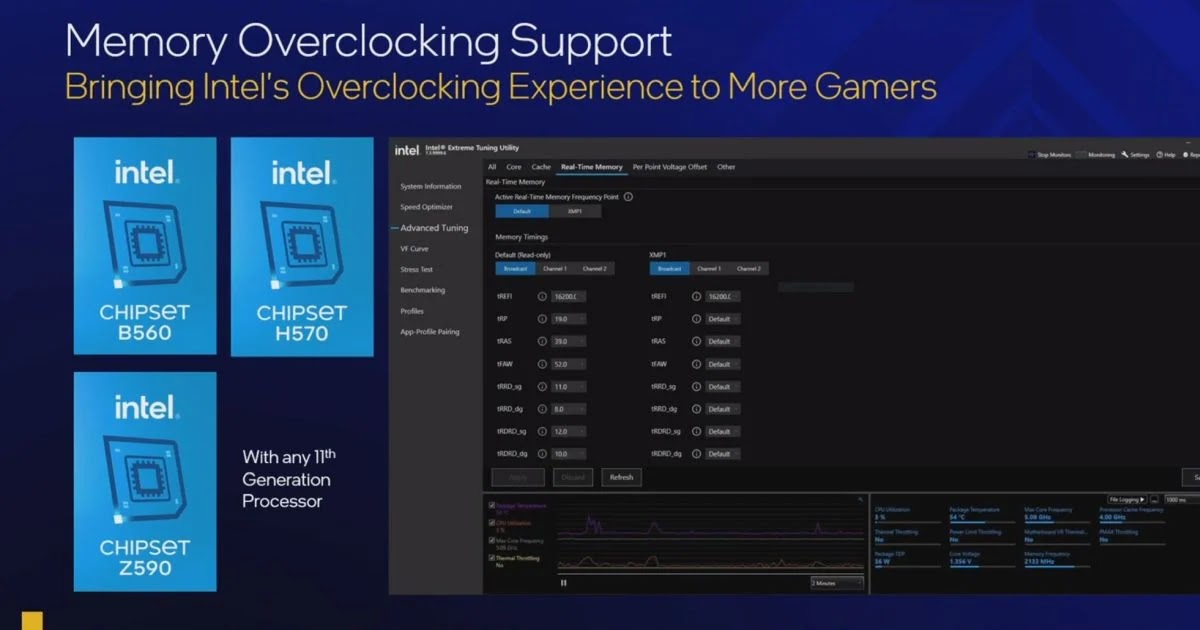
Perhaps the most important feature to be added by Intel to the 500 series chipset, however, is the ability to overclock memory on both the mid-range H570 and entry-level B560 chipsets. Speaking of overclocking, Intel says that it is also bringing new overclocking improvements to 11th gen.


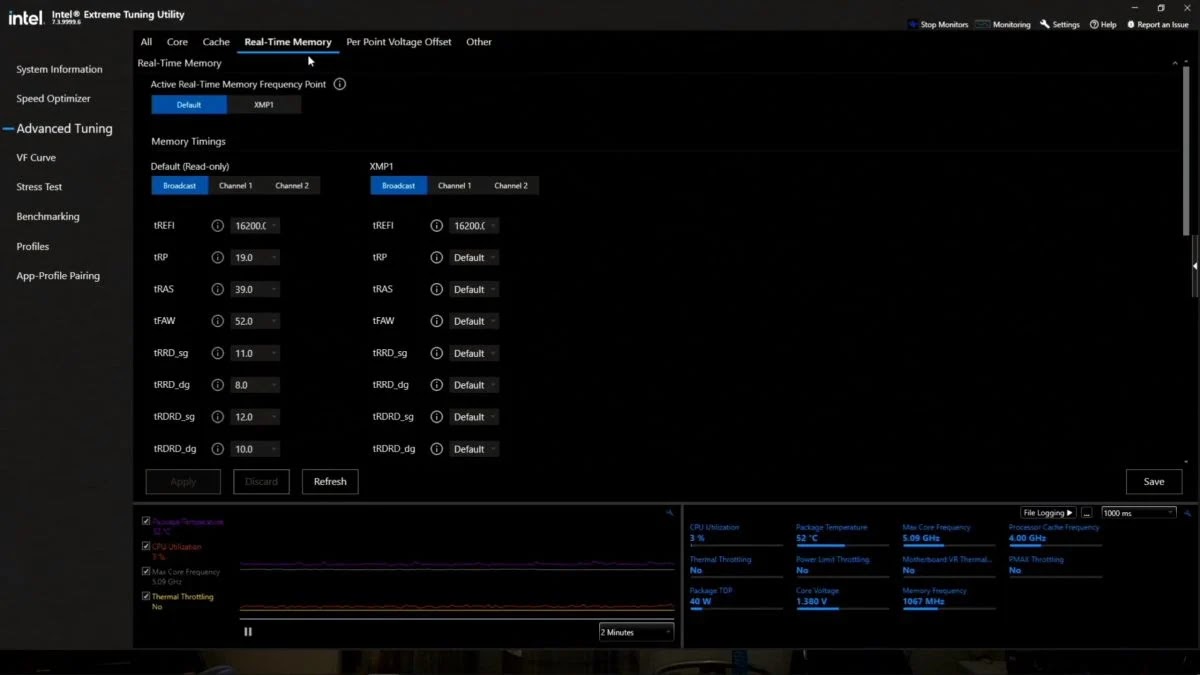
Besides memory overclocking on non-Z500 series motherboards, the chipmaker is also introducing real-time memory overclocking, as well as AVX2 and AVX-512 Offset and Voltage Guard-Band Override. The last one being of increased interest as the feature would undoubtedly increase the overall performance of a system built around the new 11th generation CPU and 500 series chipset.


As for CPU models, the new 11th generation Core series follows the same Intel hierarchy and nomenclature. To name a few and sitting on the pedestal is the Core i9-11900K, Intel’s high-performing 8-cores, 16-threads processor, with a base clock of 3.5GHz and an all-core boost clock of 5.3GHz.

Thanks to Intel’s Thermal Velocity Boost (TVB) technology. Moving down a notch is the Core i7-11700K, which has the same number of cores as the 11900K, and a base clock of 3.6GHz. Unfortunately and as you can see from the SKU list, Intel is being coy about the 11700K’s boost clock with TVB enabled.


On a related note, Intel announced a list of refreshed 10th generation Intel Core series CPUs that will work with its 500 series chipset, although we should point out that this is only applicable to the lower-tier Core i3 CPUs and Pentium Gold G Series CPUs. It’s a bit of an odd decision and frankly, we’ve been wondering why Intel didn’t just refresh some of its beefier 10th generation Core i5 and Core i7 processors while they were at it.

The only thing missing from Intel’s announcement, though, is availability. At the time of writing, the chipmaker didn’t say when its new processors and 500 series motherboards will be hitting the store shelves of PC stores, but at this stage, it’s very likely to be sooner than later. That is, assuming Intel itself hasn’t found itself a victim of the ongoing chip shortage too.

Xiaomi Shows Off Physical Concept Of Vision Gran Turismo

At the very tail end of last month, Xiaomi unveiled the Vision Gran Turismo. The car was revealed as a digital hypercar, and one that’s made...