Showing posts with label Lake-S. Show all posts

Monday, July 19, 2021

Intel Confirms 600 Series Chipset Support For Alder Lake-S, Raptor Lake-S CPUs

Intel appears to have provided confirmation that its upcoming 600 series motherboards will support both 12th generation Alder Lake-S and 13th generation Raptor Lake-S CPUs, when all three products launch in the future. The chipset board’s compatibility was discovered within documentation submitted to the SATA-IO, the body responsible for getting hardware vendors to adhere to SATA specifications and other accessories.

Breaking down the document further, it lists the model number and name of the product, Alder-Raptor Lake, along with four device IDs, 7AB0, 7ACB, 7A30, and 7A4B. Beyond that, however, there is no further information about the chipset board.

That said, the discovery does provide a bit of good news for the future; rather than create another motherboard chipset for each consecutive CPU generation, Intel has once again chosen to enable backwards compatibility between its 12th and 13th generation Core series lineup. Much like the Z270 chipset that supports both its 6th generation Skylake and 7th generation Kaby Lake processors, albeit with less features available for the former.


As for the CPU lineups themselves, we at least know that Alder Lake-S is set to be the second lineup to use a hybrid processor architecture, the first having been its 10th generation Lakefield CPUs that were recently discontinued, at least for its laptop segment anyway.

We also know that the Alder Lake-S will be the first CPU lineup to move away from the already archaic 14nm die lithography and into 10nm. Further, the new CPU series is expected to support the new DDR5 memory standard, as well as PCIe 5.0 and the possibility of a 14-core CPU as one of its offerings.

Thursday, June 10, 2021

Intel Alder Lake-S “Socket V” Chipset To Feature Lower Z-Stack, Rectangular Design


Intel’s 12th generation Alder Lake-S desktop CPUs are expected to make their debut sometime before the end of the year and while rumours may suggest that the top-of-the-line model will support as many cores as AMD’s current flagship Ryzen 9 5950X, little else is known about the lineup. That is, up until now.

According to a report by the German tech site, Igor’s Lab, Alder Lake-S’ chipset isn’t just shipping out with a larger LGA1700 chipset – codenamed Socket V – but it will also be the first socket to house a completely new processor design in a long time. Specifically, blueprints obtained by the German publication point at Socket V supporting a processor with a rectangular design. Further, the Z-Stack, which is the total height of the CPU package, will be lower by approximately 1mm.


Not only that, but Igor also seems to have stumbled upon a set of blueprints that point to a new cooler that seemingly makes use of the high-performance thermoelectric cooling technology. This isn’t the first time such a cooler has made headlines; with its LGA1200 chipset, Intel partnered up with Cooler Master to create and launch the MasterLiquid ML360 Sub-Zero cooler.


Igor also managed to get his hands on schematics that seem to detail a low-profile reference cooler that look like they could be bundled with the lineup’s mid-range and entry-level processors at launch. Naturally, given the increased die size and pin density, it is very unlikely that this cooler will be backwards compatible with LGA1200 chipsets.

Thursday, March 18, 2021

Intel 11th Generation Rocket Lake-S Desktops CPUs Are Finally Here


Intel has lifted the veil from its 11th generation Rocket Lake-S desktop CPU series, thus finally making the lineup official. As we have come to expect of such a launch, the chipmaker’s new processor range is abundant with features, both new and long-awaited.

As per initial reports, Intel’s 11th generation Core S series CPUs not only come with per-core IPC improvements but the entire lineup finally supports the latest PCIe 4.0 interface. On top of that, it’s top-of-the-line CPU will support up to 20 PCIe 4.0 lanes. And before you ask: yes, the new CPUs will be the last of Intel 14nm process node, but as we’ve mentioned many times before, the architecture has been backported from Intel’s 10nm process node.


Also, as promised, the new CPU lineup also supports resizable BAR, meaning that these processors will be able to draw upon a GPU’s entire memory capacity, in order to squeeze out a little more performance from the system, be it for gaming or slightly more professional workloads. Other features include support for DDR4-3200 RAM support, Intel Deep Learning Boost and VNNI Support, plus new integrated graphics based on the brand’s new Xe graphics architecture.

Of course, no CPU is complete with a motherboard and as with all new CPU lineup, the new 11th generation lineup is also accompanied by a new 500 series chipset that also comes with new and improved features on the platform. Off the bat, new 500 series motherboards – the high-end models especially – will support USB 3.2 Gen2x2 for transfer speeds of up to 20Gbps, support for up to 20 PCIe 4.0 lanes with all Rocket Lake-S CPUs, Discrete Wi-Fi 6e and support for Intel Thunderbolt 4.

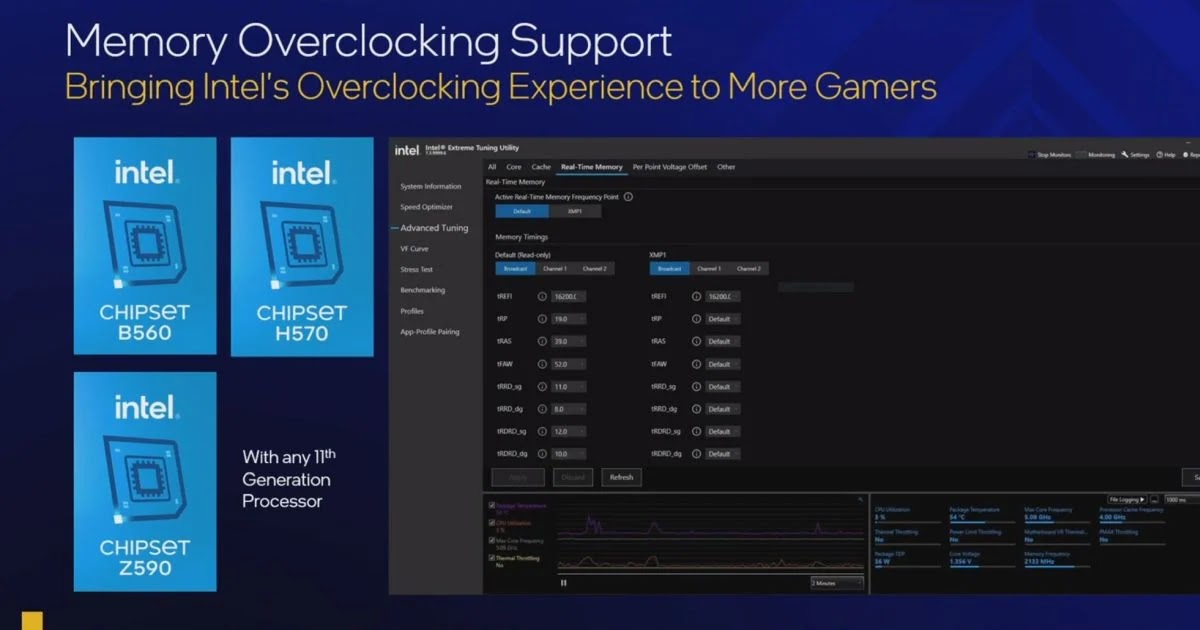
Perhaps the most important feature to be added by Intel to the 500 series chipset, however, is the ability to overclock memory on both the mid-range H570 and entry-level B560 chipsets. Speaking of overclocking, Intel says that it is also bringing new overclocking improvements to 11th gen.


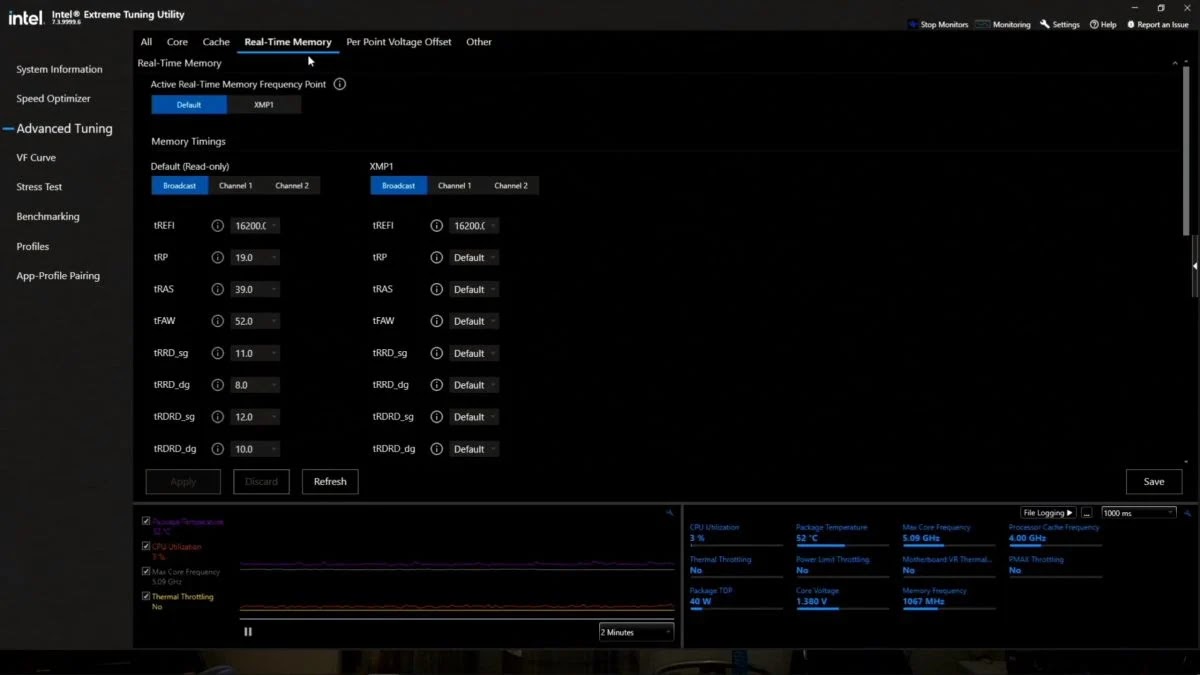
Besides memory overclocking on non-Z500 series motherboards, the chipmaker is also introducing real-time memory overclocking, as well as AVX2 and AVX-512 Offset and Voltage Guard-Band Override. The last one being of increased interest as the feature would undoubtedly increase the overall performance of a system built around the new 11th generation CPU and 500 series chipset.


As for CPU models, the new 11th generation Core series follows the same Intel hierarchy and nomenclature. To name a few and sitting on the pedestal is the Core i9-11900K, Intel’s high-performing 8-cores, 16-threads processor, with a base clock of 3.5GHz and an all-core boost clock of 5.3GHz.

Thanks to Intel’s Thermal Velocity Boost (TVB) technology. Moving down a notch is the Core i7-11700K, which has the same number of cores as the 11900K, and a base clock of 3.6GHz. Unfortunately and as you can see from the SKU list, Intel is being coy about the 11700K’s boost clock with TVB enabled.


On a related note, Intel announced a list of refreshed 10th generation Intel Core series CPUs that will work with its 500 series chipset, although we should point out that this is only applicable to the lower-tier Core i3 CPUs and Pentium Gold G Series CPUs. It’s a bit of an odd decision and frankly, we’ve been wondering why Intel didn’t just refresh some of its beefier 10th generation Core i5 and Core i7 processors while they were at it.

The only thing missing from Intel’s announcement, though, is availability. At the time of writing, the chipmaker didn’t say when its new processors and 500 series motherboards will be hitting the store shelves of PC stores, but at this stage, it’s very likely to be sooner than later. That is, assuming Intel itself hasn’t found itself a victim of the ongoing chip shortage too.

Xiaomi Shows Off Physical Concept Of Vision Gran Turismo

At the very tail end of last month, Xiaomi unveiled the Vision Gran Turismo. The car was revealed as a digital hypercar, and one that’s made...