Showing posts with label Feature. Show all posts

Wednesday, December 14, 2022

The Nokia 8210 4G Feature Phone Now Available Locally At RM 299


Launched for the global market back in July 2022 is Nokia’s most recent feature phone, the Nokia 8210 4G, which is a modern take on the brand’s classic device of the same name from 1999. Though several months late, the company has officially confirmed that the new throwback handset has finally arrived in Malaysia.

For the uninitiated, the original Nokia 8210 was the brand’s smallest and lightest mobile phone in the market. Most interestingly, it continued to be in popular demand well into the first decade of the new millennium despite its old shelf age. Though not as legendary as the Nokia 3310 model, the handset is a fan favourite amongst retro cell phone enthusiasts.

At a glance, the modernised Nokia 8210 4G closely resembles the vintage model in terms of design, but with certain differences. For starters, it is obviously larger than the original, measuring at 13.8 mm (h) x 131.3 mm (l) x 56.2 mm (w) and weighs around 107 g. The phone’s  screen is larger too, coming in at 2.8-inches and features a resolution of only 320 x 240 pixels. Of course, situated below the display is a physical keypad for typing and such, while on the bottom is a microUSB port and a 3.5 mm headphone jack.
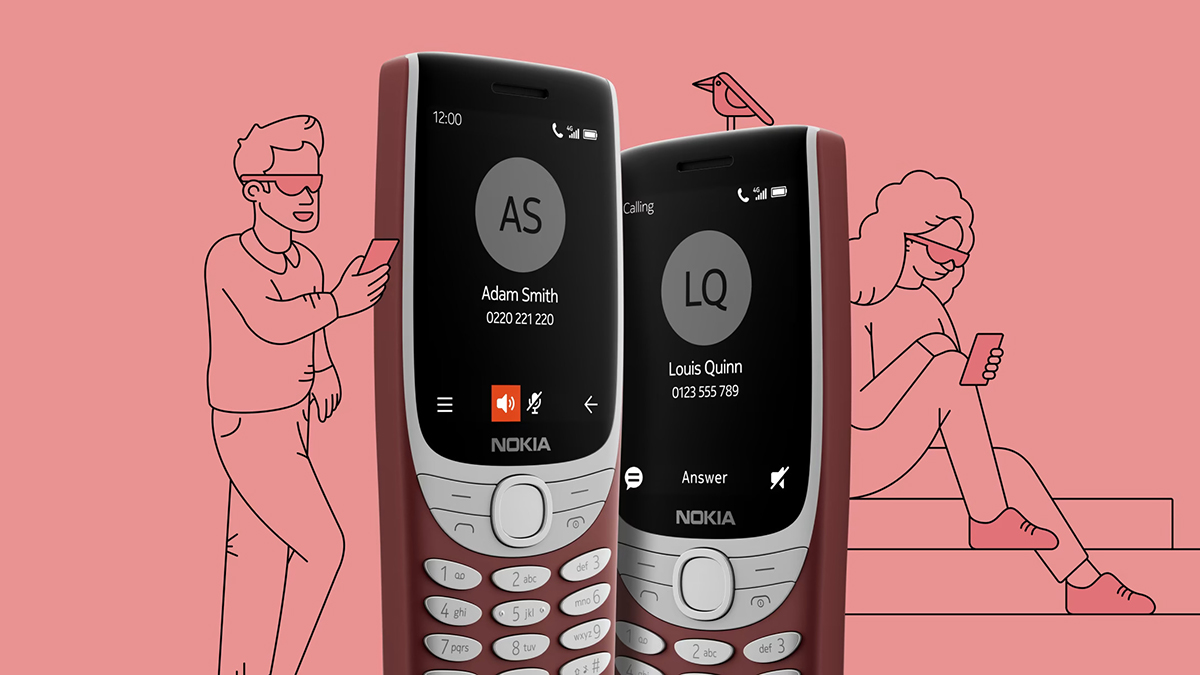

Under the hood of the phone is a 4G-capable Unisoc T107 chipset, which comes with 48 MB of RAM and 128 MB of internal storage. And yes, that wasn’t a typo – the memory configurations on the Nokia 8210 4G are offered in megabytes (MB) instead of gigabytes (GB). However, you’ll be glad to know that the phone comes with a MicroSD card slot that supports up to 32 GB. There’s no Wi-Fi function, but it does feature Bluetooth 5.0 support.


Like most of its retro-based feature phones, the 8210 4G runs on Nokia’s S30+ platform, which means you won’t have access to certain apps such as WhatsApp, Telegram, and so on. But hey, at least there’s Snake and a handful of other pre-installed games to keep yourself entertained. Besides that, also onboard is an MP3 player and FM radio function.


If you thought the memory offerings were humbling, wait till you see what Nokia has in store for the phone’s imaging system. About that, situated on the back is a 0.3 MP camera which is likely an intentional callback to the early days of mobile phone photography. And in that spirit, there’s no selfie camera in front, which means you have to take your selfies the old school way of shooting and hoping that you landed a presentable shot.

Lastly, powering the phone is a removable 1,450 mAh battery. Though small in current technology standards, Nokia says it actually provides enough juice which would allow the 8210 4G to last for weeks before needing to connect to a charger.

The new Nokia 8210 4G is priced at RM 299, and is available in Dark Blue and Red colours. Those interested can purchase the feature phone via authorised Nokia dealers nationwide, as well as the brand’s official online stores on Shopee and Lazada.

Wednesday, January 19, 2022

YouTube Testing Smart Downloads Feature For Its Android App In Europe

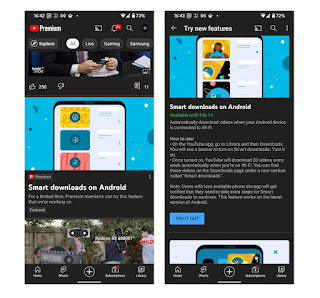
YouTube is testing a new Smart Downloads feature on its mobile app on Android in Europe, 9to5Google reports. It functions similarly to its counterpart which is already available on the audio-only YouTube Music app, where it is used to automatically download new content on mobile devices, as long as it is connected to Wi-Fi.

Smart Downloads is intended to help users to save up on mobile data, and will download 20 videos every week based on the user’s watching preferences. These videos can be viewed offline by navigating to the Downloads page under the app’s Library tab. 9to5Google says that YouTube will notify users if their devices are low on storage, and will advise them on what steps to take in order to free up space.

And much like the same function that is available on YouTube Music, the new Smart Downloads tool is only exclusively available to Premium subscribers. Moreover, the Google-owned streaming platform notes that the new feature is rolled out in a limited run, which is – as mentioned earlier – only accessible by Android users in Europe at this time. It is not known whether the Smart Downloads test will be expanded to other regions in the near future – let alone see an iOS version.

But should that be the case, Premium users are usually notified of its availability on their Home feed. To try out new experimental features on YouTube (when they are made available), simply navigate to youtube.com/new, or opt-in via the Try New Features option under Settings in the mobile app.

Tuesday, October 5, 2021

YouTube Music Background Playback Feature In November

The background playback ability that was introduced on YouTube Music sometime back as a Premium-only feature will soon be made available to all users. However, it will take a while until you’ll be able to use it though, as the Google-owned streaming service announced that the feature will only be rolled out later in November – with Canada being the first region to receive it.

If you’re unfamiliar with the feature, background playback basically allows you to continue streaming audio from YouTube Music even when it is minimised in the, well, background. This is useful in situations where you wish to multitask on other applications while also tuning in to music from the app.

However, as we’ve mentioned earlier, the feature (as well as its video counterpart) is exclusive to those paying for a monthly subscription with the platform. For non-paying users, locking the background playback ability behind a paywall is baffling, especially considering that Spotify, YouTube Music’s closest rival, has allowed both its free and paying users to play music while its mobile app is minimised for quite some time now.

Thankfully, this will no longer be considered a limitation for free YouTube Music users once November arrives. The platform did not mention when those outside of Canada can expect the feature to be rolled out in their respective regions.

Wednesday, September 8, 2021

Huawei Mate 50 Also Rumoured To Feature Satellite Communication Capabilities

It appears that the next generation iPhone may not be the only upcoming smartphone to come with satellite communication capabilities. Or at least according to a new rumour provided by a tipster on Weibo (via GizChina.it), who suggested that Chinese tech giant Huawei might also equip the feature on the Mate 50, its second flagship handset.

Much like the more recent report regarding the function on next-gen iPhones, it is said that the Mate 50’s satellite communications is intended for emergency use as well. Similarly, this enables the phone to send distress messages via SMS, independent of a cellular service connection.

The tipster claims that this feature is supported by China’s Beidou satellite system, which offers navigation and emergency SMS services. Beidou first launched in the country back in 2015 and eventually expanded its services across the globe last year, which places it alongside other satellite-based navigation systems such as the United States’ GPS, Russia’s GLONASS, and Europe’s Galileo.

Interestingly, the tipster added that the new satellite communications feature would also allow Huawei Mate 50 users to reach out to smartphones by other Chinese brands. This suggests that satellite communications might also be introduced to future devices from the likes of Xiaomi, Honor, Vivo, and so on.

If this rumour is to be believed, we might see more handsets to be equipped with this feature throughout 2022. On that note, it is also suggested that Huawei could launch the unannounced Mate 50 flagship series by early next year. Which is actually much later than the Mate series’ usual launch window, but expected nonetheless due the component shortages caused by the various US sanctions imposed on the company.

Thursday, August 26, 2021

WhatsApp Officially Launches “View Once” Disappearing Feature

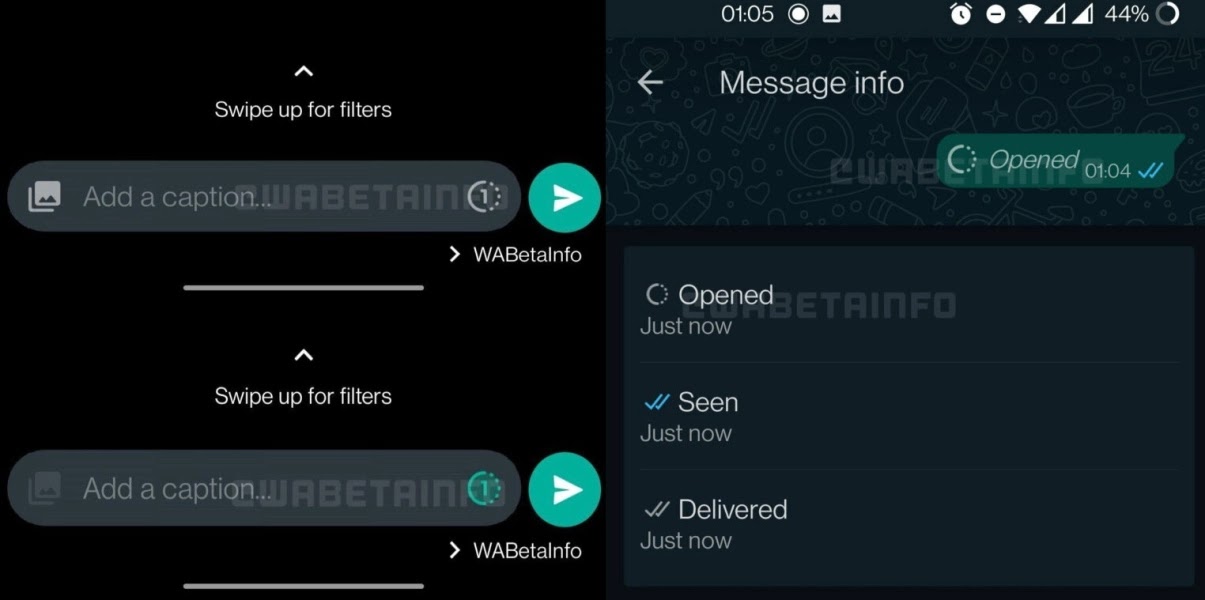
WhatsApp is finally rolling out its new “view once” feature to the general public in its latest update after being released a little over a month ago in the Android beta. The feature allows you to send photos and videos that can only be viewed once by the recipient, disappearing completely thereafter.

Similar to the disappearing messages in Snapchat and Instagram, it aims to give users more control over their privacy. Using it is simple: when sending pictures or videos to someone, click on the “1” button on the left of the send button. The recipient won’t see a preview of what you sent so they’ll have to click it to find out the content. Once they’re done viewing, you’ll see the message now says “opened” and they won’t be able to access it again. Of course, keep in mind that they can still take a screenshot and unlike Snapchat, you won’t be notified.


WhatsApp gave a use case example of sending somebody your WiFi password without having to worry about them sharing it with others, or maybe something like photos of new clothes you’re trying on at a store which you don’t need to take up your storage space. Seeing as how View Once messages are still end-to-end encrypted, maybe the feature would also be useful for espionage or just sending some “work-inappropriate” content.

The photos and videos sent through View Once can remain unopened for 14 days before they expire. Apparently, View Once messages can also be restored through backup if it was still unopened during backup. WhatsApp will also be able to see what you sent if the recipient reported your message for problematic content that breaks their terms of service. Obviously, you won’t be able to forward, save, star, or share View Once media.

Sunday, August 1, 2021

Twitter Is Testing New Like And Dislike Feature For Selected iOS Users

Twitter has confirmed via its official Support account that it is testing a new user approval function for tweets in the form of like and dislike buttons. However, the platform noted that the new feature will only be available to select users on iOS for now.

In regards to “disliking” a tweet, Twitter claims the function would act similarly to Reddit’s downvote feature, where it is used for researching on what type of replies users find relevant in a conversation. The company added that dislikes will be hidden, whereas the number of likes will be publicly visible. That being said, the number of dislikes will only be visible to the owner of the tweet and won’t affect the order of the replies. Users will be notified if their tweets receive likes, but no alerts will be given out when it receives the opposite.

According to user @DrOlufunmilayo, those on the iOS version of Twitter will see the prompt shown below. As seen from the screenshot, the new feature will completely replace the existing “heart” icon that is found alongside the reply, retweet and share buttons underneath a tweet.


A “dislike” button for social media platforms has always been a controversial issue. Prior to this, Twitter’s product lead executive Kayvon Beykpour responded to user suggestions for the feature by saying she disagreed with it. She explained that it’s difficult to find “a balance of incentives that rewards positive behaviour & disincentives toxic behaviour.”

Facebook users, in particular, have been requesting the thumbs down button for a long time, with a new rumour cropping up almost yearly. Mark Zuckerberg, Facebook CEO, stated in 2014 that the social media giant had considered adding a dislike button but was eventually scrapped due to its risk of being too, well, negative. The platform instead opted for Reactions, which allows users to react using emojis. Interestingly, Twitter is rumoured to also introduce emoji reactions similar to Facebook’s in the near future.


YouTube, on the other hand, has been testing on hiding dislike counts on videos from public view, similar to what Twitter is doing. The reason for this could be because many users argue that such a feature could be misused for abuse and bullying. At this current time, it is still unclear whether Twitter plans to expand the feature to the general public or keep it as just a researching tool for engagement.

Wednesday, July 7, 2021

WhatsApp Rolls Out ‘View Once’ Feature To Beta Users on Android


WhatsApp has begun to roll out a new feature known as View Once to beta users on Android. This particular feature is one of three new functionalities for the messaging app that has been confirmed by its CEO, Will Cathcart as well as CEO of Facebook, Mark Zuckerberg to WABetaInfo earlier this month.

Meant to deliver more privacy to users, this feature allows them to send photos and videos that would disappear immediately after it is viewed and closed by the recipient. This is opposed to the existing Disappearing Messages feature, whereby users can set their messages to be automatically removed from WhatsApp after seven days.

At the same time, users would also be notified once the media file has been viewed by the recipient. This option can also be enabled for groups and even recipients that have not activated or yet to receive the feature on their device.

However, do note that recipients can still screenshot View Once’s photos or videos before they are deleted which is something you have to be mindful about, since WhatsApp does not have a built-in screenshot detector. WABetaInfo has also said that iOS beta testers will have access to View Once soon, but didn’t mention any exact rollout date for them.

Wednesday, June 30, 2021

Facebook Smartwatch May Release Next Year; To Feature Two Cameras


Earlier in February, we saw reports that say Facebook may be working on a smartwatch of its own. New reports provide more details on what this wearable may entail, as well as when it may be released. And it’s not anytime soon, to be sure.

The Verge reports that the smartwatch by Facebook will come with a detachable display. This display will also come with two cameras . Detaching the module will then let users take pictures and videos, Naturally, you’ll be able to upload them to the company’s many platforms, including Instagram. It may also come with LTE connectivity for this purpose, so that it can work without a phone.

One camera will sit in front, the way a front-facing camera on a phone will. This one exists mostly for video calls, which probably means a lower resolution. Another sits at the back of the module, allowing for 1080p recording with auto-focus. Facebook will also be working with other companies to make accessories to allow the module to be attached to things like backpacks. Which makes it sound like an action cam.

The Verge reports that the smartwatch by Facebook will come with a detachable display. This display will also come with two cameras . Detaching the module will then let users take pictures and videos, Naturally, you’ll be able to upload them to the company’s many platforms, including Instagram. It may also come with LTE connectivity for this purpose, so that it can work without a phone.

One camera will sit in front, the way a front-facing camera on a phone will. This one exists mostly for video calls, which probably means a lower resolution. Another sits at the back of the module, allowing for 1080p recording with auto-focus. Facebook will also be working with other companies to make accessories to allow the module to be attached to things like backpacks. Which makes it sound like an action cam.


The report also states that this is the social media company’s plan to circumvent Apple and Google, going straight to users. Which also goes to explain why, despite it being a smartwatch, the detachable module behaves quite like a dumbed down smartphone.

Facebook is also reportedly already working on second and third generations of the device. Which sounds like the company is confident of its success. But the first generation will not be seeing the light of day until some time in summer 2022.

Monday, June 14, 2021

Leaked Renders Suggest Upcoming Apple Watch Series 7 To Feature A Redesign


It will be a while longer until Apple decides to unveil the latest generation of its smartwatch series, which usually falls towards the end of the year. However, thanks to a series of renders released by leakster John Prosser and concept artist Ian Zelbo (aka @Rendersbyian), we may have a good look at the design of the upcoming Apple Watch Series 7.

Based on the images provided, the new generation of the watch series is shown to sport a flat edge design – similar to those featured on the current generation iPhones and iPads. If proven accurate, this alleged redesign of the Apple Watch would corroborate with analyst Ming-Chi Kuo’s report last year which suggested the company’s plan of going for a consistent streamlined look across all of its products.


Other than that, it is suggested that the supposed redesign retains the series’ iconic Digital Crown feature on the right hand side of the device, together with power button positioned below it. The renders released by Prosser and Zelbo also revealed several possible colour options for the new Apple Watch and Solo Loop Straps which includes red, blue, green, white, and black. It’s worth noting that Kuo’s aforementioned report predicts Apple may introduce a new colour for the Series 7 as well.


Prosser did not share any information in terms of specifications for the new wearable. However, earlier rumours suggest that Apple may introduce a new optical sensor that is capable of monitoring blood sugar levels, among other possible hardware improvements.


As usual, whether this leak is accurate or not remains to be seen. That being said, Prosser’s track record when it comes to insight regarding new Apple products are usually a mix of hits and misses. Needless to say, we highly advise our readers to take allegedly leaked information such as these with a healthy dose of salt.

Thursday, June 10, 2021

Intel Alder Lake-S “Socket V” Chipset To Feature Lower Z-Stack, Rectangular Design


Intel’s 12th generation Alder Lake-S desktop CPUs are expected to make their debut sometime before the end of the year and while rumours may suggest that the top-of-the-line model will support as many cores as AMD’s current flagship Ryzen 9 5950X, little else is known about the lineup. That is, up until now.

According to a report by the German tech site, Igor’s Lab, Alder Lake-S’ chipset isn’t just shipping out with a larger LGA1700 chipset – codenamed Socket V – but it will also be the first socket to house a completely new processor design in a long time. Specifically, blueprints obtained by the German publication point at Socket V supporting a processor with a rectangular design. Further, the Z-Stack, which is the total height of the CPU package, will be lower by approximately 1mm.


Not only that, but Igor also seems to have stumbled upon a set of blueprints that point to a new cooler that seemingly makes use of the high-performance thermoelectric cooling technology. This isn’t the first time such a cooler has made headlines; with its LGA1200 chipset, Intel partnered up with Cooler Master to create and launch the MasterLiquid ML360 Sub-Zero cooler.


Igor also managed to get his hands on schematics that seem to detail a low-profile reference cooler that look like they could be bundled with the lineup’s mid-range and entry-level processors at launch. Naturally, given the increased die size and pin density, it is very unlikely that this cooler will be backwards compatible with LGA1200 chipsets.

Saturday, May 15, 2021

Next-Gen PS VR To Feature 4K Resolution, Gaze Tracking


Back in February, Sony Interactive Entertainment confirmed that it is working on a next-generation PS VR for the PS5. At the time, one major improvement that the company announced is ease to use, using only a single-cord connection. Now, insiders have shared what may be more improvements to the new generation VR headset.

Sources to UploadVR claim that the new PS VR will come with what is quite close to 4K resolution. Though more specifically, it is 4000 x 2040, or 2000 x 2040 per eye.

It will also come with the kind of gaze detection tech that Apple’s mixed reality headset will reportedly come with. Called foveated rendering, this allows the headset to fully render parts that a wearer is looking at, while rendering things in the peripheral vision to lower graphical processing load.


One other feature that the sources claim the new PS VR will have is haptic feedback. This is done via a motor in the headset. Combine this with the new VR controllers and users will basically get the complete haptic feedback package for VR.

It all sounds like taking the best parts of the DualSense and putting them into the new PS VR system. But it will be awhile before we hear any confirmation by Sony on these. As we reported before, the company is not aiming to launch the new generation VR headset this year.

Wednesday, May 12, 2021

Telegram To Debut Video Conferencing Feature In May

Remember when every social media and communications platform started introducing video conferencing features in order to compete against Zoom’s ever rising popularity? Good times. While this may seem later than most, private messaging app Telegram has revealed that it’s finally launching their own group-based video call feature starting in May, ten months after the one-to-one version was released.

According to CEO Pavel Durov, the platform’s own take will come with all of the familiar features such as screen sharing, encryption, noise-cancelling, as well as desktop and tablet support. Of course, the video conferencing function will be protected by Telegram’s end-to-end encryption as well – as with most of its existing sub-features.

From the sample video provided by Durov, the platform’s group video call function can be viewed in both portrait and landscape orientations, where the main portion of the call will display and switch between active speakers. Participants are listed just below the video window in the former, while the latter will have them displayed in a column on the right side of the screen. Telegram did not mention how many users are able to participate in a session.


Although it is late to adapt the whole group video conferencing fad, it was revealed in a recent beta that Telegram has already jumped onto Clubhouse clone bandwagon back in February. The private messaging platform has yet to reveal when that feature, introduced as Broadcast Groups, will be available to non-beta users. 

Lenovo Teases New Yoga Tablet With HDMI Input Feature

Lenovo has recently released a teaser featuring a new tablet via its official account on Chinese social media platform Weibo. Unlike the brand‘s typical offerings from this category, this new device is shown to feature a HDMI input.

As demonstrated in the image provided, the tablet could also function as a portable display that can output or mirror visuals from certain sources via a HDMI cable. In the teaser’s case, the new Yoga device is shown connected to a docked Nintendo Switch console, with Mario Kart 8 Deluxe displayed on the tablet’s screen.

Needless to say, this is pretty handy if you wish to play your games outside on a larger screen. That is, if you don’t mind lugging around the Switch’s dock along with you and at the same time finding an outdoor plug for it.

Of course, Nintendo’s console is just one of the many possible uses for the new Lenovo tablet’s HDMI-in support. With the feature, the device is definitely capable of being used as a secondary display for your PC and laptop as well. Although it may not be as generous as an actual 20+ inch monitor, users such as streamers could utilise it for displaying live chats or other data that does not require a larger screen size.

Lest we forget, the new Yoga is still a tablet which is surely capable of doing whatever a tablet can do. However, the company has yet to reveal what kind of specifications we’ll be expecting at this time. It’s not specified if it will be running Android or Windows either.

From our observation of the image, it doesn’t appear that the device does not feature any front-facing cameras on its slim bezels. It is also shown to sport a thin form factor – save for the bottom, which looks like the grip handle from the Lenovo Yoga Tab/Smart Tab series. Seeing how the tablet is positioned, we can safely assume that it also comes with a rear kickstand.

Interestingly, also featured on the teaser is the chemical element symbol for a rare metal material known as Tantalum (Ta). How this relates to the tablet is not known for now. Hopefully we’ll find out more regarding this new Lenovo Yoga device soon enough.

Twitter Rolls Out Tip Jar Payment Feature For Content Creators And Others

Twitter joins other social media platforms in rolling out a payment feature for content creators and others. As the name implies, Tip Jar will enable people to support Twitter personalities with tips.

The account owner / recipient will have to enable the feature first – after which, a Tip Jar icon will appear next to the Follow button on their profile page. Those who wish to tip can then tap on the icon and select a payment service or platform that the account has enabled.


Once a selection has been made, users will be brought off Twitter to the chosen app, where they can enter an amount and finalise payment. Available services include Bandcamp, Cash App, Patreon, PayPal and Venmo. Twitter said it takes no cut, but noted that payment service availability and features will vary by region. Android users can also send tips within Spaces.

At the moment, everyone using Twitter in English can send tips to those who have enabled the feature – expansion to other languages is planned. But for the time being, only a limited group of people across the world who use Twitter in English can add the feature to their profile and receive money. These people include creators, journalists, experts and nonprofits, but Twitter said it’ll widen that circle shortly.


Twitter said that Tip Jar is a “first step” in its efforts to set up ways for people to give and receive money on the platform. Social media platforms are banking heavily on attracting creators – Clubhouse launched its first monetisation feature last month, and Facebook has its Stars feature, with more monetisation opportunities announced and on the way.

Friday, May 7, 2021

Xiaomi May Introduce A New Extended RAM Feature For Its Smartphones

Those with Xiaomi smartphones with low-specced RAM configurations will be delighted to know that the company might be working on a way to upgrade its capacity. Thanks to a recent discovery by tipster Kacper Skrzpek on Twitter, a code to what appears to be an “extended RAM” feature was spotted on an unspecified version of Xiaomi’s MIUI system.

This concept isn’t actually entirely new and is quite similar to the Virtual Memory approach on PC operating systems such as Windows. What this feature does is allocate a certain amount of physical memory aka Read Only Memory (ROM) from the device’s storage, and converts it into Random Access Memory (RAM). This also means that after the conversion, the allocated ROM will be completely unusable for usual storage purposes – that is, until the user decides to reverse the action.

Xiaomi isn’t the first brand to introduce the extended RAM feature on smartphones, albeit allegedly. The honour belongs to fellow Chinese smartphone maker Vivo, who recently debuted it along with its latest handset in Malaysia: the Vivo V21. The latter’s device provides users the option to boost its onboard 8GB RAM up to 11GB by converting 3GB from its 128GB internal storage capacity.

If Skrzpek’s information is proven accurate, Xiaomi’s version functions somewhat similarly to that of Vivo’s. From the screenshots provided by the tipster, the former’s alleged feature is shown to be able to convert 1GB of storage into RAM – although it’s quite possible the amount may change depending on the memory configurations on different Xiaomi phones. Also provided that if the brand is planning to include this ability on all of its future or current devices.

There’s no word on when Xiaomi is planning to debut this feature on its MIUI system or smartphones. Nevertheless, it is going to be a very handy feature to improve multitasking and also gaming, especially for users who are on entry-level handsets from the company.

Xiaomi Shows Off Physical Concept Of Vision Gran Turismo

At the very tail end of last month, Xiaomi unveiled the Vision Gran Turismo. The car was revealed as a digital hypercar, and one that’s made...