Showing posts with label Companies. Show all posts

Wednesday, November 29, 2023

Chinese Companies Are Dismantling RTX 4090 Cards To Circumvent US Ban


Ever since the US ban that prohibits China from receiving anymore of NVIDIA’s GeForce RTX 4090 GPU, among other things, went into effect earlier this month, many Chinese companies have had no choice but get creative in the way they can sell the card. One such method involves them removing manufacturers’ cooler from the card and slapping on a blower-style cooler on it.

Of course, the dismantling process of these RTX 4090 is obviously a little more complicated than that; these companies are reportedly dismantling the GPU at scale, meaning that they are disassembling the GPU core from the PCB en masse, attaching them to different cards, and then slapped with blower-style coolers. Once completed, the new cards are then labelled as “AI Cards” to suggest that they are designed to be used in AI language model training.
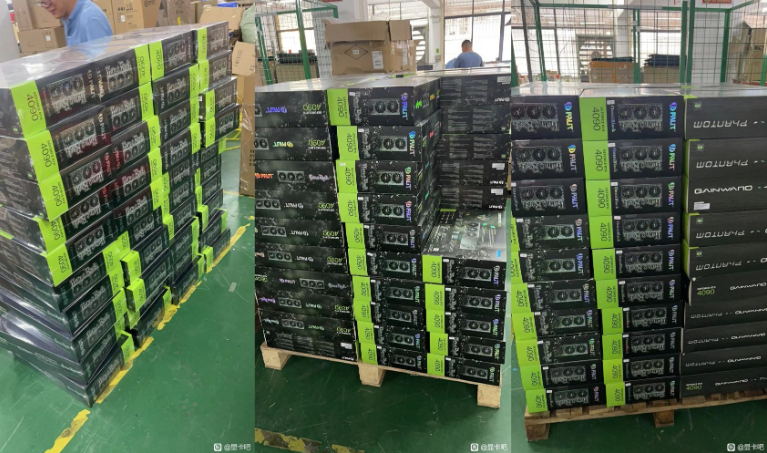

As a quick reminder, the US export bans specifically forbids the distribution and sale of the AD102 GPU, which is part and parcel of the RTX 4090. Prior to the ban, NVIDIA had actually managed to rush a large-scale order of GPUs to its AIB partners in China. In anticipation of the ban, Chinese companies had also made a somewhat smart decision to stockpile as many GPUs as physically possible.

Several of the photographs that were taken in one of this “AI Cards” disassembly lines include RTX 4090s procured from brands such as ASUS, PNY, Colorful, Palit, and Zotac. This is undoubtedly an infuriating scenario for gamers that may have been looking forward to procuring said card in China.


Even after stripping the precious RTX 4090’s AD102 GPU from their original PCBs, these Chinese companies don’t appear to waste anything either. Supposedly, they resell the leftover components and naked PCBs as spare parts, which would be beneficial to individuals looking to just upgrade their coolers. For others, they serve as a morbid reminder of where said components originated from.

The unfortunate reality to this hoarding of the RTX 4090 is that, as it stands right now, what these Chinese companies are doing isn’t “technically” against the law in their own country. Further, it has become evident that virtually none of NVIDIA’s board partners actually put fail safes in place to prevent incidents such as this to take place. Worst, NVIDIA itself has a share of the blame for this, by virtue of the GPU brand having created the environment in which these unscrupulous characters are allowed to exist.

Monday, June 14, 2021

Japanese Companies Planning To Develop A Data Centre In Space


Data centres such as those owned by Google and Microsoft are known to use a tremendous amount of energy for processing information. This in turn usually leads to a high number of carbon emissions which increases the risk of climate change, especially with so many of these facilities available around the world.

Realising this, Japanese telecommunications company NTT (Nippon Telegraph and Telephone) is partnering with local broadcasting firm SKY Perfect JSAT Holdings to develop a solution that will hopefully eliminate the issue from the face of the Earth, literally too. Both companies aim to launch a satellite system that can process and store data in space by 2025, with hopes for it to be fully operational in 2026.

According to a report by Nikkei, each satellite will be equipped with computing functions and connected by NTT-developed IOWN (Innovative Optical and Wireless Network) communication technology to act as a pseudo data center. The system will gather a wide range of data from Earth, process and analyse them, and then send back only relevant information.

NTT says that the satellite network, combined with its IOWN tech, enables for reduced exchange of massive data between space and earth, therefore speeding up its transfer process. It is also claimed to reduce power consumption to one-hundredth of what it is now, and will also contribute to decarbonisation efforts as the electricity used for data processing originates from solar energy. Both NTT and SKY Perfect JSAT are hoping to operate hundreds of these satellites in the future.

The idea of utilising space infrastructure for data preservation isn’t entirely new. As we previously reported in October of last year, Microsoft launched its own off-planet data processing system known as Azure Space. However, unlike the two Japanese companies, the US-based tech giant’s satellite network aims to provide fast and easy access to its Azure cloud computing solution for customers, especially those in remote locations.

With projects such as SpaceX’s Starlink and those mentioned above, companies are literally taking data processing to greater heights. Perhaps it’s time to update the term “cloud computing” to something more relevant, now that it has reached to the realm of infinity and beyond. 

Thursday, March 18, 2021

Chinese Tech Companies Are Trying To Circumvent New Apple Privacy Rules


Apple has some major privacy changes coming to devices running iOS 14. One of the major opponents of the move is Facebook, which has openly attacked the changes. But rather than having a public spat in a similar manner, Chinese tech giants may have a different idea.

According to a report by the Financial Times, state-backed China Advertising Association (CAA) is testing a tool to bypass the new Apple privacy rules. This will then allow companies to continue tracking users without their consent. In turn, this allows the companies to continue serving targeted ads.

The tool is known as CAID, and it’s being touted as “a substitute if the user’s IDFA is unavailable”. Though the CAA claims that the CAID is both not yet formally implemented, and “does not stand in opposition to Apple’s privacy policy”. The association goes on to say that it’s “actively communicating” with Apple regarding the matter.


The CAID has been reportedly in a free demo phase for select companies for a few months. It is even set to be released as soon as this week. Sources to the Financial Times claim that Tencent and ByteDance are currently testing the system. Apple, on the other hand, is aware of the tool and seems to have turned a blind eye so far. Though if it wanted, the company could detect which app uses the tool, and block them from the Chinese App Store.

So what’s stopping the company from actually doing so? The report quotes Zach Edwards, founder of tech consultancy agency Victory Medium, as saying that Apple can’t afford to ban every app in the country. Doing so will ultimately get it kicked out of the market.

Friday, February 19, 2021

Saudi Sovereign Fund Invests US$3.3 Billion In Major Video Game Companies


The Saudi Public Investment Fund (PIF) recently made a hefty investment into shares of several major video game studios. The investment firm, owned by the Saudi crown prince, Mohammed bin Salman (also known by his acronym, MBS), now reportedly has stakes in Activision, Blizzard, EA, and Take-Two.

According to a report by Al-Jazeera, the sovereign wealth fund has acquired US$3.3 billion (~RM13.33 billion) worth of stocks from the three game companies, during the fourth quarter of last year. To break it down, it spent US$1.3 billion (~RM5.25 billion) on Activision Blizzard, US$1 billion (~RM4.05 billion) on EA, and US$825 million (~RM3.33 billion) in Take Two.

Additionally, the Riyadh-owned firm also has a stake in the US-based ride sharing company, Uber. US$4.4 billion (~RM18 billion) worth of shares, to be exact.


It bears mentioning that this isn’t the first time the crown prince has invested in video games. Known for his love of the medium, the Saudi prince purchased shares at SNK back in November last year; he now owns more than a third of the company.

The crown prince has also courted controversy for non-gaming matters in the past, chief among which being his alleged involvement in ordering the murder of Jamal Khashoggi, a Saudi-based journalist who worked at the Washington Post.

Xiaomi Shows Off Physical Concept Of Vision Gran Turismo

At the very tail end of last month, Xiaomi unveiled the Vision Gran Turismo. The car was revealed as a digital hypercar, and one that’s made...