Showing posts with label Chinese. Show all posts

Wednesday, November 29, 2023

Chinese Companies Are Dismantling RTX 4090 Cards To Circumvent US Ban


Ever since the US ban that prohibits China from receiving anymore of NVIDIA’s GeForce RTX 4090 GPU, among other things, went into effect earlier this month, many Chinese companies have had no choice but get creative in the way they can sell the card. One such method involves them removing manufacturers’ cooler from the card and slapping on a blower-style cooler on it.

Of course, the dismantling process of these RTX 4090 is obviously a little more complicated than that; these companies are reportedly dismantling the GPU at scale, meaning that they are disassembling the GPU core from the PCB en masse, attaching them to different cards, and then slapped with blower-style coolers. Once completed, the new cards are then labelled as “AI Cards” to suggest that they are designed to be used in AI language model training.
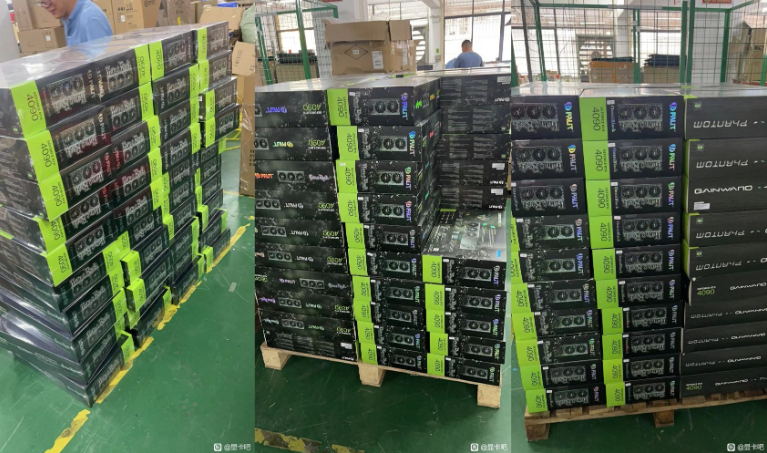

As a quick reminder, the US export bans specifically forbids the distribution and sale of the AD102 GPU, which is part and parcel of the RTX 4090. Prior to the ban, NVIDIA had actually managed to rush a large-scale order of GPUs to its AIB partners in China. In anticipation of the ban, Chinese companies had also made a somewhat smart decision to stockpile as many GPUs as physically possible.

Several of the photographs that were taken in one of this “AI Cards” disassembly lines include RTX 4090s procured from brands such as ASUS, PNY, Colorful, Palit, and Zotac. This is undoubtedly an infuriating scenario for gamers that may have been looking forward to procuring said card in China.


Even after stripping the precious RTX 4090’s AD102 GPU from their original PCBs, these Chinese companies don’t appear to waste anything either. Supposedly, they resell the leftover components and naked PCBs as spare parts, which would be beneficial to individuals looking to just upgrade their coolers. For others, they serve as a morbid reminder of where said components originated from.

The unfortunate reality to this hoarding of the RTX 4090 is that, as it stands right now, what these Chinese companies are doing isn’t “technically” against the law in their own country. Further, it has become evident that virtually none of NVIDIA’s board partners actually put fail safes in place to prevent incidents such as this to take place. Worst, NVIDIA itself has a share of the blame for this, by virtue of the GPU brand having created the environment in which these unscrupulous characters are allowed to exist.

Tuesday, August 31, 2021

Cloud Mining Company Wins Chinese Court Case; Regains More Than 485000 AMD Radeon GPUs

Genesis Mining, An Iceland-based cloud mining outfit, recently won a lawsuit in a Chinese court, against a Chinese hosting provider, Chuangshiji Technology Limited. By decree of China’s Supreme Court, the defendant was ordered to return the Radeon RX 470 8GB GPUs it seized from Genesis Mining and by all, we mean all 485681 units.

Genesis Mining’s legal woes began in 2018, when it took Chuangshiji Technology Limited to court, over multiple monetary issues with the latter. The lawsuit, which stretched over a span of several years, was filed in 2019, after the defendant began withholding said RX 470 GPUs, presumably purchased by Genesis Mining. The Genesis lawsuit specifically demanded that Chuangjishi hand over more than 560000 GPUs, along with 60000 ASIC miners after the company terminated its agreement with the company.

Naturally, things didn’t go according to plan for Genesis; Chuangjishi refused to comply and instead, began selling its ill-gotten gains, all without Genesis’ consent.


Sadly, Genesis’ victory in the Chinese court is a Pyrrhic one; while the Icelandic cloud-based mining company may have won back its nearly half a million RX 470 GPUs, China’s recent crackdown on cryptominers and their farms means that the company will have to consider two alternatives: shift its operations out of China and into a country where cryptomining isn’t banned or find new homes for them, the latter being an arduous task, given the age of the RX 470 and its GPU core.

That said, selling them to actual gamers might actually net Genesis a tidy profit, especially given the ongoing chip and GPU shortage that is happening around the world.

Monday, July 19, 2021

Chinese Smugglers Try To Smuggle 256 CPUs By Wrapping Them Around Their Bodies


As you well know, the ongoing chip shortage and COVID-19 pandemic has been causing a crisis in the PC world and that shortage is reflected in how smugglers in China have been getting – and we’re using this word sparingly – creative in their attempts to smuggle PC components. Case in point, a truck driver and his co-driver crossing the Hong Kong – Macau Bridge attempted to smuggle a bunch of CPUs across the border by wrapping them around their bodies.

According to multiple reports, the driver and his cohort were detained by Hong Kong customs officials after it was discovered that the suspects had used cling-film to wrap 256 Intel CPUs on to their bodies. Specifically, the CPUs are 10th generation Core i7-10700 and Core i9-10900K CPUs, with a total worth of US$123000 (~RM515431).

The punchline here is that this wasn’t a one-off incident; more than a week later, another smuggling attempt was foiled, with customs officials finding 52 Intel CPUs hidden inside both the driver and passenger seats. Then, earlier this week, the Hong Kong customs seemingly hit the motherlode when it seized 2200 CPUs and 1000 RAM modules, all hidden within a container truck. Along with hundreds of smartphones and cosmetic items, with a total market value in excess of US$4 million (~RM16.8 million).


Alas, the more recent smuggling attempts, however, did not involve the driver and passenger cling wrapping CPUs to their bodies or stuffing them up personal orifices. The latter most likely to hurt if one were to attempt it with sharp-edged items like a CPU.

Sunday, July 4, 2021

Chinese millenials fed up with materialistic life.


Fed up with work stress, Guo Jianlong quit a newspaper job in Beijing and moved to China’s mountainous southwest to “lie flat”.

Guo joined a small but visible handful of Chinese urban professionals who are rattling the ruling Communist Party by rejecting gruelling careers for a "low-desire life". That is clashing with the party's message of success and consumerism as its celebrates the 100th anniversary of its founding.

Guo, 44, became a freelance writer in Dali, a town in Yunnan province known for its traditional architecture and picturesque scenery. He married a woman he met there.

“Work was OK, but I didn’t like it much,” Guo said. “What is wrong with doing your own thing, not just looking at the money?”

“Lying flat” is a “resistance movement” to a “cycle of horror” from high-pressure Chinese schools to jobs with seemingly endless work hours, novelist Liao Zenghu wrote in Caixin, the country’s most prominent business magazine.

“In today’s society, our every move is monitored and every action criticised,” Liao wrote. “Is there any more rebellious act than to simply 'lie flat'?”

It is not clear how many people have gone so far as to quit their jobs or move out of major cities. Judging by packed rush hour subways in Beijing and Shanghai, most young Chinese slog away at the best jobs they can get.

Still, the ruling party is trying to discourage the trend. Beijing needs skilled professionals to develop technology and other industries. China’s population is getting older and the pool of working-age people has shrunk by about 5 per cent from its 2011 peak.

“Struggle itself is a kind of happiness,” the newspaper Southern Daily, published by the party, said in a commentary. “Choosing to ‘lie flat’ in the face of pressure is not only unjust but also shameful.”

The trend echoes similar ones in Japan and other countries where young people have embraced anti-materialist lifestyles in response to bleak job prospects and bruising competition for shrinking economic rewards.

Official data show China’s economic output per person doubled over the past decade, but many complain the gains went mostly to a handful of tycoons and state-owned companies. Professionals say their incomes are failing to keep up with soaring housing, child care and other costs.

In a sign of the issue’s political sensitivity, four professors who were quoted by the Chinese press talking about “lying flat” declined to discuss it with a foreign reporter.

Another possible sign of official displeasure: T-shirts, mobile phone cases and other “lie flat”-themed products are disappearing from online sales platforms.

Urban employees complain that work hours have swelled to “9 9 6”, or 9am to 9pm, six days a week.

“We generally believe slavery has died away. In fact, it has only adapted to the new economic era,” a woman who writes under the name Xia Bingbao, or Summer Hailstones, said on the Douban social media service.

Some elite graduates in their 20s who should have the best job prospects say they are worn out from the "exam hell" of high school and university. They see no point in making more sacrifices.

“Chasing fame and fortune does not attract me. I am so tired,” said Zhai Xiangyu, a 25-year-old graduate student.

Some professionals are cutting short their careers, which removes their experience from the job pool.

Xu Zhunjiong, a human resources manager in Shanghai, said she is quitting at 45, a decade before the legal minimum retirement age for women, to move with her Croatian-born husband to his homeland.

“I want to retire early. I don’t want to fight any more,” Xu said. “I’m going to other places.”

Thousands vented frustration online after the Communist Party's announcement in May that official birth limits would be eased to allow all couples to have three children instead of two.

The party has enforced birth restrictions since 1980 to restrain population growth but worries China, with economic output per person still below the global average, needs more young workers.

Minutes after the announcement, websites were flooded with complaints that the move did nothing to help parents cope with child care costs, long work hours, cramped housing, job discrimination against mothers and a need to look after elderly parents.

Xia writes that she moved to a valley in Zhejiang province, south of Shanghai, for a “low-desire life” after working in Hong Kong. She said despite a high-status job as an English-language reporter, her rent devoured 60 per cent of her income and she had no money at the end of each month.

She rejects the argument that young people who “lie flat” are giving up economic success when that is already out of reach for many in an economy with a growing gulf between a wealthy elite and the majority.

“When resources are focused more and more on the few people at the head and their relatives, the workforce is cheap and replaceable,” she wrote on Douban. “Is it sensible to entrust your destiny to small handouts from others?”

Xia declined an interview request.

Guo, the writer in Dali, said he puts in more hours as a freelancer than he did at a newspaper. But he is happier, and life is more comfortable: He and his wife eat breakfast on their breezy sixth-floor apartment balcony with a view of trees.

“As long as I can keep writing, I’m very satisfied,” Guo said. “I don’t feel stifled.”

A handful who can afford it withdraw from work almost entirely.

A 27-year-old architect in Beijing said she started saving as a teenager to achieve financial freedom.

“From last September, when I saw all my savings had reached 2 million (yuan) (US$300,000), I lay down,” said the woman, who would give only the name Nana, in an interview over her social media account.

Nana said she turned down a job that paid 20,000 yuan (US$3,000) per month due to the long hours and what she saw as limited opportunities for creativity.

“I want to be free from inflexible rules,” said Nana. “I want to travel and make myself happy.”

Saturday, April 17, 2021

Chinese Chipmaker Debuts First Homemade GPGPU; Based On TSMC 7nm FinFET Process

Shanghai Tianshu Intellectual Semiconductor Co. (Tianshu Zhixin) announced earlier this week that it was close to bringing its first-ever homegrown 7nm General Purpose GPU (GPGPU), Big Island (BI), into mass production and commercial delivery.

Tianshu Zhixin’s comes months after Big Island was first announced at the beginning of the year. Back then, the Chinese chipmaker hinted at BI being made with a 7nm process node, along with a 2.5D chip-on-water-on-substrate (CoWoS). The company failed to mention what 7nm process it was using for its GPGPU, but Tom’s Hardware has confirmed that it is a 7nm from TSMC’s foundries.

In addition to its “mass production” announcement, Tianshan Zhixin also shared some information about BI in the form of a slide. It’s written in Chinese, but based on what we can make out, the GPGPU is using 32GB HBM2 memory with speeds up to 1.2TB/s. There’s also a laundry list of its performance in floating point operations, including the usual FP32 and FP16 performance metrics.


At the time of writing, Tianshu Zhixin did not say when its first round of BI GPGPUs are scheduled to be shipped, nor did it say who would be its first batch of customers.

Friday, March 19, 2021

FCC Begins Pulling Licenses Of Two Chinese Telcos In America


The US Federal Communications Commission (FCC) announced that it had begun the process of cancelling the operating licenses of two Chinese telcos. The move is likely part of Washington’s continuing efforts to root out any potential for Chinese espionage in the US.

According to the report by Reuters, the telcos named were China Unicom Americas as well as Pacific Networks and its subsidiary ComNet which collectively are owned by CITIC Group Corporation. At the moment, China Unicom Americas and Pacific Networks have a two-decade old authorisation to operate in the US.

The FCC accused the firms of failing “at this stage to dispel serious concerns” about their US authorisations. FCC Commissioner Geoffrey Starks observed that many Chinese telcos also owned data centres in the US, but said that the agency currently lacked authority to “address this potential national security threat.”

Last Friday, the FCC, using a 2019 law, designated five Chinese companies as national security threats: Huawei Technologies, ZTE, Hytera Communications, Hangzhou Hikvision Digital Technology and Dahua Technology. In addition to that, Facebook last week has also dropped an application to build a new Internet cable between the US and Hong Kong based on “ongoing concerns from the US government about direct communications links.”


Taken all together and depending on your point of view, Washington is either deep in a fit of paranoia or acting prudently and rapidly to secure its networks. Regardless, there is a massive irony here.

Beijing is notorious for severely restricting the activities and reach of Western companies on the Chinese mainland – a decades-long complaint of the West. Washington, the champion of free markets and democracy, may end up doing the same thing to Chinese firms.

Chinese Memory Maker Releases Data For DDR5 RAM Running At 6400MHz


Shenzhen Longsys Electronics Co. Ltd isn’t a name that would immediately ring a bell, but the China-based memory maker recently came into focus after news about its romp with the next-generation DDR5 memory surfaced. On top of that, it was tested at a frequency of 6400MHz.

According to Tom’s Hardware, Longsys currently has two DDR5-6400 RAM modules in the works; a 16GB variant with a single-rank design and a 32GB model with a dual-rank design. Regardless of design, both variations feature an eight-layer PCB, have CAS Latency (CL) of 40, and requires only 1.1V to operate.

Based on Longsys’ data, its DDR5-6400 RAM showed as much as 64% gains over the current DDR4 memory standard in the Master Lu benchmark, but to be fair, it was not made clear as to what frequency the DDR4 memory was running on.


What is interesting to note is that the system Longsys appears to be using to test its DDR5 RAM is an unreleased Intel 12th generation Alder Lake-S system. It’s not all that surprising, given that the Alder Lake-S is currently the only chipset so far that claims to support DDR5 and as it stands, AMD is still keeping mum about its next generation of Ryzen’s capabilities.

That said, it should also be pointed out that Longsys isn’t the first company to announce its entry into the realm of DDR5. Another Chinese memory maker, Asgard, recently announced its own 64GB DDR5-4800 RAM solution and in capacities of 64GB.

Thursday, March 18, 2021

Line Comes Under Scrutiny After Chinese Engineers Reportedly Accessed User Data


The popular messaging app Line is now under investigation by the Japanese government after local media reported that it allowed Chinese engineers at a Shanghai company to access Japanese users’ data without telling them.

According to the report by Reuters, a government official has stated that investigations were ongoing and that they are unable to tell if Line violated any regulations yet. At the same time, a spokesperson from Line denied that the firm broke any laws or regulations.


But on its website, the company later apologised for causing any concern and for inadequately explaining its data management policies to users, adding that no inappropriate access took place.

Local media has reported that four Chinese engineers, tasked with system maintenance, were given access to Japanese servers from 2018 containing names, telephone numbers, and email addresses of users.

The alarm over the incident probably stems from Japan’s often choppy relations and historical unease with China. It doesn’t help that China-backed hackers were blamed for a recent massive breach of Microsoft Exchange email servers.


For what it’s worth, China has acquired a reputation for spying and hacking in the last few years.

Accordingly, researchers at Stanford University last month raised concern over social media app Clubhouse’s affiliation with Shanghai-based company Agora. Also, last month, TikTok settled a privacy lawsuit alleging that it sent user data to Chinese servers or certain locations in which China-based employees could access the data.

Beijing may not like it, but the very mention of China raises suspicion these days.

Chinese Tech Companies Are Trying To Circumvent New Apple Privacy Rules


Apple has some major privacy changes coming to devices running iOS 14. One of the major opponents of the move is Facebook, which has openly attacked the changes. But rather than having a public spat in a similar manner, Chinese tech giants may have a different idea.

According to a report by the Financial Times, state-backed China Advertising Association (CAA) is testing a tool to bypass the new Apple privacy rules. This will then allow companies to continue tracking users without their consent. In turn, this allows the companies to continue serving targeted ads.

The tool is known as CAID, and it’s being touted as “a substitute if the user’s IDFA is unavailable”. Though the CAA claims that the CAID is both not yet formally implemented, and “does not stand in opposition to Apple’s privacy policy”. The association goes on to say that it’s “actively communicating” with Apple regarding the matter.


The CAID has been reportedly in a free demo phase for select companies for a few months. It is even set to be released as soon as this week. Sources to the Financial Times claim that Tencent and ByteDance are currently testing the system. Apple, on the other hand, is aware of the tool and seems to have turned a blind eye so far. Though if it wanted, the company could detect which app uses the tool, and block them from the Chinese App Store.

So what’s stopping the company from actually doing so? The report quotes Zach Edwards, founder of tech consultancy agency Victory Medium, as saying that Apple can’t afford to ban every app in the country. Doing so will ultimately get it kicked out of the market.

Monday, February 8, 2021

Chinese Miners Now Grabbing NVIDIA GeForce RTX 30 Series Laptops To Mine Ethereum


The recent rally and current value of both Bitcoin and Ethereum have clearly sparked renewed interest within the crypto mining community, as evidenced by one miner who unashamedly showed off his 100-card NVIDIA GeForce RTX 3080 mining rig. Now, in what can only be described as an act of desperation, Chinese GPU miners are turning their attention towards gaming laptops powered by NVIDIA’s GeForce RTX 30 series GPUs.

News of the RTX 30 series laptops being bulk bought was first reported on the Chinese social media platform, Weibo, with one BiliBili user by the name of “Fish Pond F2pool” showing just how lucrative mining Ethereum currently is with an Ampere-based GPU. It’s all in Chinese, obviously, but as a side note, she makes it clear in the video that she made the video purely out of fun and to give an example.

Getting back to the main point, the content creator shows a laptop equipped with an RTX 3060 set to mine Ethereum. The kicker here is that she’s plugged her laptop into a wall socket at a local Starbucks, and she’s sipping a cup of coffee while at it. For a period of two hours, the laptop’s RTX 3060 was able to mine 0.00053 ETH, which at current market rate, is around RM3.50. On a related note, that’s also supposedly how much her coffee cost.

Cryptomining with graphics cards has long been a popular method employed by miners. For the uninitiated, mining cryptocurrency requires a mining rig to complete a series of complex calculations or puzzles, known as “blocks”. How much a miner is paid depends on how fast his system can complete the puzzle. Simply put, the more cards in a mining rig, the more coins they get, as well as puzzles.


In contrast to trading, GPU mining doesn’t require any money to be put down. Well, aside from the initial cost of purchasing the graphics card needed for the task. Further, GPU miners, at this current moment, put up less resistance in mining Ethereum than an ASIC miner.

Nevertheless, the news of Chinese miners hoarding RTX 30 series gaming laptops en masse is not a good sign and only adds to ongoing GPU shortage. As it stands, both NVIDIA and its rival, AMD, have hinted at the graphics card drought stretching well into the year, and the worse part is that there is no end in sight.

Xiaomi Shows Off Physical Concept Of Vision Gran Turismo

At the very tail end of last month, Xiaomi unveiled the Vision Gran Turismo. The car was revealed as a digital hypercar, and one that’s made...