Showing posts with label Apple. Show all posts

Sunday, December 3, 2023

Apple May Be Scrapping Its In-House 5G Modem Efforts


We’ve seen reports from as early as 2019 that Apple was working on making its own 5G modems, and that it will be part of its own SoC. It would also later be decided that long-term chipmaker for the fruit company, TSMC, would be handing the production side of things. The iPhone maker has added other items to its list of things it wants to make in-house, but it looks like the 5G modem may get removed instead.

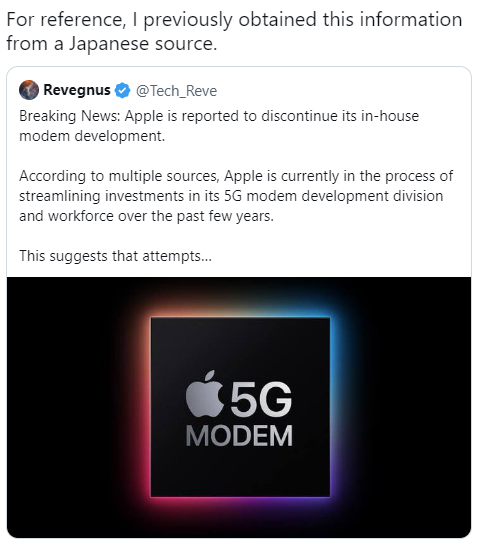
A post on South Korean online platform Naver claims that Apple is “reorganising its continued investments in its own 5G modem development department”, and has been doing so over the past few years. The post goes on to say that the project appears to have failed, and is expected to be “completely eliminated”.


The post does appear dubious on its own, but the claim has been corroborated by industry leakster @Tech_Reve via their own sources. This does somewhat reinforces the claim that the 5G modem integration into Apple silicon as quite thoroughly fallen through.

That being said though, there are currently more elements pointing to the opposite of these recent claims. For one, Apple has already signed a pretty expensive deal with Broadcom to make 5G components. Then there’s the initial deal of buying out the entire smartphone modem business from Intel back in 201

At any rate, considering the nature of this new claim’s source, it should be taken with a massive pinch of salt. Apple is stuck using 5G hardware from Qualcomm for at least another two years, and quite a lot can change in the meantime. Speaking of which, it would take more reports from more reputable sources corroborating these claims for them to be more likely.

Wednesday, November 1, 2023

“Scary Fast” Apple Event Shot On iPhone Included Lots Of Expensive Gear


Earlier yesterday morning, Apple held its “Scary Fast” event where it announced its new M3 family of processors, and MacBook Pros and iMacs powered by said chip. In true Apple fashion, the event also had the disclaimer that the entire event was “Shot on iPhone” which sounds amazing, until it was (unsurprisingly) revealed that the entirety of it was done with a ton of really, really expensive camera equipment.

If you’re wondering what iPhone Apple used to shoot the entire “Scary Fast” event, it’s the iPhone 15 Pro Max. It goes without saying that the end result of that shoot definitely looks impressive but again, a camera inside a phone is only as good as the resources thrown at it.


In Apple’s official behind-the-scenes video, the crew behind the entire process shows off a great deal of professional equipment that includes industrial-set studio lighting, high-end gimbals, dollies, as well as the drone because how else do you get that long, fast-moving close up shot of your CEO.

Needless to say, a lot of blood, sweat, and probably tears of virgins that went into the production process, but more importantly, it can also interpreted that the behind-the-scenes look of Apple’s “Scary Fast” event also sends an indirect message that, the iPhone 15 Pro Max used here is only one of several cogs in the machine and that, once again, a camera is only as good as the equipment it’s paired with.


For comparison’s sake, here’s another video shot with the iPhone 15 Pro, featuring Olivia Rodrigo albeit on a smaller scale because, as The Verge puts it: she’s no Tim Apple.

Tuesday, July 25, 2023

Google says Apple employee found a zero-day, but did not report it


Google fixed a zero-day in Chrome that was found by an Apple employee, according to comments in the official bug report. While the bug itself is not newsworthy, the circumstances of how this bug was found and reported to Google are, to say the least, peculiar.

According to a Google employee, the bug was originally found by an Apple employee who was participating in a Capture The Flag (CTF) hacking competition in March. But that Apple employee did not immediately report the bug, which at the time was a zero-day — meaning Google wasn’t aware of the bug and no patch had been issued yet. The bug was instead reported by someone else who also participated in the competition, didn’t actually find the bug themselves and wasn’t even on the team that found the bug.

“This issue was reported by sisu from CTF team HXP and discovered by a member of Apple Security Engineering and Architecture (SEAR) during HXP CTF 2022,” the Google employee wrote.

After this story first published, TechCrunch viewed a Discord channel where someone claiming to be the Apple employee who originally found the zero-day explained their side of the story, particularly the reason why they didn’t report the bug immediately, in response to Sisu, the person who reported the bug to Google.

“It took me 2 weeks working on it full time to root cause, write [the] exploit [Proof of Concept] and writeup the issue such that it can be fixed,” the person, who goes by Gallileo, wrote on July 6.

“It was reported on June 5th, through my company. Yes it was late, there are multiple reasons for that. I first had to find the person responsible, the report had to be signed off by people and then the person responsible was OOO. It’s commendable that chrome decided to fix it asap, but I think there wasn’t any real urgency. Only you and my team was aware of it and the issue is likely not that great in a real world scenario (doesn’t work on Android, pretty visible since it freezes the Chrome GUI for a few seconds),” Gallileo wrote.

Gallileo and Sisu did not respond to a request for comment.

Apple did not respond to a request for comment.

Google spokesperson Ed Fernandez told TechCrunch in an email that “our understanding is public in the bug.”

“We recommend reaching out to Apple for any further details,” Fernandez wrote.

It’s not uncommon for CTF teams and CTF players to find zero-days during competitions, especially in challenges of this type and competitions that are “high profile,” according to Filippo Cremonese, a researcher who participates in CTF competitions with the Italian team mhackeroni, which incidentally may be the best hacker team name ever.

What makes the story of this bug interesting is that it was apparently found by an Apple employee in a Google product, and — for some reason — that Apple employee decided not to report the bug at the time.

In the original report on March 26, the person who reported it said that the bug was found by someone on the team COPY during a CTF organized by the team HXP. The person, whose name is not disclosed in the report, said they decided to report it even if they didn’t find it themselves because they were “not 100% sure it was reported to the chromium team.”

“So I wanted to be safe,” the person wrote.

“Since you are the one disclosing this issue and there are no duplicates, it seems that the team that discovered this issue has chosen not to disclose it to us?” the Google employee wrote in another comment to the bug report.

The bug was fixed on March 29, according to the bug report. Google decided to award $10,000 as a bug bounty to the person who reported it, who, again, was not the one who found it.

UPDATE, July 20, 2:30 p.m. ET: This story was updated to include Discord messages posted by the person who claims to have found the bug originally.

UPDATE, July 24, 12:09 p.m. ET: Added clarification on twelfth paragraph.

UPDATE, July 24, 12:017 p.m. ET: On Friday, Sisu, who identified as Martin Radev, and is the person who first reported the bug to Google, published a timeline explaining his side of the story. Radev said that the Apple employee reported the bug in June. They also said they are in touch with the Apple employee to figure out what to do with the $10,000 bounty they received from Google. Radev wrote that “a donation is to be made.”
Tuesday, January 3, 2023

Apple A17 Chip May Prioritise Battery Life Over Power


TSMC has recently started mass producing chips using its new 3nm process. As is the case with ever smaller processes, this will lead to more efficient chips, which will likely be a benefit to the iPhone 15 family that Apple will inevitably release next year.

As Bloomberg reports, “TSMC says that its 3nm processes offer better performance than its 5nm chips, while requiring about 35% less power”. And while the performance part is about as vague as can be, the efficiency part is probably something to expect from what Apple will probably call the A17 Bionic chip for next year’s iPhone 15 range.


With that being said, the devices most likely to benefit from the improved power efficiency are the Pro versions of the iPhone 15. Presumably, Apple is keeping the Always-On display exclusive to these models. While their actual impact on battery life vary from user to user, these would likely be the devices that need the improved efficiency to counter the increased battery drain.

This year, with the iPhone 14 range, Apple also only gave its newest chip, the A16 Bionic, to the Pro models. If the company continues this trend, as well as giving only these versions the Always-On display, then the improved efficiency of the new chips would be exactly what the iPhone 15 Pro models need.


Overall it sounds like good news for the Pro models of the iPhone 15 that is expected to be announced late next year. Not only is it getting a new chip made with a new process, the chip also happens to tout efficiency as one of its main improvements. Though if Apple decided to maintain the difference between the base and Pro models of the iPhone 14 in the iPhone 15 range next year, it still gives the impression that the non-Pro models are being sidelined. Not only will they be having one less feature, but they will also be getting a year-old chipset by the time of release.

Monday, December 19, 2022

Apple Reportedly Plans To Launch Updated MacBook Pro Lineup In Early 2023


Apple is expected to launch several new MacBook Pros and other Mac products with updated internals next year, along with a few external monitors in the works. This comes as the company seems to be failing to meet its 2022 deadline of completely transitioning its lineup of products away from Intel to its in-house Apple Silicon.

Reliable Apple leaker, Bloomberg’s Mark Gurman, claims that Apple will launch updated 14-inch and 16-inch MacBook Pros early next year, offering the highly-anticipated M2 Pro and M2 Max chipsets. Reports from earlier this month also hint at the updated models getting faster LPDDR5X RAM that would provide more bandwidth and consume less power.


Apple still only sells an Intel-powered high-end version of the Mac mini but that will apparently change soon as the tech giant reportedly plans to replace it with an M2 Pro-powered offering. The Mac Pro is expected to receive its long-delayed Apple Silicon treatment with a high-powered chip that Gurman speculates will be the M2 Ultra.

The report claims that the M2 Ultra is set to be equipped with up to 24 CPU cores, 76 graphics cores, and will be able to be configured with up to a whopping 192GB of memory. A higher-end variant dubbed the M2 Extreme would have offered double the amount of CPU and GPU cores, but Gurman says that this was scrapped because of the cost and complexity of fusing four M2 Max chips together, which would have apparently priced the Mac Pro at a minimum of US$10000 (~RM44220).


In related news, the Cupertino-based company is purportedly working on several new external monitors as an update to the Pro Display XDR. Just like this year’s Studio Display, the new monitors will be powered by Apple Silicon to use fewer resources from the attached machine.

The US$2 trillion (~RM8.84 trillion) firm is predicted to shift its Mac Pro assembly from Texas to Vietnam. It was forced to do the assembly in the US after political pressure from the Trump administration but with the new government, Apple can move its production back to Asia.

Wednesday, December 14, 2022

Apple Might Finally Allow App Sideloading On iPhone

Apple is reportedly planning to allow alternative app stores and sideloading on iPhones, a major u-turn from the company’s long-standing policies. This is seen as the tech giant’s compliance with new European Union laws that are set to go into effect soon.

According to Bloomberg, engineers in the company are preparing to make Apple’s platform more open by finally allowing users to bypass the App Store when installing third-party software on their iPhones and iPads. This would allow them to avoid the company’s strict restrictions as well as the infamous 30% commission taken from developers on purchases.


The move is apparently a response to a new EU law titled the Digital Markets Act. The legislation will start being applicable in May 2023 but companies will have until early 2024 to actually comply. Companies that will be subjected to the law are those that have a valuation of at least EUR75 billion (~RM351 billion) and have a minimum of 45 million monthly users in the EU. Failure to comply could result in penalties amounting to 10% of a firm’s worldwide turnover and up to 20% for repeated infringements.

The act mandates that companies that fall under its purview allow the installation of third-party apps and allow users to change default settings with ease. Interestingly, it also requires messaging apps to work together, putting up the possibility of popular messaging services such as WhatsApp, Signal, and others becoming interoperable.


Apple has spent years lobbying against sideloading and third-party apps with senior vice president Craig Federighi calling the practice a floodgate for malware last year and more recently, CEO Tim Cook lamented sideloading’s damage to digital privacy. The firm has apparently not yet decided on whether or not to comply with the EU law’s provision allowing developers to install in-app third-party payment systems, something the Cupertino-based company has famously fought against.

While no country or region outside the EU has yet to enact similar legislation, it is unlikely that the system overhaul would be limited to just Europe. On a related note, another EU legislation will force Apple to use USB-C on iPhones, which the company has confirmed. That being said, it remains to be seen if the shift will apply to Apple devices sold worldwide in the near future.

Could This Be The First Look At Apple Store TRX?

There are five Apple Stores in Southeast Asia with three of them being in Singapore and two in Bangkok, Thailand. It goes without saying that Apple users felt a little bit left out and it has been rumoured for quite some time that an Apple Store will be opened in the Tun Razak Exchange (TRX) at Jalan Tun Razak, Kuala Lumpur.

According to the last major update regarding the rumour last April, it was estimated that Apple Store TRX could be opening its doors in 2022. As the year is going to end in less than three weeks with The Exchange TRX is not exactly ready for the public just yet, you can generally take that estimation out of the equation.


But, not the rumour itself though. As shown above, this particular image which claimed to be the first glimpse of Apple Store TRX has made its way to the Klang Valley Shopping Malls thread on the Skyscraper City forum. Unfortunately, the image has since been deleted although it has since spread like a wildfire.

The deletion may have strengthened its authenticity but it is still rather hard to verify whether the image was really taken at TRX since we were not able to see the view outside the scaffoldings. The resolution of the image is also not high enough for us to zoom in to check the logo on the safety jackets worn by the workers.

Naturally, we have also tried reverse search the image but didn’t receive any good results. So, do take this image with a grain of salt, if you must.


Meanwhile, the Project Director for The Exchange TRX, Mitch Wilson has recently stated that the area is currently scheduled to be open sometime in Q4 2023. The statement also noted that there will be more than 400 stores and 100 dining outlets throughout its four retail levels.

He also revealed some of the confirmed tenants which include Golden Screen Cinemas (GSC), a Seibu department store, and a supermarket by Hong Kong’s Dairy Farm Group. The Exchange TRX will also feature a 10-acre public park on its rooftop.

Monday, December 6, 2021

Apple MacBook Pro with M1 Pro and M1 Max Now Available For Malaysia

Aside from the 3rd generation AirPods, the new MacBook Pro (MBP) with M1 Pro and M1 Max processors are now available from Apple Malaysia’s website as well. All these products were first introduced during the company’s Unleashed event last month.

For those who missed the launch, the M1 Pro and M1 Max processors are available for both MBP 14 and 16. In terms of CPU, the M1 Pro is available with 8 and 10-core options which is also inclusive of 14 and 16-core GPU respectively, alongside up to 32GB of unified memory.


On another hand, the M1 Max comes with a 10-core CPU as standard while you can choose to obtain it with either 24 or 32-core GPU together with up to 64GB unified memory. In addition to that, the chip also has double the memory bandwidth of M1 Pro at 4000GB/s.

Meanwhile, other new elements that Apple has introduced through the latest MBP 14 and 16 are thinner screen bezels as well as a notch on their ProMotion 120Hz displays which houses the new 1080p FaceTime HD. These new models also marked the return of MagSafe charging, SDXC reader, and HDMI 2.0 port although the company has also decided to remove the Touch Bar.

Depending on the exact specs that you choose, the price of M1 Pro-based MBP starts at RM8,799 and can go all the way to RM21,999. As for the M1 Max variants, the price ranges from RM12,399 to RM25,199 and all of them can be obtained through Apple Malaysia’s website right away.

Saturday, November 27, 2021

Apple Reportedly Planning To Debut Its Self-Driving Car In 2025

It’s been a while since we heard anything substantial about Apple’s Project Titan electric vehicle, apart from a certain mishap back in September which involved one of its prototypes. Now, a new report by Bloomberg’s Mark Gurman claims to have acquired new information regarding the company’s first EV from people who are familiar with the matter.

As we’ve already covered when rumours regarding Project Titan first surfaced, Apple’s first EV is believed to be fully autonomous rather than a conventional one with semi-autonomous features. According to the insiders, new Project Titan lead Kevin Lynch insisted that the first model should be able to drive itself. 

Gurman’s latest report cites several sources supporting this particular tidbit, as well as the company’s aim to debut the vehicle in 2025. In regards to the latter, earlier rumours suggested that Apple originally envisioned to debut the car in 2024, but the plan was supposedly pushed back to sometime between 2025 and 2027.

Whether the company is able to meet the 2025 launch window for its EV mainly depends on whether it can complete its fully autonomous system on time, the insiders noted. Progress-wise, sources claim that Apple has supposedly finished much of the “core work” on the car’s processor.

Other than that, people familiar with the matter told Bloomberg that Apple plans to have its first EV to feature a lounge-like interior with a touchscreen infotainment system in the middle, but would lack a steering wheel or pedals. This further suggests that the vehicle would act as a fully-autonomous passenger shuttle rather than a standard car. In terms of safety, the sources added that the company intends to include a manual override mode in case of emergencies.


With four more years to go, it will definitely be a while until Apple is expected to officially announce or showcase its first ever EV. A fully autonomous system is indeed possible to an extent with current technology, but most of these rely on dedicated pathings with little to no interference or interaction with human-based traffic. That being said, it is not known whether the company’s vehicle is intended to be used on the road or for smaller-scaled use cases (such as in-campus transportation).

Friday, October 8, 2021

Apple up their repairability game


So now... no 3rd party can ever repair your phone cause even if they source genuine parts... your phone still brick..

only way to repair is to get their people to do it for you...

iPhone 13 pro max screen replacement cost $329 (RM1,374)... jia lat.... screen crack jer ....you have to pay 1/6 of your phone...

but wait... that is not alll....

your screen repair cost ain't gonna be the US $329 rate...

so far... they have not release iPhone 13 pro max screen replacement cost but since US charge the same for iPhone 13 pro max and iphone 12 pro max... it is safe to say the screen repair cost in Malaysia for iPhone 13 pro max would be the same with iPhone 12 pro max... which is RM1,899

Tuesday, October 5, 2021

Apple Reportedly Cancels Plan To Release iPad Air With OLED Display For 2022

Earlier in June this year, renowned analyst Ming-Chi Kuo reported that Apple would be updating certain 2022 iPad models with OLED displays, starting with the next-generation iPad Air. However, according to a recent investor note obtained by MacRumors, Kuo now says the company has allegedly decided to exclude the Air variant from receiving this upgrade.

Instead, it is said that the company will continue featuring LCD displays for next year’s iPad Air model. The analyst states that one reason behind this was due to costs as well as quality concerns, which did not meet Apple’s expectations. This also seemingly corroborates with a report by The Elec that was published back in late September, which suggests that Apple has called off a joint-project with Samsung to use an OLED display developed by the South Korean giant for a forthcoming iPad Air model.

Meanwhile, an earlier prediction of Kuo’s suggests that Apple is upgrading the 11-inch iPad Pro to feature a mini LED display – a tech that is already included in the current generation 12.9-inch Pro model. It is also mentioned in the investor note that Kuo claims Apple intends to have the new 11-inch model to be the “focus of [the] iPad line in 2022,” and concluded that releasing an OLED-equipped iPad Air would be detrimental to its potential sales.

While Kuo’s track record of predicting future Apple’s releases has been accurate to a certain degree, it is still advisable to take the information provided by the analyst with a pinch of salt. Whether his predictions are accurate or not will only be determined when Apple officially unveils its 2022 iPad line-up, which – as most of us are aware – is still far off.

Apple Watch Series 7 Receives General Release Date: Malaysia’s Status Still Unknown

Of all devices that were launched during the California Streaming event last month which also include iPhone 13 Series, iPhone 13 Pro Series, 6th generation iPad mini, and 9th generation iPad, there are still some mysterious elements regarding Apple Watch Series 7. For example, its actual rollout date was not revealed by Apple during the event but that has just changed this evening.

The company has announced that Series 7 will be made available in selected markets starting from 15 October onwards. Interesting enough, more than 50 countries and regions are part of the first-wave markets for the new smartwatch including the usual suspects such as the United States, United Kingdom, Japan, and China.


Despite the large group of first-wave markets, it seems that Malaysia is not part of it though as Apple Malaysia’s website still listed the Series 7’s availability as “later this year” at the time this article is published. As a comparison, Apple websites for Singapore and Thailand have noted that customers will be able to order Series 7 through them starting from 8 October.

On another hand, Series 7 is not listed on Apple’s websites for Indonesia and Vietnam. We are now reaching out to Apple to find out more about the watch’s availability in Malaysia and will keep you posted once we receive further updates.

Friday, October 1, 2021

Apple Slapped With Lawsuit Over Cracked M1 MacBook Displays

Apple has found itself in another legal wrangle, yet again, in the US. Earlier this week, Bursor and Fisher, a law firm based in California, filed a class-action lawsuit against the company from Cupertino, over reports of cracking M1 MacBook displays.

The law firm is specifically suing Apple for selling its M1 Macbooks even it knew that their product was being fitted with unreliable displays that could crack even under the most normal use cases. The lawsuit also takes its accusation further by suggesting that Apple used defective displays on purpose, as a means of getting unfortunate consumers to head over to its stores. Where it could charge them as much as US$850 (~RM3545), just to repair their affected M1 MacBooks.

Issues brought on by the cracked displays reportedly include blacking out, a light show of magenta, purple, and blue lines, or simply “ceasing to function” altogether. Moreover, it seems that replacing the cracked displays of the affected M1 MacBooks do not guarantee that the issue will not occur again, as some consumers who did repair their machines reportedly suffer repeat performance.


At the time of writing, Apple has yet to comment on the matter.

Tuesday, September 28, 2021

Apple Being Investigated Again By Brazil For Missing iPhone 13 Charger

Brazil’s Foundation for Consumer Protection and Defense (Procon-SP) has revealed that they’ve already started investigating Apple’s decision to once again sell the new iPhone without the charger, before it’s even started shipping in the country. The report by local publication TechTudo says that by 29 September, both Apple and Samsung will be notified for selling the charger separately from the iPhone 13, Galaxy Z Flip3, and Galaxy Z Fold3.

Apple already got in trouble with Procon-SP when it first decided to exclude the power brick from the iPhone 12, with the regulator fining the tech giant US$2 million (~RM8.3 million) earlier this year, which also included charges of misleading advertising and unfair terms. Even before they had taken action against the company, the regulator already concluded back in November that Apple’s move did not demonstrate environmental gain.


Procon-SP’s executive director Fernando Capez told TechTudo that it’s not legal to sell the phone and charger separately as “you can only charge the device with that power brick,” leading to customers being obligated to buy two products. Even though Apple already says on its website that the iPhone 13 doesn’t come with the charger in the box, he believes this is not enough – calling it “camouflaged information”.

Capez added that consumers already have an expectation of getting the charging brick with their smartphones and wants Apple to stamp the change on the packaging so that consumers are aware. For the record, while Samsung also followed Apple’s decision as well, the South Korean firm avoided a fine from Procon-SP by striking a deal to include a “gift” charger with Galaxy S21 pre-orders in Brazil.


The consumer protection regulator is looking into forming a class action to help any consumers who feel that Apple should give them a free charger, and advises consumers that for now, they should file a small claims suit in civil court. Apple did not give a response to TechTudo, though when the company was fined in March, they commented that “all iPhones sold in the country work with the available chargers, including third-party ones since they follow Anatel standards.”

Tuesday, September 14, 2021

Vimeo Now Supports Dolby Vision, But Only On Apple Devices

After adopting HDR10 in 2017, Vimeo has announced that the video-sharing platform now also supports Dolby Vision. There is a catch to this though: this feature is only available for Apple devices at the moment.

As you may know, not all Apple devices are able to support the proprietary HDR format. Among products that are compatible with the Dolby Vision includes iPhone 8 and newer, iPad Pro 2nd generation and above, certain Mac models, and the Apple TV 4K that is paired with a Dolby Vision-supported TV.

Works with both Safari web browser and Vimeo dedicated app, it will automatically detect and play videos in Dolby Vision on compatible devices. On another hand, incompatible products will receive the best visual format that matches them.

Within the Apple family, only iPhone 12, iPhone 12 mini, iPhone 12 Pro, and iPhone 12 Pro Max are able to capture Dolby Vision videos at the moment. Of course, one can also use Final Cut Pro to edit their HDR videos and then export them as Dolby Vision-compatible videos before uploading them to Vimeo.

For the full list of compatible devices as well as which ones can work with adapters and external monitors, you can check out Apple’s website.

Xiaomi Shows Off Physical Concept Of Vision Gran Turismo

At the very tail end of last month, Xiaomi unveiled the Vision Gran Turismo. The car was revealed as a digital hypercar, and one that’s made...