Showing posts with label A. Show all posts

Wednesday, November 29, 2023

Google Drive Files Gone Missing Due To a Bug In The Desktop App


Google Drive is one of the best cloud storage options available and is open to the public. However, according to a trending support thread on Google’s support forums, users have reported that some of their files have started to disappear from the service in recent months. Furthermore, since none of these files were deleted manually, they don’t appear in the platform’s recycling bin feature and thus cannot be recovered (so far).

Early on in the investigation, many speculated that the files vanished due to a hacker attack, but this isn’t the case. According to a thorough investigation, it has been concluded that the issue stems from the Google Drive app for desktop, which affects users regardless of whether their system is Windows or Mac. With that said, users on the browser variation of the service can rest easy.


It was also discovered that the bug would eliminate the data from the account, almost reverting the account back to a state before that data was made. Unfortunately, there’s no explanation for it so far, but Google has confirmed that this problem is related to a syncing issue seen in the recently rolled-out v84.0.0.0 through 84.0.4.0 of Drive.


Although this issue affects – as Google puts it – a “limited subset of Drive for desktop users,” it is recommended to backup all important files and documentation. Furthermore, the company has warned users to avoid disconnecting their Google account from the Drive on desktop, and that they should not tamper with the “DriveFS” folder that’s locally found on their machines in any way, shape, or form.

Tuesday, July 25, 2023

Google says Apple employee found a zero-day, but did not report it


Google fixed a zero-day in Chrome that was found by an Apple employee, according to comments in the official bug report. While the bug itself is not newsworthy, the circumstances of how this bug was found and reported to Google are, to say the least, peculiar.

According to a Google employee, the bug was originally found by an Apple employee who was participating in a Capture The Flag (CTF) hacking competition in March. But that Apple employee did not immediately report the bug, which at the time was a zero-day — meaning Google wasn’t aware of the bug and no patch had been issued yet. The bug was instead reported by someone else who also participated in the competition, didn’t actually find the bug themselves and wasn’t even on the team that found the bug.

“This issue was reported by sisu from CTF team HXP and discovered by a member of Apple Security Engineering and Architecture (SEAR) during HXP CTF 2022,” the Google employee wrote.

After this story first published, TechCrunch viewed a Discord channel where someone claiming to be the Apple employee who originally found the zero-day explained their side of the story, particularly the reason why they didn’t report the bug immediately, in response to Sisu, the person who reported the bug to Google.

“It took me 2 weeks working on it full time to root cause, write [the] exploit [Proof of Concept] and writeup the issue such that it can be fixed,” the person, who goes by Gallileo, wrote on July 6.

“It was reported on June 5th, through my company. Yes it was late, there are multiple reasons for that. I first had to find the person responsible, the report had to be signed off by people and then the person responsible was OOO. It’s commendable that chrome decided to fix it asap, but I think there wasn’t any real urgency. Only you and my team was aware of it and the issue is likely not that great in a real world scenario (doesn’t work on Android, pretty visible since it freezes the Chrome GUI for a few seconds),” Gallileo wrote.

Gallileo and Sisu did not respond to a request for comment.

Apple did not respond to a request for comment.

Google spokesperson Ed Fernandez told TechCrunch in an email that “our understanding is public in the bug.”

“We recommend reaching out to Apple for any further details,” Fernandez wrote.

It’s not uncommon for CTF teams and CTF players to find zero-days during competitions, especially in challenges of this type and competitions that are “high profile,” according to Filippo Cremonese, a researcher who participates in CTF competitions with the Italian team mhackeroni, which incidentally may be the best hacker team name ever.

What makes the story of this bug interesting is that it was apparently found by an Apple employee in a Google product, and — for some reason — that Apple employee decided not to report the bug at the time.

In the original report on March 26, the person who reported it said that the bug was found by someone on the team COPY during a CTF organized by the team HXP. The person, whose name is not disclosed in the report, said they decided to report it even if they didn’t find it themselves because they were “not 100% sure it was reported to the chromium team.”

“So I wanted to be safe,” the person wrote.

“Since you are the one disclosing this issue and there are no duplicates, it seems that the team that discovered this issue has chosen not to disclose it to us?” the Google employee wrote in another comment to the bug report.

The bug was fixed on March 29, according to the bug report. Google decided to award $10,000 as a bug bounty to the person who reported it, who, again, was not the one who found it.

UPDATE, July 20, 2:30 p.m. ET: This story was updated to include Discord messages posted by the person who claims to have found the bug originally.

UPDATE, July 24, 12:09 p.m. ET: Added clarification on twelfth paragraph.

UPDATE, July 24, 12:017 p.m. ET: On Friday, Sisu, who identified as Martin Radev, and is the person who first reported the bug to Google, published a timeline explaining his side of the story. Radev said that the Apple employee reported the bug in June. They also said they are in touch with the Apple employee to figure out what to do with the $10,000 bounty they received from Google. Radev wrote that “a donation is to be made.”


Friday, April 14, 2023

Thieves Discovered Using Hacking Tool Disguised As A JBL Portable Speaker To Steal Cars


A new form of carjacking has been discovered by UK-based automotive cybersecurity researcher Ian Tabor, which allows thieves to break into keyless vehicles using a special hacking tool to spoof the security system. One particular version of this device, he noted, could appear as a seemingly harmless portable speaker from JBL.

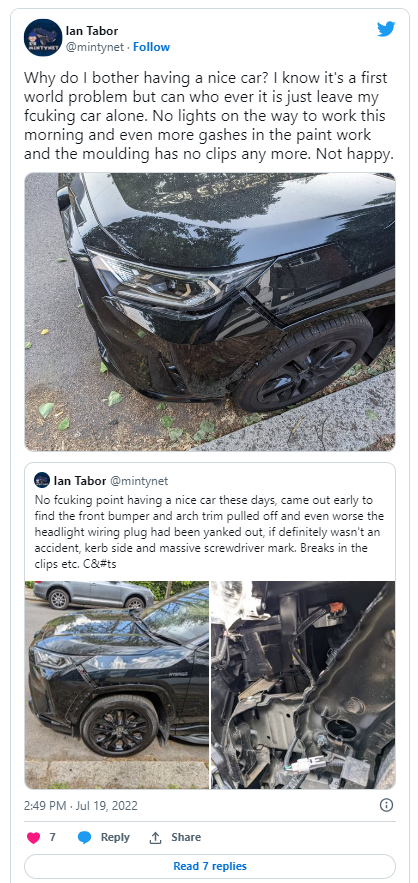
What led to Tabor researching the matter was actually caused by his own experience of losing his Toyota RAV4 last year. The first few attempts of the theft were even documented by the researcher on Twitter, where he assumed that these were merely acts of senseless vandalism on his car. More specifically, Tabor tweeted that vandals have torn off its front left-side bumper and partially dismantled the headlight not once but twice in three months. 


The third time, unfortunately, was the charm for the thieves as the RAV4 went missing a few days after the second attempt. This incident prompted Tabor to investigate how his car was stolen, together with fellow automotive security expert Dr. Ken Tindell. Their findings have been published as a detailed report via the latter’s Canis Automotive Labs blog on Github.

In their research, it is discovered that the carjackers are using a new and sophisticated approach called CAN (Controller Area Network) Injection, which exploits a newly found vulnerability in 2021 Toyota RAV4 vehicles dubbed as CVE-2023-29389. This particular flaw automatically trusts messages from other ECUs (electronic control units), allowing physically proximate attackers to drive a vehicle by accessing its CAN bus and then sending a forged key validation message. However, thieves are first required to pull away the bumper in order to expose the car’s headlight connector to access the ECU, hence the presumed vandalism attempts.


What’s even more concerning is that such methods, which have been documented on video by the way (shown above), would reportedly take only two minutes to break into keyless vehicles. Upon further digging on Youtube, crime forums and even the dark web, Tabor discovered that thieves have been using CAN Injection tools that are sold online as emergency start devices. These are originally intended for use by owners or automotive professionals when a car’s key fob is lost, stolen, or otherwise unavailable.

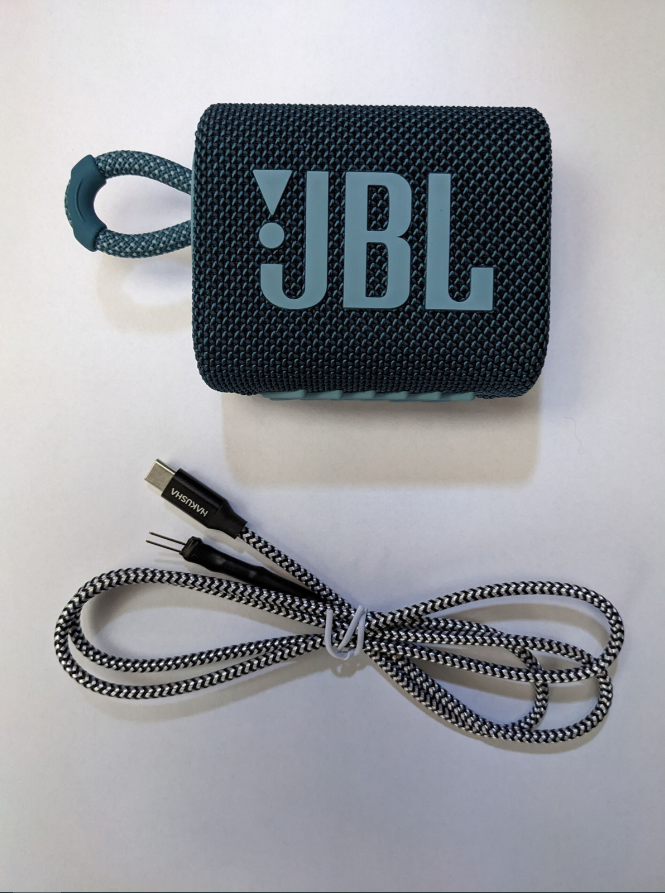
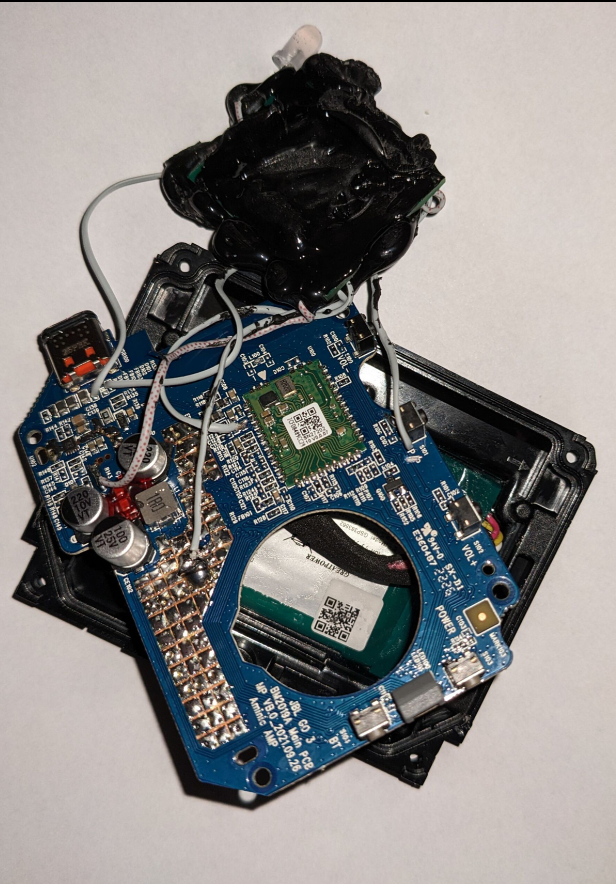
As mentioned earlier, one version of this hacking tool, which both security experts purchased for reverse engineering purposes, came in the form of a fake JBL portable speaker – a disguise that can easily fool any unsuspecting individual or authority if uninspected. Our own research has found that other similar tools are also available as generic key fobs and, of all things, a certain retro handset. Of course, we won’t link our discoveries here due to obvious reasons, and we do not condone the use of such equipment.


According to Tindell, pressing the play button on the fake JBL portable speaker will trigger it to send out a CAN message burst that instructs the targeted vehicle’s ECU to unlock its doors. Of course, with the car believing that the false key is valid, thieves are also given access to its Push Start function and are able to drive off.

While the attack was successfully replicated on a Toyota RAV4, it is still possible that something similar could occur on other vehicles using the same technology and architecture. Tabor and Tindell have alerted Toyota regarding the vulnerability, but have yet to receive any acknowledgement or response from the automaker.

Tuesday, February 21, 2023

Modder Transforms Portable Gas Stove Into A Small Form Factor PC


The PC Modding and custom-design casing community are nothing new at this point and safe to say, the stuff that comes out of the minds of some individuals are nothing short of creative feats. Recently, one PC modder showed how they were able to make a DIY PC by transforming a portable gas stove into a chassis.

The modder, Sunoshop, hails from Vietnam and originally shared the video of his portable gas stove custom PC on TikTok, but has since caught fire within the PC Master Race subreddit. If one were to dig a little deeper into the chassis thickness of the stove, one would find that it is around 120mm thick, with the encased space just nearly half that. For reference, the NVIDIA GeForce RTX 4090 Founders Edition is about half the overall thickness at 61mm, and it is unlikely that the chassis would accommodate the card’s PCB, length-wise.

 For that matter, you can especially see why the GPU slot within this portable gas stove PC remains empty; as fun as a project as this chassis may seem, the Sunoshop would have to dig deep and figure out how they would be able to cram a GPU into it.

Despite its lack of a GPU, that isn’t the point that defines this portable gas stove PC. To boot it up, the modder made it so that they’d have to turn the gas knob on the side, just as you normally would on such an appliance. Then, instead of bright blue flames in the centre, what you get is a ring of RBG, emanating from the PC fan that is built in the middle of the system.


As for where the canister for the portable gas stove would be, that space has been filled with the PC’s PSU. Then, just underneath where the hob lays is where all the PC internals lay, in all their RGB glory.

The only factors that remain a mystery to us are what components Sunoshop had used to build the portable gas stove PC. Even at a glance, our resident PC enthusiast can’t quite finger the chipset the build is based on. In fact, the only thing that could made out was that the SSD inside was definitely one from Kingston.

Whatever the case, this design sure beats the heck out of the KFConsole, at least in terms of creativity.

Thursday, December 15, 2022

TSMC Is Building A Second Fab In Arizona

TSMC, the Taiwan-based semiconductor manufacturer, recently provided an update regarding its status in Arizona, US. With the first fab set to begin production of the N4 process by 2024, it is now making plans to construct a second fab that will start production of the 3nm process by 2026.

TSMC says that the construction of the second fab will also provide jobs for more than 10000 construction workers, along with an additional 10000 high-paying high-tech jobs, 4500 of which will be direct jobs from the company itself. In total, the semiconductor company will also be investing around US$40 billion (~RM176 billion), making it the most significant foreign direct investment in the state’s history.


“When complete, TSMC Arizona aims to be the greenest semiconductor manufacturing facility in the United States producing the most advanced semiconductor process technology in the country, enabling next-generation high-performance and low-power computing products for years to come,” Dr. Mark Liu, TSMC Chairman, said. “We are thankful for the continued collaboration that has brought us here and is pleased to work with our partners in the United States to serve as a base for semiconductor innovation.”

Once completed, both of TSMC’s fabs will be able to manufacture over 600000 wafers per year, with an estimated end-product value of more than US$40 billion (~RM176 billion). The first fab itself, which went into construction back in 2020, will have a production capacity of 240000 wafers a year and is where not only the N4 process will be conducted, but also N4P and N4X.


The announcement marks a shift in the global manufacturing supply chain, due in no small part to the ongoing economic conflict between the US and China. Because of sanctions and restrictions put in place by both economic powerhouses, tech giants and manufacturers have had little or no choice but to shift their factories and manufacturing plants out of the latter country, TSMC being one such entity.

Of course, TSMC isn’t the only manufacturer and chipmaker to establish a presence in the US. Last year, Samsung announced that it would be opening a new semiconductor plant in the state of Texas, to the tune of US$17 billion (~RM75 billion).

Saturday, August 27, 2022

Quest VR Headsets To No Longer Require A Facebook Account For Login


Meta has recently announced that a Facebook account is no longer needed for Quest VR headset logins. Instead, owners are now required to create a new Meta account and a Meta Horizon profile in order to fully utilise the virtual reality headgear – both of which are currently being rolled out on a gradual basis across the globe.

As some may recall, this isn’t the first time Meta has shifted the login policy for its headsets. Prior to this, the company discontinued the original Oculus accounts in 2020, requiring users to log in to their Quest VR devices with a Facebook account instead. The move proved to be unpopular, with existing headset owners – those with and without an existing Facebook account –  raising privacy concerns due to the tech giant’s well-known (but infamous) track record on the subject.


This supposed U-turn may seem like an attempt to quell users of any fears related to the stigma that Meta possesses. However, all this does is raise even more eyebrows at best, as you’re still required to register with the company anyway – this time around with another account made directly under the brand itself, which is undeniably redundant.

Despite all this, Meta is adamant that this move is the best course of action moving forward. “Our new Meta account structure gives you more flexibility and control, letting you choose how you do and don’t show up—and whether Facebook and / or Instagram is part of your experience in VR and other surfaces where you use your Meta Horizon profile,” the social media conglomerate said in its recent blog post.


If you’re cool with this (not like we’re given much of a choice to begin with), you can create a new account through the Meta mobile app using an email address, Facebook account, or Instagram account. Once it is created, all that’s left is to set up a linked Meta Horizon social profile for your Quest VR headset. Additionally, you can also choose to remove your Facebook profile from your newly created Meta account afterwards.

Monday, July 25, 2022

Prodrive Racing Simulator Is A Custom PC Worth GBP39000

Racing sim games can be played on a standard gaming PC or console setup, but you can choose to go the more immersive route with a sim racing rig. But if you really want to take the sim racing experience to the next level, then you can look towards UK-based motorsports company Prodrive to provide you with that experience. The company has announced what it calls simply the Prodrive Racing Simulator.

From the announcement, Prodrive intends its Racing Simulator to be an expensive piece of furniture for your home. The company likens it to a grand piano that’s always sitting in the background, and that you’ll occasionally play, rather than something you hide away when not in use.


And it certainly looks the part, with the seat, screen, steering wheel and pedals sitting in the sculpted carbon monocoque housing that appears  to be “floating” within the birch canopy. This was cooked up by CALLUM, the design company with one of the founding members being Ian Callum, the name behind the look of cars like the Aston Martin DB7.


For its tech specs, the PC that powers the Prodrive Racing Simulator comes with an unspecified Nvidia GeForce RTX graphics card with 12GB of VRAM, as well as 16GB of RAM. The monitor that comes with it is an AOC 49-inch 5K curved screen with a 165Hz refresh rate. The steering wheel is a Precision SIM LM-PRO that has five rotary dials, 12 buttons and carbon fibre paddles to give you the race car experience.


With the look to emulate a grand piano in design, comes a similar price tag to the musical instrument. The Prodrive Racing Simulator comes with a price tag of GBP39000 (~RM208120). If you’re in the UK, you can even give it a try at the company’s Banbury headquarters before buying it.

Friday, November 5, 2021

Ghost of Tsushima Director’s Cut Review: More Narrative Greatness With A Touch Of Grit

You’re probably tired of hearing this from me, but Ghost of Tsushima is great. And it got even better when Sucker Punch Productions gave it a free multiplayer component. For the most part, that’s already a lot to give for a single game, and many were expecting the studio to work on a sequel. But then the company announced a Director’s Cut, which included the Iki Island expansion.

And to put it simply, the expansion is also great – for all the same reasons that made the base game so enjoyable. So let’s talk about that. Being built on an amazing foundation, the only remaining element was a new story to tell, and boy did Sucker Punch pull it off again.

Another setting, Another Mongol Invasion

Being the continuation of the main story in Ghost of Tsushima, the Director’s Cut expansion naturally kept the Mongol invasion as an important part of the story. Very early on, the story makes clear that the events of the Iki Island expansion happen some time after the main game. That, and there is a canon ending to the base game, which forces you to make a decision after the final duel. There is also what I see as a very minor retcon in the base game’s story in order to tell this one. Which is fine, because it wasn’t a major detail back in the base game.


Though this time, the game takes a sharper turn from the road that history has provided. Which is actually fine, because it’s sort of necessary for the story that the expansion is trying to tell. And the story is essentially one of Sakai Jin dealing with the ghost of his own past.

This time, the fictional invading force is an oddly specific Mongolian tribe led by the a Shaman known as the “Eagle”, Ankhsar Khatun. For context, Khatun is the female equivalent of Khan. As the plot progresses, she managed to poison Jin with a special drug that amplifies his darkest thoughts and suppressed memories. And it is through dealing with this poison that Jin faces his past, contemplates what he should or should not have done, and learns to deal with his choices at the end. Again, not the most original of stories, but with a past as grey as his, it makes for a compelling story all the same.


Of course, not everyone is as lucky, or mentally strong, as Jin. Many of the others on Iki Island were poisoned by the Eagle, and have subsequently irreparably lost their minds. And as Jin fights his inner demons, he also helps the locals fight off the Mongols so that this new threat does not take over the island, and move on not only to Tsushima, but the Japanese mainland as well.

Depicting The True Greyness Of The Warrior Class


The relative greyness throughout Jin’s past also reflects the greyness of the role of the samurai during that era. This makes it a far more realistic depiction of the warrior class of the time. Quite the contrast to the main game, which reinforces the stereotypical idealised version of bushido.

Without going into anymore detail, it’s safe to say that the samurai had to do some really nasty stuff in order to serve their lord, and act as peacekeepers. Honour in battle is certainly far from the focus this time around, and I’ll leave it there to avoid the risk of spoiling the story any further.

New Toys To Play With


There are also three new enemy types added to Ghost of Tsushima Director’s Cut. One, which you’ll be introduced to very early on, is the shaman, who makes nearby enemies more resilient to damage, and fights like a spearman up close. Another looks like your average grunt, but can swap between dual swords, sword and shield, and pole-arm at will, and even has a unique pole-arm move set. And the final one is a new brute with a double-bladed pole-arm, who is a lot faster than the others in its class. Enemies in general also can take more hits before going down. All that being said, this list looks to be exclusive to the Iki Island region.

On another note, one improvement that you can expect to be transferrable to the main game is more varied stealth assassination animations. Ditto a new chiburi sheathing animation that was previously exclusive to boss duels. That being said, it’s unclear if these are part of the Director’s Cut, or part of the overall improvements that Sucker Punch promised. What’s definitely a new addition thanks to the Director’s Cut is a new armour set with its own unique set of skills, which is a lot of fun and very overpowered if you have quick reflexes in combat. Your horse gets some love too, which comes in both practical and comedic flavours.

Iki The Animal Sanctuary


If you like animals, then the Iki Island expansion has a treat for you – mostly in the form of three more animal types that you can pet. Scattered around the new area are animal sanctuaries for the monkey, deer and cat. The expansion adds a new limited gameplay mechanic that allows a more active use of your flute in these sanctuaries. Play them well, and the animals will calm down enough to trust you and let you pet them. They appear throughout the expanded area, but you can only pet them in their respective sanctuaries.

This is still quite the major improvement over the foxes in the main game. Beyond a single quest in Act II, the only time foxes appear are near their dens, from which they lead you to the nearest fox shrine. You can also only pet them once, if you see them after praying to said shrines. Beyond that, the foxes of Tsushima appear to completely vanish from the island. And unlike the foxes, as long as you return to the sanctuaries on Iki, you can pet the animals as often as you like.

PS5 Exclusive Features Not A Must, With One Exception

Having reviewed the Director’s Cut on a PS5, I’ll say that the improvements on this version of the game are mostly unimportant. Sure, you get constant 60fps gameplay rather than 30fps, but the DualSense features like haptic feedback and adaptive triggers are not really all that big an improvement. This is especially the case for the latter, which was a little disappointing after having experienced what Insomniac did with Ratchet & Clank: Rift Apart.


All that being said, if you want Japanese lip sync, then unfortunately the PS5 version is a must. It’s a strange thing to be locked behind the latest-generation console. I don’t know if this is a hardware limitation, and I have a hard time believing that it is the case, but here we are. Translations are still whack, with some names translated completely differently. But since these are remnants of the base game, there isn’t much that can be done there short of overhauling the text of from it.

Conclusion


If you can’t get enough of Ghost of Tsushima, then the Director’s Cut is for you. Since it’s built on the bones of such a brilliant game, there’s little that can go wrong. And thankfully, not only did nothing go wrong, but we got another compelling, albeit shorter story experience to continue where the base game left off.

In terms of landmass, the in-game version of the Iki Island is about a third of Tsushima. Though in terms of actual story, it feels a lot more than just a third of the main game. Because of this, the story feels faster – and better – paced. And because of the smaller landmass you can wrap things up pretty quickly. This includes all the side quests, challenges and collectibles, simply because there’s less traversing in between.

For this review, I’ve done almost all there is to do in slightly over 12 hours. Your experience may be quicker if you forgo the collectibles, and play on a difficulty that’s lower than Lethal+. Though that being said, I feel the desire to finish my current playthrough and go for a third one, this time completing the game in canonical order, while making use of the new toys for more of the base game. You don’t have to do that, because in an update quite late into the review cycle, Sucker Punch has added the ability to replay boss duels and outpost captures.


But for all the praise I pile onto this, I must reiterate one criticism. And that’s the fact that Japanese lip sync is locked behind the PS5 version. As I mentioned before, I can live without the DualSense improvements. I can also live without 60fps gameplay, although having it is certainly nice. But by far the one thing that drastically improved my enjoyment of the game is the Japanese lip sync. And it really feels unfair for those who don’t have the console but want to experience Ghost of Tsushima Director’s Cut at its best state, narratively speaking.

If you’ve never experienced Ghost of Tsushima, definitely jump into the PS5 version of the Director’s Cut. If you don’t yet have the console, then I would say you wait until after you get it. For those who have experienced the base game, I’d say that the new elements and replayabllity makes it worth its asking price, regardless of if you’re upgrading to the PS4 or PS5 versions.

Sunday, October 31, 2021

Grand Theft Auto Trilogy Remaster May Have A 7 December Physical Release

Rockstar Games confirmed that the Grand Theft Auto Trilogy Remaster is real. While no dates were mentioned, it will probably be coming some time this year. And it looks like it will have a physical release for previous generation consoles, and the Nintendo Switch, coming in December.

Polish outlet PPE cites retail sources as saying that the Grand Theft Auto Trilogy Remaster will get physical copies for the PS4, Xbox One and Nintendo Switch. These will be available on 7 December. The PS5, as well as Xbox Series X and S, will also be getting physical editions, but later in 2022.

The dates of the physical editions may be an indication of the general release date for the trilogy remaster. That being said, video games leaker Tom Henderson has claimed that the title is scheduled for release on 11 November instead. While it’s not impossible that physical and digital versions of the same game launch on different days, it’s always strange when it happens.

On a related note, VGC reports that retailer Base.com had listed the trilogy remaster as being priced at US$70 (~RM292) for current-gen consoles, and US$60 (~RM250) for previous-gen machines. The listing has since been removed, but they can just as much be placeholder prices as they can be real ones.

Official confirmation from Rockstar as to if any of these numbers are accurate is also said to be coming on 22 October, the 20th anniversary of GTA3. So we may be a short 10 days away from from finding out for sure.

Xiaomi Shows Off Physical Concept Of Vision Gran Turismo

At the very tail end of last month, Xiaomi unveiled the Vision Gran Turismo. The car was revealed as a digital hypercar, and one that’s made...