Showing posts with label Survey. Show all posts

Saturday, June 19, 2021

Survey: Half Of Malaysian Gen Z, Millennials Will Be Frequent Augmented Reality Users By 2025

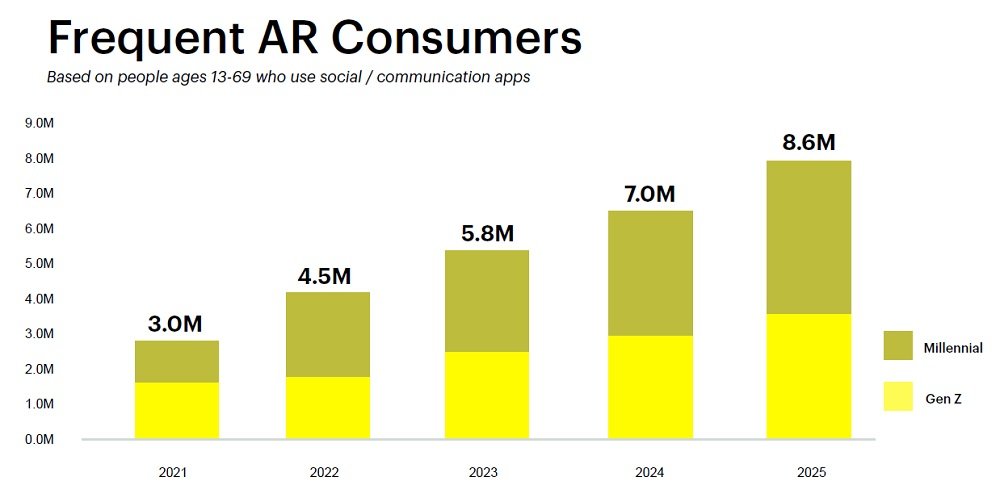
Deloitte Digital and Snap Inc., the developer of Snapchat, have produced a report estimating that half of Malaysian Gen Z-ers and millennials will be frequent augmented reality (AR) users by 2025.

As of 2021, the report found that approximately 3 million Gen Z-ers and millennials are frequent AR users, as in people who use AR weekly or daily. That figure is expected to grow by a whopping 187% to 8.6 million in 2025.

The report also revealed a shift in AR use towards utility as opposed to the playful videos that AR has been long known for. Today, 64% of Malaysian consumers on Snapchat use AR primarily at home for activities like communication (98%), media and entertainment (81%), gaming (79%), and shopping (67%).

Nine in ten Malaysians believe that AR will be even more important in their lives in the next five years. When asked what they expect to use AR for in the future, utility was put front and centre, with most Malaysians wishing to use the technology to help them stay connected with others, learn something new, and improve productivity levels.

The survey / report had 15,000 respondents from around the world, including Malaysia, with about half of which use Snapchat.

It’s no surprise why Snapchat is going all-in on AR since it plays such an outsized and even definitive role on the platform. Last month, the messaging app revealed the latest generation of its Spectacles which is specially designed for AR.

Wednesday, June 9, 2021

Survey: Most Europeans Favour Replacing Lawmakers With Artificial Intelligence


Terrible news for humanity but great news for Skynet: A survey has found that 51% of Europeans would reduce the number of lawmakers in their respective parliaments and hand those seats to an artificial intelligence (AI) that would have access to their data.

According to CNBC, the survey was conducted by IE University’s Center for the Governance of Change and had 2,769 respondents from 11 countries across the world. IE University itself is based in Spain.

Oscar Jonsson, one of the researchers behind the study, told CNBC, “Everyone’s perception is that that politics is getting worse and obviously politicians are being blamed so I think it (the report) captures the general zeitgeist.”


He noted the decades-long decline of belief in democracy as a system of government. Replacing lawmakers with AI was particularly popular in Spain, where 66% of respondents favoured the idea.

On the flip side, 69% of people surveyed in the UK opposed it along with 60% of Americans and 54% of Germans. In an awkward sign for the ruling Chinese Communist Party, roughly 75% of the respondents in China supported the idea.

There’s a notable generation gap too. Most Europeans aged 25 to 44 supported the idea, while a majority of those aged above 55 rejected it.

Friday, May 7, 2021

Survey Shows Southeast Asian Social Media Users Don’t Want Their Financial Info Stored Online

A whopping 76% of social media users said they would choose not to store their financial information online, according to a Kaspersky-YouGov survey of several Southeast Asian countries, including Malaysia.

But there are notable gaps between generations. Baby Boomers (85%) show the highest resistance against having their financial data stored online, followed by Gen X (81%), Millennials (75%), and finally Gen Z (68%). It’s possible that this reflects young people’s greater openness to fintech innovations like e-wallets.

In general, social media users in the region don’t want their personally identifiable information (69%), family information (64%), and current location (54%) stored online. But only 47% would choose not to have their job details stored online – probably because of the widespread use of employment and professional networking websites.


“It is a welcome insight that users here are now thinking thoroughly about the data they share and don’t share online. Most also know now that cybercriminals and the general online public should never get their hands on such information. Awareness, however, does not necessarily equate to action,” said Kaspersky Managing Director for Asia Pacific Chris Connell.

Just 54% of Southeast Asian social media users check and change the privacy settings of devices, apps, or services they use, and very unsurprisingly, only 47% avoid illegal or pirated software and applications.

All respondents in the survey, which was conducted last November, were working professionals active on social media. Aside from Malaysia, the other Southeast Asian countries included in the survey were the Philippines, Singapore, and Vietnam.

Sunday, May 2, 2021

Survey: 70 Percent Of Malaysian Employers Would Make COVID-19 Vaccination Compulsory

A survey of over 1,000 Malaysian employers and employees found that 70% of the former would make COVID-19 vaccination compulsory for all their staff. In contrast, only 33% of employers in Australia, 33% in the United Kingdom, and 35% in New Zealand would require their staff to vaccinate.

Malaysian employees appear too happy to oblige. The survey by Employment Hero found that 76% of them agreed to take the vaccine and only 7% said they would refuse.

Still, most of those surveyed are unsure when they’ll be able to work from their offices again. Only 29% of Malaysian employees and 31% of Malaysian employers are expecting to return to the office in the next six months.

Because of that, some employers are considering adjustments to their operations. 32% of Malaysian employers foresee that their teams would continue working remotely or flexibly, and just as many said they would allow more geographic and work hour flexibility.


Unsurprisingly, as the COVID-19 pandemic rages on, stress levels among Malaysian employees (61%) and employers (58%) have increased, but many employees (47%) aren’t comfortable discussing their mental health with their superiors.

“The mental-health fallout of COVID-19 in the workforce needs more attention. The workplace is an important environment to discuss mental health, but because of the stigma attached to it and the fear of job losses, many people are continuing to suffer in silence,” said Employment Hero CEO and co-founder Ben Thompson.

The survey was conducted in March 2021, aiming to understand how the COVID-19 pandemic has affected employers and employees across the world.

Wednesday, March 31, 2021

US-UK Survey Finds That 30% Of WFH Workers Wore Pyjamas In Online Meetings


Nearly one-third (30%) of people working from home have worn pyjamas during online meetings, the Evening Standard said citing a YouGov survey which polled both US and UK workers. One in ten (11%) didn’t even bother to wear pants.

The survey, which was commissioned by AI-powered transcription app Otter.ai, also found that, during meetings, 23% of remote workers had shopped online, and 15% had played computer games.

Unsurprisingly, there’s a good deal of resistance against returning to traditional in-office work. Only 14% wanted to return to the office full-time when it’s safe to do so. A full 20% don’t want to return to the office – ever.


But a good plurality prefers a middle ground. 45% want to work between one and three days per week in the office once it becomes safe to do so. Why? It’s obvious. 43% of remote workers miss office conversations and chatter – the top item picked by people when asked what they missed about the office.

As for the top reasons why people want to continue working from home at least part-time, 51% picked to avoid the commute to the office and 34% flexible working hours. 26% said they were more productive working from home.

Conducted in January this year, the survey had 2,027 respondents roughly split between US and UK remote workers. In Malaysia, the government is proposing legal changes to support the work from home culture and promote flexible working arrangements, The Star said.

Tuesday, March 30, 2021

Battlefield 6 Survey Hints At Free-To-Play Mode, Battle Pass


If there was any indication of what we can expect in Battlefield 6, this may very well be a list of them. Leaker Tom Henderson has said on Twitter that publisher Electronic Arts has sent out surveys to players. And these ask if they are keen on seeing a number of features in the next Battlefield game.

Among the items in the list include things like “a F2P element” and Battle Passes. While we already see these in other games, it looks like Battlefield 6 will be embracing them as well. These are among other items like evolving maps and weapon blueprints, as well as a clan system.

Despite being a survey for what players want to see in Battlefield 6, chances are players won’t actually get much of a choice. Henderson also says that it’s most likely that the listed features have already been developed. Instead, interest in the items will determine which are marketed more actively. Unpopular items may get announced later, rather than immediately when the game gets announced.

It’s an odd way to do things, but at the same time it makes some sense. VGC reports that Battlefield 6 may be due for a reveal in as early as May 2021. If that’s the case, it seems way too late to ask about which features to be implemented into the game. While it may be announced early, it will likely be available during its usual year-end window.

Monday, March 15, 2021

Kaspersky Lab Survey: Over Half Of Cybersecurity Professionals Not Allowed To Share Findings


A survey by Kaspersky Lab found that over half (52%) of IT and cybersecurity professionals are barred by company rules from sharing their findings with outsiders. This may have major cybersecurity implications and in many ways, preventing hacks, discovering vulnerabilities, and securing systems are all harder to do if professionals aren’t exchanging knowledge.

Worryingly, the survey also pointed out that only 44% of respondents have actually made their discoveries public. In companies where external sharing is allowed, 77% of cybersecurity analysts did so. But when it isn’t allowed, only 8% did – presumably in a clandestine manner and at the risk of being terminated.

Kaspersky experts noted that company-mandated secrecy is driven by worries that cybercriminals may react and adapt if they know they’ve been detected. Sergey Soldatov, head of Kaspersky Lab’s Security Operations Center, emphasised the need for balance.


“Any information about a threat will help your peers to investigate an attack and plan an effective response,” he said, but added, “until you know whether a response’s actions will be successful or not, you can’t reveal that a company is doing something, since attackers will easily understand that they were detected and go underground.”

The results from the survey which is titled IT Security Economics 2020 were based on correspondence with over 5,200 IT professionals across 31 countries in June 2020. The final report is rather long but if you want to have a go with it yourself, check out Kaspersky Lab’s blog right here.

Saturday, January 16, 2021

Snapchat Survey: 44 Percent Of Malaysians Don’t See 2021 As A “Fresh Start”


Snap Inc. said today that its multi-country survey of Snapchatters found that 44% of Malaysian users didn’t view the beginning of 2021 as a “fresh start.” Still, the remaining 56% saw 2021 as an opportunity for a new beginning. On a separate question, just over half of Malaysian users are looking forward to COVID-19 vaccine.

Conducted at the tail end of 2020 through the beginning of this year, the survey also found that 58% of Malaysian Snapchatters were making New Year resolutions, with wellness being their top priority. 71% said they planned to exercise more, and 63% to eat healthier, notably ahead of respondents from all of the other countries surveyed.

With vaccination being the talk of the town now, 53% of Malaysian Snapchatters said they were looking forward to the vaccine. It should be said that this puts Malaysia (at least its Snapchat users) just a point ahead of the United States (52%) and a few points behind the UK (56%) – a far cry from Brazil (86%) and India (77%).

That being said, the Malaysian Ministry of Health recently released the results of an online survey showing that the majority of Malaysians are receptive towards COVID-19 vaccine. Many Malaysians’ apparent pessimism over 2021 is not surprising, however.

An Ipsos survey conducted late last year found that 70% of Malaysians agreed with the statement “There will be a new global pandemic caused by a new virus.” A new virus hasn’t emerged (yet), but since most of the country is now under varying forms of a fresh MCO, can you blame many Malaysians for feeling a little blue?

The Snapchat survey was conducted from 20 December 2020 until 4 January 2021, and involved over 7,300 respondents across 17 countries, including Malaysia.

Xiaomi Shows Off Physical Concept Of Vision Gran Turismo

At the very tail end of last month, Xiaomi unveiled the Vision Gran Turismo. The car was revealed as a digital hypercar, and one that’s made...