Showing posts with label Over. Show all posts

Tuesday, February 21, 2023

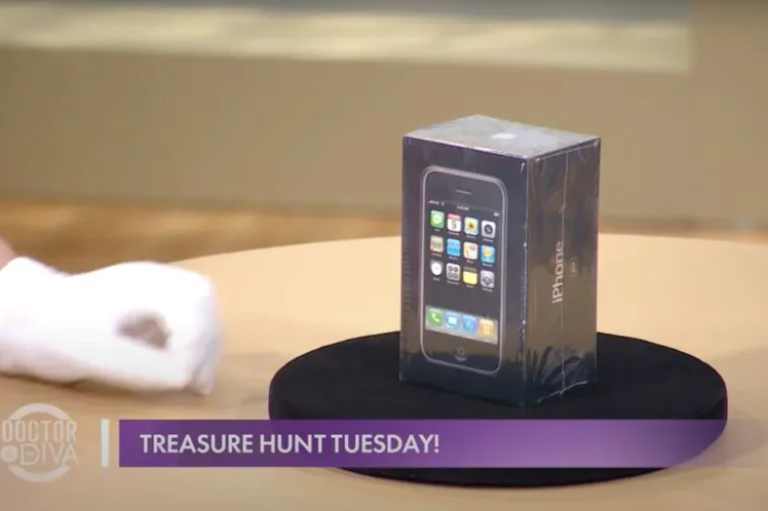
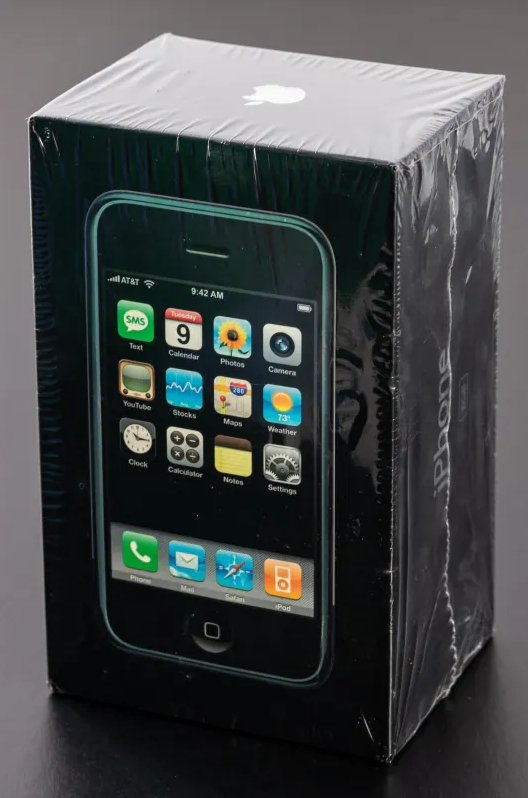
Sealed Original iPhone Gets Auctioned For Over US$63000


Phones are getting more and more expensive as the years go by, and among the brands most guilty of this include Apple and its iPhones. There’s a very fair chance that you’ll be right in thinking that the iPhone 15 series coming out at the end of the year will be more expensive than ever. But whatever that price may be, it will still be dwarfed by the price that the first ever iPhone just went for in a recent auction.

The still factory-sealed first-generation iPhone was put up for auction with LCG Auctions earlier in the month, with the auction itself having ended over the weekend. It had a starting price of US$2500 (~RM11080), which is already a ridiculous price to pay for any phone, never mind one that’s 16 years old. But by the end of the auction, it went for US$63356.40 (~RM280796), including a “buyer’s premium”.


There’s also an interesting story to go with this relic from the earlier days of the second millennium. This still sealed first iPhone was owned by one Karen Green, who got the iPhone as a gift, according to a linked Business Insider article. As for why the phone remained sealed, this was because it wasn’t something that Green could use anyway. iPhones of the time were only compatible with the telco AT&T in the US, while Green already had three phone lines with another telco, Verizon.

An old relic of the past like the original iPhone selling for such a huge sum of money is pretty incredible on its own. But what makes it more so is the fact that it’s not the only one in recent times. Just last October, another sealed iPhone was auctioned off to the tune of US$40000 (~RM177280). Indeed, Green intended to hold on to hers for awhile longer to let its value bloat up even further, but decided to sell it to fund a business she’s running.

Tuesday, January 3, 2023

Apple A17 Chip May Prioritise Battery Life Over Power


TSMC has recently started mass producing chips using its new 3nm process. As is the case with ever smaller processes, this will lead to more efficient chips, which will likely be a benefit to the iPhone 15 family that Apple will inevitably release next year.

As Bloomberg reports, “TSMC says that its 3nm processes offer better performance than its 5nm chips, while requiring about 35% less power”. And while the performance part is about as vague as can be, the efficiency part is probably something to expect from what Apple will probably call the A17 Bionic chip for next year’s iPhone 15 range.


With that being said, the devices most likely to benefit from the improved power efficiency are the Pro versions of the iPhone 15. Presumably, Apple is keeping the Always-On display exclusive to these models. While their actual impact on battery life vary from user to user, these would likely be the devices that need the improved efficiency to counter the increased battery drain.

This year, with the iPhone 14 range, Apple also only gave its newest chip, the A16 Bionic, to the Pro models. If the company continues this trend, as well as giving only these versions the Always-On display, then the improved efficiency of the new chips would be exactly what the iPhone 15 Pro models need.


Overall it sounds like good news for the Pro models of the iPhone 15 that is expected to be announced late next year. Not only is it getting a new chip made with a new process, the chip also happens to tout efficiency as one of its main improvements. Though if Apple decided to maintain the difference between the base and Pro models of the iPhone 14 in the iPhone 15 range next year, it still gives the impression that the non-Pro models are being sidelined. Not only will they be having one less feature, but they will also be getting a year-old chipset by the time of release.

Saturday, December 17, 2022

US Court Charges Eight “Influencers” Over 12 Fraud Cases Worth US$114 Million


Eight individuals who portrayed themselves as social media influencers in the US were recently charged with 12 counts of fraud by the US Department of Justice (DOJ) and Securities and Exchange Commission (SEC). The suspects and scammer group are said to have conspired to run a pump-and-dump scheme, where they would target companies and purchase thousands of dollars in stock, and then scam people by selling them as “hot tickets” on their respective social media accounts.

Collectively, the 8-member scammer group had around 1.5 million followers on Twitter, but they also had a server on Discord called “Atlas Trading”. In order to lend credibility to their schemes, the group also claimed to be Wall Street experts on a trading podcast called “Pennies: Going in Raw”, hosted by two of the scammer group’s cohorts, Daniel Knight and Mitchell Hennessey.


It should be noted that the scammer group believed that their conversations on Discord were private, but investigators had reportedly recorded their discussions or retrieved transcripts of them. Naturally, it doesn’t help their case that the documents contain really damning statements, several of which have members of the group outrightly acknowledging that what they’re doing could and will get them into hot water with the law.

One member of the scammer group, Knight, practically admitted that what his group did was akin to robbing folks; during a Discord chat, when the participants were discussing targetting a company called GTT Communications and buying its stocks “in the right way”, Knight simply responded with the followed reply:

“The f**king right way? We’re robbing f**king idiots of their money.”

Both the US DOJ and SEC state that in the two years that the scammer group was in business, it collected more that US$114 million (~RM502 million) in profits, in small increments over the period. As an example of how that works: the group bought over 300000 shares in GTT Communications at US$1.76 (~RM7.76) per share. Following their purchase, it would then dump all the shares at US$1.99 (~RM8.77) after misleading its followers by claiming that they were on the verge of “something big”.

All eight members of the scammer group now stand accused of 11 counts of securities fraud and one count of conspiracy to commit securities fraud by the DOJ. Each count carries a life sentence, which is 25 years in the US. That means if they are found guilty on all counts, they’ll be in jail for nearly 300 years. Mind you, that’s just the criminal indictments; the SEC has its own issues against the group as well, and the government body could strip away the group’s ill-gotten gains, as well as impose additional financial penalties too.

Monday, July 25, 2022

Full NVIDIA AD102 GPU Allegedly Runs Control At Over 160 FPS In 4K

A recent leak about a full-fat NVIDIA AD102 Ada Lovelace GPU suggests that the top-tier GPU can and will run rings around the current king-of-the-hill, the GeForce RTX 3090. How fast is the card, you ask? Apparently, it can run Remedy’s Control at 4K resolution and above the 100 fps mark.

Now, to be clear, this rumour about the AD102 isn’t to be confused with the non-Ti variant of the supposed RTX 4090 that has been making its rounds online. By comparison, the full-fat AD102 GPU ships out with as many as 18432 CUDA cores, which is approximately 12% more CUDA cores than what the RTX 4090 is expected to ship out with.

Getting back on point, and according to a Twitter user that goes by the handle AGF (@XpeaGPU), the AD102 GPU was able to run the game Control at 4K resolution, with the framerates sustaining themselves beyond the 160 fps mark. Further, those framerates were also achieved with ray-tracing and DLSS enabled, but not without its own set of drawbacks. In order to achieves those numbers, the GPU was also reported to have pulled more than 800W off the wall.

By comparison, the RTX 3090 at the same resolution and ray-tracing parametres turned on would yield approximately half the number of frames. With our RTX 3090 Founders Edition, our framerate in-game hovered between 60 and 74 fps.

The arrival of this AD102 rumour is interesting, given that just yesterday, we posted a report about another rumour regarding the RTX 4090 and how it is expected to be nearly 70% faster than the RTX 3090. However, those performance numbers were supposedly pulled off an as-of-yet unconfirmed 3DMark Time Spy Extreme benchmark and as such, should be treated with the usual consumption of salt.

For another matter, there are other missing variable that can render claims about the AD102’s prowess unreliable at this point. For starters, the source doesn’t specify the exact game settings the GPU was running Control with, nor did they say if the Lovelace GPU is actually using a new generation of Tensor Cores. Much like Ampere and its 2nd generation Tensor Cores.

Second, there aren’t any additional details about the AD102’s specs, not even its TDP or clockspeeds.
Friday, October 1, 2021

Apple Slapped With Lawsuit Over Cracked M1 MacBook Displays

Apple has found itself in another legal wrangle, yet again, in the US. Earlier this week, Bursor and Fisher, a law firm based in California, filed a class-action lawsuit against the company from Cupertino, over reports of cracking M1 MacBook displays.

The law firm is specifically suing Apple for selling its M1 Macbooks even it knew that their product was being fitted with unreliable displays that could crack even under the most normal use cases. The lawsuit also takes its accusation further by suggesting that Apple used defective displays on purpose, as a means of getting unfortunate consumers to head over to its stores. Where it could charge them as much as US$850 (~RM3545), just to repair their affected M1 MacBooks.

Issues brought on by the cracked displays reportedly include blacking out, a light show of magenta, purple, and blue lines, or simply “ceasing to function” altogether. Moreover, it seems that replacing the cracked displays of the affected M1 MacBooks do not guarantee that the issue will not occur again, as some consumers who did repair their machines reportedly suffer repeat performance.


At the time of writing, Apple has yet to comment on the matter.

Tuesday, September 14, 2021

South Korea Fines Google KRW207.4 Billion Over Android Dominance Abuse

South Korea recently passed its Anti-Google Law, which goes into effect today, 14 September 2021. Tangentially related is another fine the country is laying on the internet search giant which amounts to KRW207.4 billion (~RM735 million). This is allegedly because of the company’s abuse of the dominance of its Android mobile operating system.

The Korea Fair Trade Commission said that Google’s anti-fragmentation agreements (AFA) with phone makers prevents them from developing or using modified versions of Android. In addition to the fine, the commission also banned Google from making manufacturers sign new AFA contracts, and making it modify existing ones.


These moves are reportedly intended to spur competition by letting companies create more forks of Android. This then would allow each brand to modify the mobile OS to “target different device classes or use cases” without Google retaliating. Google, naturally, will be appealing the decision, saying that the ruling “will undermine the advantages enjoyed by consumers”.

All things considered though, it remains to be seen if this is really enough for there to be any real change to the status quo, at least on the mobile phone front. Things may be different on the smart TV or wearable sides of the market.

Wednesday, September 8, 2021

ProtonMail Caught Handing Over IP Address Of French Activist To Swiss Authorities

ProtonMail, an email provider that champions privacy through it’s end-to-end encrypted service, is under heavy criticism after a police report was uncovered showing that they had provided French authorities with the IP address of a French climate activist, leading to their arrest. While ProtonMail does not need to comply with French or EU laws, the Switzerland-based company must comply with the Swiss courts; and so, French authorities went through the Swiss police to get a court order.

Andy Yen, Proton Technologies CEO, came out with a statement that the company had no choice but to comply with the legally binding order as they are obligated to follow local laws. Under its own transparency report, they state that they are legally bound to log IP addresses “in extreme criminal cases,” such as when an account is suspected to be involved in criminal activity. “There was no possibility to appeal this particular request,” he said.

Andy added that their encryption be bypassed, meaning they, and therefore the authorities, have no access to the contents of users’ emails. “We do not know the identity of our users, and at no point were we aware that the targeted users were climate activists,” said the CEO. While Swiss law requires users to be notified of any requests for their data, ProtonMail notes that “in certain circumstances,” a notification “can be delayed.”


The data request was part of an investigation into a group of climate activists that protested against gentrification by occupying commercial locations and apartments near Paris’ Place Sainte Marthe. While it started as a local effort, it quickly grew into a national movement. On 1 September, the group published an article on an anti-capitalist news site that French police had contacted the Swiss authorities through Europol to uncover the owner of their ProtonMail account.

Proton reports that in 2020, it received 3572 orders for user information, contested 750 orders, and complied with 3017 requests. That number is more than double the number of requests from the Swiss authorities on behalf of foreign governments from the previous year, meaning that Swiss courts are issuing orders that violate privacy at an alarming rate. Amidst this worrying case, Andy Yen encourages its users to use Tor or ProtonVPN, as Swiss law does not touch on IP logging for VPNs.

Thursday, July 22, 2021

Apple To Allow iOS, iPadOS Apps To Use Over 5GB RAM


Apple mobile devices back in the day never had a lot of RAM. And it never needed them, considering that the mobile OS are so optimised. But as newer devices come with more, a strange limitation of iOS and iPadOS have since surfaced. The restriction here is that apps could never make use of more than 5GB of RAM. And Apple is working on removing this limitation.

In the second version of the iOS and iPadOS 15 beta versions, developers were allowed access to the extra RAM via an entitlement code. This will allow the app to tell the operating system that it can work better with the extra resource.


Granted, the caveat here is that the app must still be able to work properly without it. After all, having that much RAM is still a luxury exclusive to newer devices. Beyond the iPhone 12 Pro and Pro Max, no other iPhone will be able to make use of this, for example.


All that being said, most apps wouldn’t need to make use of that much resource. Overall, this will be a benefit that is mostly only seen by owners of the newer models of the iPad Pro. Access to more RAM will certainly allow their performance to match laptops, as the company frequently touts.

Monday, July 19, 2021

Malaysian Artist Red Hong Yi Sells Doge Banknote NFT For Over RM320000


Red Hong Yi, the Malaysian artist who was recently in the news for creating a cover for TIME magazine, has just sold a non-fungible token (NFT) artwork after a two-week auction on the Binance NFT Marketplace for 36.3 ETH, worth roughly a little over RM320000.

The digital artwork titled “Doge to the Moon” is the first in her “Memebank” collection, which comprises six spoofed and redesigned banknotes from different countries. The series is a reflection of how meme assets, cryptocurrencies, and NFTs have disrupted industries, including traditional banking and art galleries.

Doge to the Moon, based on the Chinese Yuan and featuring the popular Doge meme, is a nod to China being at the forefront of the cryptocurrency landscape, and being the first in history to issue paper money during the Song Dynasty.


The winning bidder of the NFT will get the physical silk print banknotes as well as the accompanying copper plate that has been etched with the design. Red has encouraged the winner to print as many copies of the banknote as they want, saying that it’s a critique of central banks and fiat money because continual printing of paper money leads to inflation (looking at you, Weimar Republic in 1923).

“NFTs may still be a novel concept to many, but I do believe in its potential to create a more transparent and efficient world. NFTs have been gaining prominence in the arts industry in recent times and have allowed artists to create digital certificates of ownership for their valuable work, ” says Red.


Some of the references in the Doge banknote include the Dogecoin logo, “WOW” phrase, and 06122013 — the date dogecoin was created, 6 December 2013. She mentioned that part of the proceeds will be donated to Mercy Malaysia’s COVID-19 Pandemic Fund, and a portion will also go into social and art projects to support the local community.


The other Meme Banknotes in the series — based on the US Dollar, Euro, British Pound, Malaysian Ringgit, and Japanese Yen — will be minted and made available on the Binance NFT Marketplace over the next five months. There are plans for a Memebank Exhibition to be held later this year in Kuala Lumpur to showcase all the physical Meme Banknotes in the series.

Sunday, July 4, 2021

G7 Nations Agree To Minimum Corporate Tax Rate Amid Feud Over Digital Taxes


The G7 nations, which include some of the world’s richest countries, have agreed to a minimum corporate tax rate of 15%. The development is important because several member countries have been feuding over digital taxes that the US argues unfairly targets its companies.

The agreement aims to force large, profitable multinational companies to pay taxes where they operate – not just where they base their headquarters. For many years, large MNCs – especially tech companies – have been accused of not paying enough taxes or shifting profits overseas to avoid taxes.

US Treasury Secretary said the deal would end the practice of countries racing to the bottom on corporate taxation, Reuters said. She also said that European countries would repeal their digital services taxes because of it.

The US, which is part of the G7, has been threatening to slap punishing tariffs on six countries, including fellow G7 members Britain and Italy, over their digital taxes. The UK previously defended its digital tax as “reasonable, proportionate and non-discriminatory.”

Facebook, Amazon, and Google all seem publicly supportive of (or are at least resigned to) the G7 tax deal, according to CNBC’s reporting. The G7 (Group of Seven) nations are the US, the UK, Canada, France, Germany, Italy, and Japan.

Wednesday, June 30, 2021

China Arrests Over 1100 Suspects Linked To Cryptocurrency-Related Money Laundering


Chinese authorities have nabbed more than 1,100 suspects for using cryptocurrencies to launder money illegally gained from telephone and Internet scams, China’s Ministry of Public Security said, according to Reuters.

The arrests seem to be a continuation of Beijing’s broader crackdown on cryptocurrency, which last month saw banks and payment firms banned from offering crypto-related services. China already bans cryptocurrency exchanges and initial coin offerings (ICO), but is testing its own central bank-backed digital currency.

The ministry announced the police had busted over 170 criminal groups which used cryptocurrencies for money laundering. It also said the launderers charged their criminal clients a commission of 1.5% to 5% to convert ill-begotten funds into digital currencies via cryptocurrency exchanges.


China’s Payment and Clearing Association described cryptocurrencies as an increasingly “important channel for cross-border money laundering” due to their anonymous, convenient and global nature, Reuters said.

Despite the strides made by cryptocurrencies at gaining public acceptance in the recent years, they seem to be hitting a rough patch right now. In addition to China’s intensifying hostility to cryptocurrency, Elon Musk’s Tesla reversed its decision to accept bitcoin as payment for cars.

One bright spot is that El Salvador has now adopted bitcoin as legal tender, perhaps encouraging others to follow suit.

Thursday, June 10, 2021

Qualcomm Snapdragon 7c Gen 2 Offers Slight Performance Upgrade Over Its Predecessor


Qualcomm has unwrapped the new Snapdragon 7c Gen 2 processor which is designed for Windows and Chrome OS systems. The new system-on-chip (SoC) is the successor to the original Snapdragon 7c that was announced at the end of 2019.

However, the new SoC still carries plenty of features from the original Snapdragon 7c. In fact, the Snapdragon 7c Gen 2 is not exactly an all-new release but is deemed more as a generational update or in other words, a refresh.

Based on their specs sheet, the only noticeable difference that we can easily spot between these two processors is the fact that the Kyro 468 octa-core CPU within the Snapdragon 7c Gen 2 is slightly faster at up to 2.55GHz. As a comparison, the original Snapdragon 7c which features a similar CPU maxed out at 2.4GHz which means we are looking at around six per cent of improvements in terms of CPU performance.

Among the features that were carried over from the original Snapdragon 7c includes Spectra 255 ISP with 14-bit image signal processing, Hexagon 692 DSP, and 5th Gen Qualcomm AI Engine. Also equipped with Snapdragon X15 LTE modem, the Gen 2 release continues to support LPDDR4x-2133 RAM as well as Aqstic and aptX HD codecs.

Despite not carrying significant upgrades, Qualcomm claims that the new SoC is still able to overcome other chips from competitors such as Intel and MediaTek:


The role of the Snapdragon 7c Gen 2 remains the same as per its predecessor which is to serve the entry-level market. Qualcomm is also pitching the SoC to the education sector as well as for machines that are meant for first-line workers and lightweight users.

In terms of availability, you can expect products powered by Snapdragon 7c Gen 2 to appear in the market in the next few months. However, only time will tell if there are any OEMs committed enough to release such products in our market, although it is possible that Qualcomm’s partner in Ipoh, SNS Network may have some plans for the new SoC.

Monday, May 17, 2021

Steam Hinted To Port Games Over To Consoles Later This Year

 
There’s a chance that Steam, Valve’s popular digital storefront on PC, might be porting its exclusives to video game consoles later in 2021. This was hinted, albeit vaguely, by none other than the company’s president Gabe Newell a few days back during a talk at Sancta Maria College in Auckland, New Zealand.

“You will have a better idea of that by the end of this year,” Newell replied when asked by a student if Steam would be porting games to consoles. Seeing that the PlayStation 4 being the only console to feature virtual reality capabilities via its PSVR peripheral, it could be possible for Valve to port Half-Life: Alyx over to it. That, or to the PS5 since Sony had recently teased the next iteration of its virtual reality system for the new console.

It’s also worth noting that earlier in January, Newell revealed that several newer games are currently being worked on by his company. Although no further details were shared in regards to this, he did mention that Valve will announce them eventually. That being said, Newell’s response to the student’s question could be referring to these upcoming yet unannounced games, which may see a multi-platform release.

There’s also a long-shot speculation from others who believe that Valve might also bring its Steam digital storefront to consoles. However, such a move is quite unlikely and wouldn’t make sense as video game consoles feature their own closed stores such as Nintendo sShop, PlayStation Store, and the Microsoft Store on Xbox consoles.

Regardless, we’ll only find out what Valve actually has in store for home video game consoles in late 2021.

Tuesday, April 20, 2021

Apple Reportedly Mulling Over Apple TV With Built-in Speakers And Camera

Apple is reportedly considering the prospect of making an Apple TV device that comes with a built-in camera and speakers. According to Bloomberg, the company from Cupertino is already in the early stages of building the device.

Still focusing on the redesigned Apple TV, Bloomberg says that Apple’s upcoming home entertainment box would have integrated speakers, along with a camera for FaceTime. At this point, it doesn’t appear that the streaming box will have a display attached to it, meaning that users are probably going to have to connect it to a TV.

On another note, Apple is also said to be mulling over the possibility of merging its HomePod with an iPad display, which would make it a direct rival to Amazon’s Echo Show and, to a varying degree, Google’s Home Hub. As to why Apple is doing this, it is believed to be that the company is looking to revamp its Apple TV and HomePod. In an effort to revitalise and make them just as successful as its other products.


Getting back to the HomePod and iPad hybrid, the product will also be fitted with a robotic arm, enabling the attached iPad to track your movements around a room and theoretically giving whoever is on the video call line in sight of you.

Unsurprisingly, there is still no confirmation from Apple about these two home-based products, nor when these products would actually make it on to the consumer market. On that note, this is very likely going to be a steep uphill battle for the brand, especially since both Google and Amazon have long held a foothold in the ecosystem.

Sunday, April 18, 2021

China Fines Alibaba For RM11.5 Billion Over Monopolistic Behaviour


China’s authorities have issued a CNY 18.23 billion (~RM11.5 billion) fine to Alibaba over what they consider a monopolistic practice. Beijing had initiated an anti-monopoly investigation into Alibaba in December last year – notably after company founder Jack Ma became persona non grata in government circles.

State regulators zeroed on an Alibaba practice that forces merchants to choose between two platforms, rather than being allowed to work with both, CNBC reported. The government said that the policy allowed the firm to extend its market dominance and obtain unfair competitive advantages.

The report further stated that China’s State Administration for Market Regulation (SAMR) declared that the policy “infringes on the businesses of merchants on the platforms and the legitimate rights and interests of consumers.”


In addition to the fine, regulators ordered the company to file self-examination and compliance reports to them for three years. The fine is roughly equivalent to 4% of Alibaba’s 2019 revenue.

Alibaba publicly signalled acceptance of the penalty and that it would comply with the regulators’ demands, saying that it wouldn’t have achieved growth “without sound government regulation and service.”

The company along with sister firm Ant Group have weathered considerable scrutiny from the Chinese government ever since their founder, Jack Ma, made critical remarks about the country’s regulatory system. Ma has largely stayed out of public view, only resurfacing briefly in January to address a group of teachers.

Paypal Co-Founder Peter Thiel Slams Google, Apple Over Their Links To China


Paypal co-founder and American billionaire investor Peter Thiel criticised tech giants Google and Apple over their respective links to China in a national security discussion with former Trump officials. Thiel, who sits on Facebook’s board of directors, slammed Google for refusing to work with the US military on AI technology, but working with Chinese universities and researchers instead.

He accused the company of “effectively working with the Chinese military” since there’s no clear separation between civilian and military spheres in the country. Puzzled by Google’s actions, he cited company insiders told him that “they figured they might as well give the technology out the front door, because if they didn’t give it – it would get stolen anyway.”

Google strongly denied Thiel’s claims and told CNBC, “We do not work with the Chinese military. We are proud to continue our long history of work with the U.S. government, including the Department of Defense, in many areas including cybersecurity, recruiting and healthcare.” Relatedly, former Google CEO Eric Schmidt chaired a government commission that recently urged the Biden administration to invest in AI-powered weapon systems to defend against China.

During the event hosted by the Richard Nixon Foundation, Thiel also pointed to Apple as “structurally a real problem”, noting that its iPhone supply chain is deeply embedded in China.

He called on the US government to apply “a lot of pressure on Apple with its whole labor force supply chain on the iPhone manufacturing in China.” It should be noted though that manufacturing of Apple products – including iPhones – has already begun to shift elsewhere, like India and Vietnam.

Saturday, April 17, 2021

Genesis Celebrates Arrival In China With Over 3000 Drones; Claims New World Record


Rather than featuring fireworks to celebrate its official arrival in China, Hyundai subsidiary Genesis had decided to go for something more spectacular: a fully controllable light show in the sky. The Korean luxury car brand lit up the Shanghai skyline with a whopping 3,281 aerial drones on 29 March, breaking the current Guinness World Record for “The Most Unmanned Aerial Vehicles (UAVs) airborne simultaneously.”

The drone-based light show demonstrated an impressive display of formations, including a rendition of Genesis’ logo, 3D-like wireframes of its G80 and GV80 car models, greetings, and much more. You can view highlights of the showcase in the video embedded below.

Prior to this, the record holder for the title was China’s own Shenzhen Damoda Intelligent Control Technology, which used 3,050 drones last year on 20 September. According to Guinness, Russian UAV manufacturer Geoscan and US chipmaker Intel preceded that record with a total of 2,200 and 2,066 units respectively.

Speaking of the latter, Intel opened for the Winter Olympics with a showcase of 1,218 drones back in 2018, where it claimed the same Guinness World Record at that time. The company also provided an aerial light show in Malaysia for last year’s New Year Eve celebrations at Dataran Merdeka, although only approximately 300 drones were used.


Despite the smaller number used for the local celebration, the cost for the showcase itself was recorded to top at least US$ 225K (~RM 919,710). With that in mind, one could only imagine the amount of money spent for the aforementioned demonstrations that feature even more drones – especially by Genesis.

Xiaomi Shows Off Physical Concept Of Vision Gran Turismo

At the very tail end of last month, Xiaomi unveiled the Vision Gran Turismo. The car was revealed as a digital hypercar, and one that’s made...