Showing posts with label Latest. Show all posts

Wednesday, July 20, 2022

Insta360’s Latest 360 Camera Features Dual Leica Co-Developed 1-Inch Sensors


Insta360 has recently unveiled the 1-inch 360 Edition One RS action camera, a new addition to its One RS series that was launched back in March. This newer model features 1-inch front and back sensors as part of its 360-degree imaging system, which is co-developed by the company and Leica. It’s worth noting that this is the second device from Insta360 to feature a sensor of similar size in collaboration with the renowned German camera manufacturer – the first being the 1-inch One R from 2020.

Keeping in line with the brand‘s modular action camera approach, the 1-inch 360 Edition can also be attached to the battery base of the original One RS or other compatible accessories from Insta360. Included together with it is a vertical mounting bracket that doubles as a grip, a core module with an LCD screen and microSD slot, as well as a battery module.


The latter two can be slotted into the bracket on top of each other, with the 1-inch 360 Edition camera attached on the very top to complete the entire assembly. Insta360 says each module is securely attached to the bracket as well as one another, thus enabling IPX3 water resistance. Meanwhile, found on the grip are two release buttons for freeing the modules, a power button, and a record button. Situated underneath it is a 1/4-inch screw mount for attaching a tripod or a selfie stick.


The camera itself is capable of recording up to 6K resolution 360-degree videos or capturing up to 21MP photos, thanks to the two Insta360 and Leica developed 1-inch sensors on either side. In addition, the core module of the 1-inch 360 Edition is equipped with an upgraded processor, which enables the camera to support its built-in FlowState Stabilisation system and Active HDR video capture. The battery module, on the other hand, allows for up to 62 minutes of 6K 30 fps video recording.


You can also find all previously available features and AI-powered enhancements from Insta360’s other cameras on the 1-inch 360 Edition One RS. These include PureShot, PureShot HDR, Starlapse, Cinelapse, Skyswap, TimeShift, MultiView, and the impressive Invisible Selfie Stick feature. Additionally, the new 360-degree action camera comes with live streaming and webcam capabilities as well.


The Insta360 1-inch 360 Edition One RS is offered in two options: the complete set including the camera, grip, core and battery modules for US$ 800 (~RM 3,519), or just the camera module for only US$ 650 (~RM 2,859). The new camera’s availability and pricing for the Malaysian market has not been confirmed at this time.

Wednesday, October 6, 2021

Samsung Adds Wallpaper-Based Themes In Latest Android 12 Beta

Samsung has added its own wallpaper-based colour themes in the second One UI 4.0 beta with support for the “Dynamic Color” feature on Android 12’s Material You design. The Beta 2 release makes Samsung’s One UI the first third-party Android skin to adopt it, with OPPO’s and OnePlus’ recent betas lacking the prominent component of Android 12.

Dynamic Color uses AI to customise and determine your phone’s colour palette based on your chosen wallpaper. The generated accent is applied to various parts of the OS, including the settings, lockscreen, and other nooks and crannies.


Samsung’s Android 12 beta programme requires opting in through the Samsung Members app, and is currently only available for the Galaxy S21 series. To try this out, make sure you have the latest beta and then click on “Color Theme” in the “Wallpaper” settings.

Material You’s colour themes still don’t have that much support when it comes to third-party apps, with native Google apps such as Photos having just adopted the design language. 9to5google says that apps that support Dynamic Color still don’t work with Samsung’s version.


Google is quite late with this year’s software release as Android 12 has still not even been pushed out to Pixel phones yet despite already being released on the Android Open Source Project. With the Pixel 6 launching soon, only time will tell who will be the first to roll out a stable Android 12 update to consumers.

Tuesday, October 5, 2021

Canon’s Latest Dual Fisheye Lens Lets You Shoot VR Compatible Videos

Canon’s latest product announcement has caught most people off-guard. Instead of a new camera or a traditional lens, its newly revealed product is a dual fisheye lens that allows you to shoot content specially viewed on VR or AR headsets.

Known as the RF5.2mm F2.8 L Dual Fisheye, the new lens is designed to be used together with Canon’s high-end mirrorless cameras such as the EOS R5 – taking advantage of their large CMOS sensors to capture and deliver high quality content. Undeniably, its design may seem unusual for most users – featuring two bulging fisheye lenses on a flat surface that is attached to an RF mount connector. When attached to a compatible EOS camera, it does give you an impression that your camera either has a new pair of eyes or, amusingly, a snout.

But as bizarre as it looks, the whole point of its design is to enable your camera to capture up to 190-degree stereoscopic high resolution 3D footage or photos, while at the same time giving them a perception of depth. Other than that, Canon says it features coatings to control flare and ghosting, a F.28 to F16 aperture range, as well as dust and water resistant sealing.

Oh, and the Dual Fisheye is manual-only, by the way. Much like most lenses, it features a ring that adjusts the focus on both lenses simultaneously. There’s also an Allen screw adjustment that enables you to calibrate the focus on one lens if required.

Canon also announced a forthcoming firmware update for compatible cameras which would enable them to support the lens and the company’s new EOS VR system. Included in the update are new features such as MF (manual focus) peaking and Magic Window UI that aids users to customise their footage or photos for different types of VR/AR headsets.

Concurrently, new EOS VR Utility and EOS VR Plugin applications have also been introduced. These allow users to edit footage captured with the Dual Fisheye with a variety of tools for customising its resolution output and export format (DPX, Pro Res, H264, etc.). Last but not least, Canon will release an EOS VR plugin for Adobe Premiere as well.


The new Canon RF5.2mm F2.8 L Dual Fisheye is slated to be released in select markets in late December 2021 and will retail at US$1,999 (RM8,362). The company has yet to announce whether the lens will be making its way to Malaysia in the foreseeable future.

Tuesday, September 14, 2021

Apple Addresses Critical Security Loopholes Across All Devices Via Latest Firmware Updates

Apple today has rolled out a series of firmware updates for all supported devices under its ecosystem. According to the respective support pages published on the company’s website, these contain security-based fixes for the CoreGraphics and WebKit vulnerabilities that potentially allows for a “zero-click” installation of malicious software onto affected Apple products.

Malware that exploits these vulnerabilities are capable of infecting a device without requiring the victim to do anything, hence the term “zero-click”. One such example of this is the Pegasus hacking platform, a spyware tool developed by an Israeli firm known as the NSO Group.

If both of these names sound familiar, this is because they have been associated with several attacks on platforms including Apple’s iMessage, as well as Facebook’s encryption-based private messaging service WhatsApp. The Pegasus tool is alleged to be capable of committing various privacy breaching acts such as compromising user data and passwords, as well as remote activation of a device’s onboard microphone or camera.

Security researchers at Citizen Lab reports that NSO may have likely been relying on the CoreGraphics loophole – an exploit also first discovered by the research group –  to gain access and install the Pegasus spyware onto a target’s device. Apple credited Citizen Lab for the crucial discovery in the patch notes that are included together with the series of recently released firmware updates.

Meanwhile, Apple notes that this particular WebKit vulnerability addressed in the new update was discovered by an anonymous researcher. Prior to the fix, the exploit is reported to have affected devices under the company’s iOS and macOS Big Sur platforms. For the uninitiated, WebKit is the web browser engine used by various Apple first party applications such as Safari, Mail, and App Store. This isn’t the first time a vulnerability was discovered in the engine, as the company has addressed three other similar issues back in MarchMay and July of this year.


Apple users are highly advised to update their devices with today’s newly released firmware upgrades. These latest versions include iOS 14.8 for the 7th gen iPod touch and iPhone models from 6s onwards; iPadOS 14.8 for all iPad Pro models, iPad Air 2 onwards, iPad 5th gen onwards, and iPad mini 4 onwards; macOS Big Sur 11.6 for all supported Mac devices; and finally, watchOS 7.6.2 for Apple Watch Series 3 onwards.

Saturday, August 21, 2021

Latest SteamVR Beta Allows For Floating Desktop Windows While In-Game

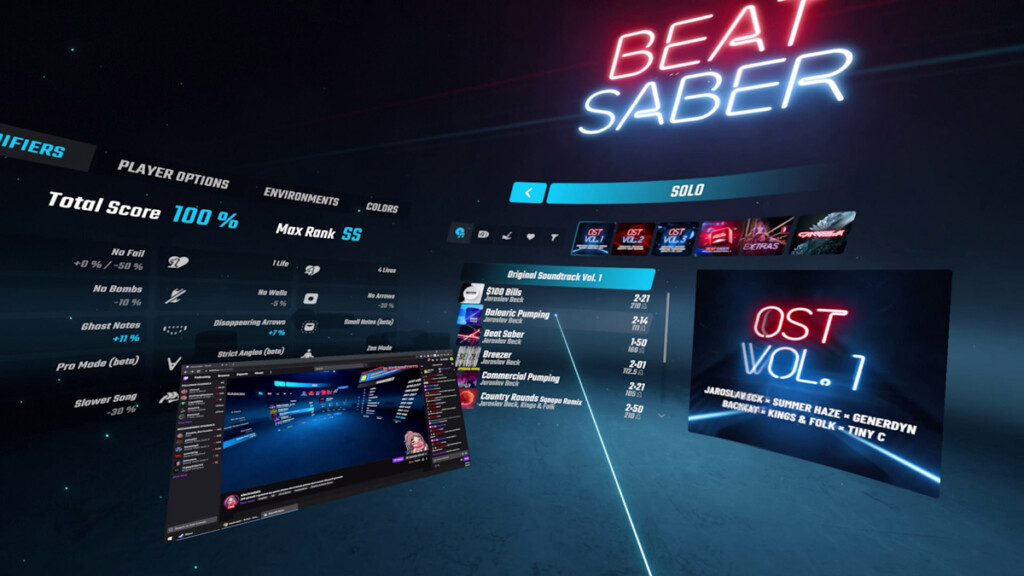
Valve has introduced a neat feature to the latest version of SteamVR, which lets you float windows from your desktop into your virtual space. These windows can be positioned wherever you wish, and would remain there as part of the interface while in-game.

This update is a more flexible approach over the version prior, where users could only bring in a desktop window by attaching them onto your in-game VR controller. The only drawback to this is that you’ll need to lift up your controller in order to glance at the window, which might obstruct your view when playing certain games.

With this new feature, users can simply let a desktop window float anywhere in their virtual space, enabling you to multitask while in a VR game or application. These windows are view-only when you’re in a game or application, and can only be interacted with by pointing at it with your VR controller. On that note, the controller can also be used as a mouse pointer for interaction, such as web browsing or managing content playback via the floating window. Pretty handy, especially if you plan to catch up on a Netflix show while flying a Cessna in Microsoft Flight Simulator – just make sure to keep your plane in the air while doing so.

Although the floating window feature seems like the better alternative, Valve decided to keep the attach-to-controller option just in case. In addition, users can also choose to undock the attached window and position them to float in-game.

To enjoy this new feature, make sure to have your SteamVR beta client updated to version 1.19.6. It’s also worth noting that you can easily opt in to the beta programme by navigating to the app’s Properties window, then to the Betas tab, and choosing SteamVR Beta Update. Upon selecting the option, SteamVR will then download and update to the latest beta version.

Xiaomi Shows Off Physical Concept Of Vision Gran Turismo

At the very tail end of last month, Xiaomi unveiled the Vision Gran Turismo. The car was revealed as a digital hypercar, and one that’s made...