Showing posts with label After. Show all posts

Thursday, May 30, 2024

ICQ Is Officially Shutting Down After 28 Years


ICQ, the instant messaging program of the 90s and early 2000s, is officially and finally shutting down after close to 30 years of service. The app, known for its iconic “Uh-Oh” prompt whenever messages were received, will be shutting its doors to the world on 26 June.

The announcement, if you could even call it that, was posted on the app’s main page, with the simple message “ICQ will stop working from 26 June”, along with a reminder that users to migrate over to the Russia-based social media platform, VK. Yes, the same VK created by Pavel Durov, who is also responsible for the creation of the messenger app, Telegram.


ICQ was initially owned by US telco AOL, who acquired the messaging platform back in 1998 to the tune of US$400 million (~RM1.88 billion). Durov, under VK, purchased the platform in 2010.

It can be argued that the decline in ICQ’s popularity began with the rise of smartphones and other messaging apps like WhatsApp. Naturally, VK tried to keep the spark alive by modernising it, redesigning and adding different features to it but sadly, it didn’t help.

At its peak, ICQ had over 100 million registered users. While that pales in comparison to the over two billion users WhatsApp boasts today, it was an achievement for many users back in the day, especially at a time when smartphones weren’t available.

Wednesday, October 6, 2021

Telegram Gains 70 Million Users After Facebook’s Recent Outage

As most of us are very aware by now, Facebook’s entire ecosystem – including its own social media platform, Instagram, Messenger, and Whatsapp – was affected by a major six-hour outage late Sunday evening, which lasted till early Monday morning in Malaysia. This expectedly ensued chaos amongst its users, resulting in those relying on the company’s various services for both business and personal use to seek the closest alternatives. Among those in line to willingly welcome these “refugees” are none other than WhatsApp’s closest rival, Telegram.

In fact, the amount of users the platform has recently gained greatly surpasses the influx of new registrations it experienced in January. As a refresher, WhatsApp announced an update to its privacy policy back in early 2021, revealing that it would begin sharing user data with parent company Facebook. The move backfired, raising privacy-related concerns which resulted in over 25 million users of the private messaging service to jump ship to Telegram.

According to the platform’s founder Pavel Durov, Telegram welcomed over 70 million users on Monday – the largest number of registrations it had ever received in a single day. While a milestone in every sense, Durov also acknowledged that the unexpected surge of new users in the short time frame have caused slower speeds on the platform due to the increased load.

Meanwhile, Twitter also greeted Monday’s Facebook-less crowd with a “hello literally everyone” tweet, which was posted not long after various reports regarding the outage were shared online. And as expected, various other brands ranging from tech to fast food franchises also rode along the wave, replying to the tweet with jokes and memes directed at the situation.

Just in case you missed it, Facebook revealed that the cause of the outage was apparently due to “some configuration changes” on its backbone routers, which are responsible for the traffic between the company’s data centres. The social media giant also assured that despite this unexpected shortcoming, all user data has not been compromised during the downtime.

Tuesday, October 5, 2021

Ethereum Creator Went Into Crypto After His WoW Character Got Nerfed

Ethereum, and the cryptocurrency Ether, is pretty ubiquitous these days in the world of blockchain. But its creation can be traced back, sort of, to the Blizzard MMO World of Warcraft. And more specifically, a nerf to a Warlock skill all the way back in 2010.

Vitalik Buterin, the creator of Ethereum, explains in his bio that he was a player of WoW from 2007 to 2010. In that final year, “Blizzard removed the damage component from my beloved warlock’s Siphon Life spell”. This ends up being the trigger in helping Buterin realise “what horrors centralised services can bring”.


And that put Buterin on the blockchain path, starting with writing for a blog called Bitcoin Weekly, and later cofounding Bitcoin Magazine. He even dropped out of university to focus on his crypto projects, which were “taking up 30 hours a week” of his time. And thus Ethereum was born.

There’s a nice dose of irony to the whole story as well. After all, Ethereum is a faction of the Ethereal race in WoW. And yet, here we are, with the tech named after an element in the game. For those who know the story, it will now serve as an eternal reminder of where the name came from.

Bank Negara Temporarily Suspends CCRIS Access For Agencies After Alleged Cyber Attack

Bank Negara Malaysia (BNM) has temporarily suspended all access to the Credit Control Reference Information System (CCRIS). The suspension comes after what is believed to have been a cyberattack by hackers whose target was the personal data of all individuals available on the CCRIS database.

It should be pointed out that the suspension has affected all credit reporting agencies (CRAs), chief among them being CTOS, Credit Bureau Malaysia, and Experian. In light of the cyberattack and with regards to Experian, the agency says that it has temporarily paused its services to the BNM-owned CCRIS. Further, the agency also says that it has conducted its own in-depth security investigations into the matter and says that it found no evidence that its systems, servers, or facilities had been compromised during the cyberattack.

CTOS also made a similar statement, stating that all of its assets were secure, despite the attack. In an effort to allay any fears among its clientele, the credit agency also made its CTOS SecureID to them, should they decide that they would like to monitor the dark web for any evidence of their personal data being sold.

BNM has also assured users that access will be restored once CRAs gain control over their own security. In the meantime, it says that financial consumers can continue to access their CCRIS reports via the provided link.

At the time of writing, BNM has yet to confirm if an investigation is underway. However, considering that the attack caused BNM to suspend all access to CCRIS, it is highly likely that the threat actors who attacked its security are individuals with advanced knowledge of the system’s API.

Friday, October 1, 2021

South Korean ISP Sues Netflix After Traffic Surge From Squid Game And Other Shows

Squid Game, a South Korean produced Netflix original, is probably the most widely talked about TV show as of late. So much so that it has garnered a high number of views worldwide, which earned it the number 1 spot of being the current most popular title on the streaming service across 90 countries – including Malaysia.

Naturally, its popularity also surged in its home turf of South Korea, which resulted in a huge spike in local network traffic. While the influx of viewership may have placed a wide smile on Netflix’s face, the same can’t be said for South Korean internet service provider SK Broadband. 

According to Reuters, the local ISP has sued the streaming service to pay for the costs from increased network traffic and maintenance work caused by the spike, as well as to pay for using its dedicated line since 2018. For context, Netflix is the second-largest data traffic generator in the country – with the first being Google’s YouTube platform.

SK Broadband says that unlike other content providers such as Amazon, Apple and Facebook, both aforementioned platforms are not paying for network usage fees – although, the reason behind this is not stated. It added that Netflix’s data traffic, which it has been handling since May 2018, jumped 24 times to a staggering 1.2 billion bits of data processed per second as of September this year. It says that this surge has been riding on the success of several local Netflix productions, with the most recent being Squid Game and a K-drama known as D.P. 

The lawsuit comes after Seoul Central District Court’s ruling against Netflix back in June this year. The court stated that the ISP is offering “a service provided at a cost” and it is “reasonable” for Netflix to be “obligated to provide something in return” for the service. According to court documents seen by Reuters, SK Broadband estimated the network usage fee the streaming service needed to pay in 2020 alone is about KRW 27.2 billion (RM 95.7 million).

On the other hand, Reuters says that Netflix has appealed against the ruling, with fresh proceedings to start in late December. The streaming service had also recently issued a statement saying that it contributed to the creation of about 16,000 jobs in South Korea – stemming from about KRW 770 billion in investments and an economic effect of about KRW 5.6 trillion. At the same time, it noted that it will review SK Broadband’s claim, as well as to discuss and explore ways to work with the ISP to ensure customers are not affected.

Sunday, July 4, 2021

Apple Digital Legacy Service Lets Users Choose Heirs For Their iCloud Data After Death


Apple is adding a Digital Legacy feature that allows users to nominate contacts as legacy contacts who will be granted access to their Apple account in the event of their demise.

For years, users and campaigners have lobbied the tech giant to implement a formalised method of accessing emails, photos, and other contents of a loved one’s iCloud account after their death.

Up until now, the company had only advised users to include access to their personal information in their will:

“We encourage customers to add an inheritance plan to their will that covers the personal information they store on their devices and in iCloud. This may simplify the process of acquiring a proper court order and reduce delay and frustration for family members during a difficult time.”


With Digital Legacy, that process is both simplified and formalised; Legacy contacts will use a “legacy contact Apple ID” to sign in. The user will have access to the iCloud data and will be able to download it using the ID and access key.  Once logged in, the legacy contact user must provide a valid copy of the primary user’s death certificate in order to gain access to the deceased person’s data.

It should be pointed out that Facebook has had a Legacy contact feature for years. In the case of the social network, its Legacy contacts feature is in charge of memorialised accounts or offers users the choice of having their account deleted after Facebook is informed of your death.

It should be noted that for Apple’s Digital Legacy service, payment information such as credit card details, subscriptions, licensed media, and Keychain password will be excluded from the accessible data.

Wednesday, June 30, 2021

Google Kills Its AR Measure App Three Years After Project Tango


Google retired Project Tango in 2018 to make way for ARCore. Now, the AR app known as Measure will also be joining the Google Graveyard. For those whom have never downloaded it, it will never be found again. But for those who did download it at least once before, it “is no longer supported and will not be updated”.

Android Police noted the the app is no longer listed in the Google Play Store for accounts that did not previously download it. But for those that did, it should still work normally. And at the time of writing, the internet search giant still has Measure listed in its AR & VR experiences site. Chances are this will be removed soon.

For those who don’t know, Measure was one of the most compelling uses of AR back in the day. We’re talking about when the Lenovo Phab 2 Pro was first announced back in 2016, as the first phone that supported Project Tango. That being said, it’s safe to say that the idea was better than the implementation, as the app wasn’t exactly accurate. So while it was fun, to say that it was practical was probably  stretch.

AR tech on mobile phones are these days more used for location based games instead. You have the likes of Pokemon Go, Harry Potter: Wizards Unite, and even one for The Witcher. And they are all battery hogs, much like Measure was back in the day.

Sunday, June 20, 2021

Google Kills Its AR Measure App Three Years After Project Tango


Google retired Project Tango in 2018 to make way for ARCore. Now, the AR app known as Measure will also be joining the Google Graveyard. For those whom have never downloaded it, it will never be found again. But for those who did download it at least once before, it “is no longer supported and will not be updated”.

Android Police noted the the app is no longer listed in the Google Play Store for accounts that did not previously download it. But for those that did, it should still work normally. And at the time of writing, the internet search giant still has Measure listed in its AR & VR experiences site. Chances are this will be removed soon.


For those who don’t know, Measure was one of the most compelling uses of AR back in the day. We’re talking about when the Lenovo Phab 2 Pro was first announced back in 2016, as the first phone that supported Project Tango. That being said, it’s safe to say that the idea was better than the implementation, as the app wasn’t exactly accurate. So while it was fun, to say that it was practical was probably  stretch.

AR tech on mobile phones are these days more used for location based games instead. You have the likes of Pokemon Go, Harry Potter: Wizards Unite, and even one for The Witcher. And they are all battery hogs, much like Measure was back in the day.

Wednesday, June 16, 2021

Rumour Suggests Huawei And Leica Partnership To End After P50 Series’ Release


The newly established partnership between Sharp and Leica that was revealed earlier, along with the unveiling of the Aquos R6 smartphone may come as a surprise for many. This is the first time for the German camera maker to collaborate with another smartphone brand after exclusively partnering with Huawei since 2016. However, Leica’s contract with the Chinese tech giant may finally come to an end later this year, according to a recent rumour.

This information comes from Finnish leakster Teme (aka @RODENT50) via Twitter, who said that the partnership will end after the release of Huawei’s P50 flagships which are said to be officially unveiled in July. The most possible reason that comes to mind to why Leica may be considering ending this deal is the ongoing US sanctions imposed on the Chinese company. This has drastically impacted Huawei, causing it to cut down on smartphone production due to the shortage of supplies, especially semiconductors. This is quite apparent as aside from the upcoming P50 series, the company has not unveiled or released any other smartphone model in 2021.

Although this may seem like an impending end of a six-year partnership between the two companies, there’s a chance that Teme’s information is inaccurate. Interestingly, the leakster followed-up on this tweet a few days after, stating that the Leica-Huawei collaboration could still continue even after the release of the P50 series. He also noted that the camera maker’s new partnership with Sharp will not affect its relationship with the Chinese giant as multi-branded deals are quite common in the smartphone industry. For instance, optical systems manufacturer Zeiss to this date has partnered with three smartphone makers, namely Sony, Vivo and Nokia.

Regardless, we highly advise our readers to take this information with a pinch of salt. And this isn’t the first time that the Leica-Huawei partnership is rumoured to be expired either. Chinese tech insider Digital Chat Station also suggested the same insight on Weibo in late 2020, which was shot down by both companies in their own respective statements. This then resulted in the leakster to delete his post on the Chinese social media platform soon after.

Wednesday, June 9, 2021

Microsoft Says Russian Hackers Going After Govt Agencies, Think Tanks, NGOs


Microsoft said that the Russia-based hacker group designated Nobelium has this week targeted government agencies, think tanks, consultants, and non-governmental organisations. Nobelium is also blamed for the notorious SolarWinds cyberattacks that breached multiple departments of the US federal government last year.

In a blog post, the Redmond-based software giant revealed that the hackers went after 3,000 email accounts at over 150 different organisations in at least 24 countries – although the organisations in the US took the brunt of the cyberattacks. At least a quarter of the affected organisations worked on international development, humanitarian, and human rights issues.

The hackers apparently began their attacks by obtaining access to the Constant Contact account of USAID, the US government agency responsible for foreign aid and developmental assistance. Then they sent out phishing emails with a link that, when clicked, installs a backdoor that Microsoft calls NativeZone, which can be used for a variety of actions like stealing data or infecting other computers on a network.


Hackers backed by the Russian government have been blamed for quite a few high-profile breaches in the US. For example, they’re suspected to have stolen thousands of emails from the US State Department, and penetrating the National Nuclear Security Administration – which oversees the US nuclear weapons stockpile.

Earlier in the year, Microsoft blamed China-backed hackers for compromising its mail server software Microsoft Exchange in order to access email accounts. That breach was so serious that the FBI eventually decided to access private computers in the US to purge them of backdoors.

Monday, May 10, 2021

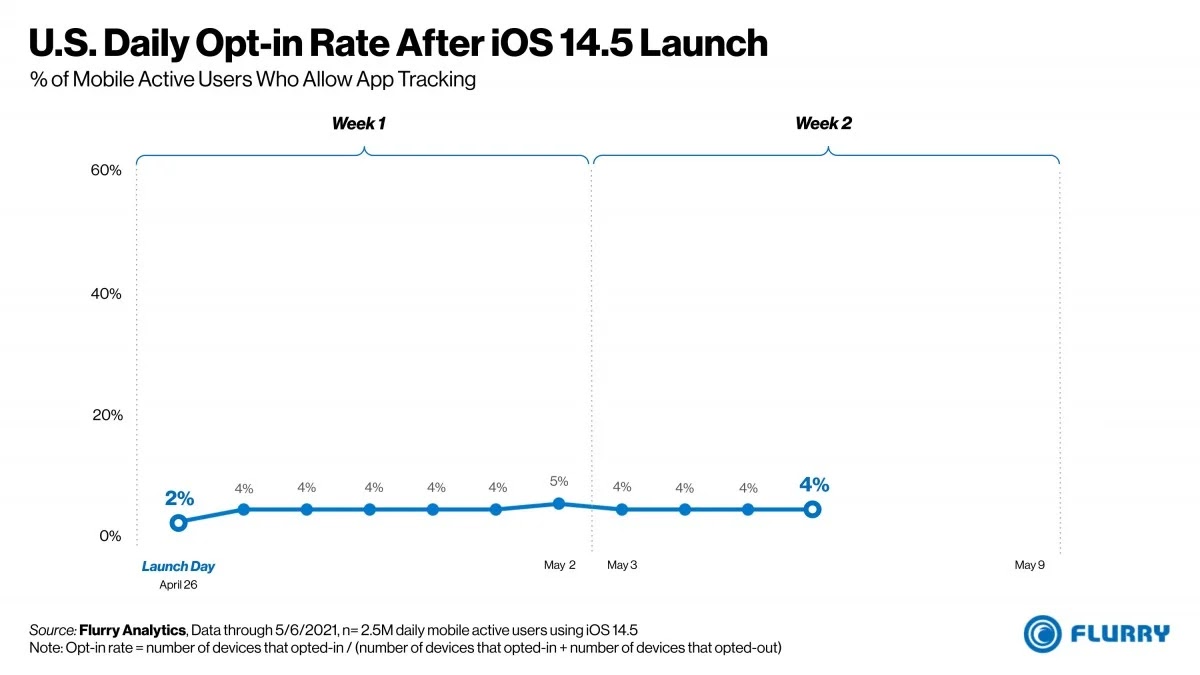
Analysts: Only 12-Percent Of Global Users Allowed App Tracking After iOS 14.5 Rollout

A study by Verizon-owned Flurry Analytics has discovered that the majority of iOS users worldwide have chosen not to enable app tracking. As you may recall, Apple recently rolled out version 14.5 of its operating platform for iPhones which introduces its new App Tracking Transparency (ATT) feature. This enables users to decline certain apps from acquiring their Identifier for Advertisers (IDFA) data to be shared and collected for targeted advertising.

In the study, the analytics firm found that only 12% out of 5.3 million daily active users worldwide allowed app tracking on their devices after the rollout of iOS 14.5. Meanwhile in the US, that number is reported to be only 4% out of 2.5 million users. Additionally, only 5% and 3% of users worldwide and in the US respectively have set up their app tracking preferences to Restricted in their device settings, Flurry Analytics said.

At this current time, the numbers are definitely not in favour of certain companies such as Facebook and its numerous subsidiaries. As previously reported, the social media giant has been aggressively campaigning against Apple’s implementation of its ATT feature, while championing itself to protect the sustainability of small businesses which relies heavily on Facebook’s services. So much so that it even went as far as warning its users of the possibility of charging for its social media services, should they continue to deny apps to access their data.

Perhaps the more drastic consequences are the upcoming restrictions that will befall users of Facebook’s private messaging service WhatsApp. To quickly recap; should users (on both iOS and Android) refuse to accept its new privacy policy by 15 May 2021, the service will remove certain functions such as messaging and calling via the app, and will also eventually delete accounts that are inactive over 120 days.


However, WhatsApp recently updated its Security and Privacy page, noting that no accounts will be deleted nor would it completely remove functions from users who have not accepted its policy after the deadline hits. Instead, the platform now states that it will allow them to continue using the entirety of its services for a couple of weeks, but with a Hail Mary of persistent reminders to have users reconsider accepting the changes. Once the unspecified period has exceeded, WhatsApp will then gradually limit its services for another couple of weeks and will remove them completely from these users after that.


Apple’s new ATT feature has indeed caused a significant impact, and could somewhat be considered as a win for privacy-conscious users. However, as described by Newton’s Third Law of Motion: For every action, there is an equal and opposite reaction. At this time, Facebook’s mulling of charging for its social media services and WhatsApp’s decision to limit and remove functionalities are likely to be just the tip of an inevitable iceberg that’s due for collision.

Wednesday, April 28, 2021

Ant Group Denies Exploring Jack Ma’s Exit After Explosive Report


Ant Group strongly denied that the company ever considered the option of having founder Jack Ma sell his stake in the company to help end ongoing scrutiny from the Chinese government. The fintech giant was responding to an explosive Reuters report which cited anonymous sources alleging that the option was indeed being considered.

Sources told Reuters that officials from China’s central bank (People’s Bank of China) and financial regulator China Banking and Insurance Regulatory Commission met separately with Ma and Ant between January and March, where the possibility of the billionaire’s exit was raised.

One Reuters source said the company hoped Ma’s stake could be sold to existing investors in Ant or sister company Alibaba. But another source claimed that the billionaire was told, during his talks with regulators, that he wouldn’t be allowed to sell his shares to any entity or persons close to him – though the door was open for him to transfer his stake to a Chinese investor affiliated with the state.

Reuters said it couldn’t tell if Ant and Ma would ultimately proceed with a stock divestment option – or which one. Not long after the article was published, Ant tweeted that the story was “untrue” and “baseless”, adding that, “Divestment of Mr. Ma’s stake in Ant Group has never been the subject of discussion with anyone.”

Ma’s companies have been in government crosshairs ever since he criticised China’s regulatory system last October. Chinese authorities scuttled Ant’s high-profile IPO in November and initiated an anti-monopoly probe against Alibaba in December, which recently culminated in a CNY 18.23 billion (~RM11.5 billion) fine.

Saturday, April 17, 2021

Uber Ordered To Pay US$1.1 Million After Blind Woman And Her Dog Were Refused Rides


Uber has been ordered by an independent arbitrator to pay US$1.1 million (~RM4.6 million) to an American blind woman seeking redress for the fact that Uber drivers refused to transport her and her guide dog on multiple occasions. According to the BBC, the arbitrator found that drivers illegally discriminated against the woman based on her blindness, and tossed out Uber’s argument that it wasn’t liable in this case.

Like Grab in Malaysia (and elsewhere), Uber officially maintains that its drivers aren’t employees, but third-party contractors. That changed last month in the UK at least when a ruling by the country’s Supreme Court prodded the company to reclassify its drivers as workers.

The woman, Lisa Irving, asserted that she was verbally abused by some of the drivers over her guide dog. She also claimed that ride cancellations led to her arriving late to work, which contributed to her subsequent termination. A representative of Irving reportedly said that under American law, “a guide dog should be able to go anywhere that a blind person can go.”

In the US, Uber was previously sued by the blind community over its policy on guide dogs. The company opted to settle the lawsuit in 2017, agreeing to inform its drivers that they cannot deny service to people with guide dogs.

Russia Backtracks on Decision To Block Twitter After Receiving Signs of Cooperation


The Russian government is seemingly backing off from banning Twitter for now, seeing how the platform has somewhat agreed to delete banned content faster. Still, regulators said they would continue to throttle Twitter’s speed in the country until mid-May.

Last month, Russia accused the social media platform of failure to remove posts related to suicide, drugs, and child pornography. State regulators then began slowing down the loading of photo and video content on Twitter, threatening to block the platform completely if it didn’t change course.

But according to the Associated Press (AP), Roskomnadzor – the country’s media regulating authority – said on Monday that it had decided against a ban, “taking into account the decision made by Twitter for the first time to change the principles and speed of its own moderation service in Russia, and the removal of a significant part of the prohibited content.”


The agency noted that Twitter was taking 81 hours to delete banned content after receiving notification – a far cry from the 24 hours required by law. But officials were willing to give the company more time to comply after holding talks with it on 1 April, Reuters said.

Russian officials previously slammed social media platforms for enabling street protests that demanded the release of jailed government critic Alexei Navalny. Last Friday, a Moscow court fined Twitter 8.9 million Rubles (~RM477000) for not removing content that encouraged minors to participate in unauthorised protests.

Thursday, March 18, 2021

Line Comes Under Scrutiny After Chinese Engineers Reportedly Accessed User Data


The popular messaging app Line is now under investigation by the Japanese government after local media reported that it allowed Chinese engineers at a Shanghai company to access Japanese users’ data without telling them.

According to the report by Reuters, a government official has stated that investigations were ongoing and that they are unable to tell if Line violated any regulations yet. At the same time, a spokesperson from Line denied that the firm broke any laws or regulations.


But on its website, the company later apologised for causing any concern and for inadequately explaining its data management policies to users, adding that no inappropriate access took place.

Local media has reported that four Chinese engineers, tasked with system maintenance, were given access to Japanese servers from 2018 containing names, telephone numbers, and email addresses of users.

The alarm over the incident probably stems from Japan’s often choppy relations and historical unease with China. It doesn’t help that China-backed hackers were blamed for a recent massive breach of Microsoft Exchange email servers.


For what it’s worth, China has acquired a reputation for spying and hacking in the last few years.

Accordingly, researchers at Stanford University last month raised concern over social media app Clubhouse’s affiliation with Shanghai-based company Agora. Also, last month, TikTok settled a privacy lawsuit alleging that it sent user data to Chinese servers or certain locations in which China-based employees could access the data.

Beijing may not like it, but the very mention of China raises suspicion these days.

Uber Reclassifies All UK Drivers As Workers After Supreme Court Ruling


Uber will be reclassifying all of its 70,000 UK drivers as workers, Bloomberg reported. This means Uber drivers will get minimum wage, vacation pay, and other benefits. The move follows a growing push for gig worker rights around the world – including in Malaysia, where they still lack legal rights.

Uber’s move, which is currently restricted to the UK, was prodded by an unanimous labour-friendly ruling by the country’s highest court last month. The e-hailing pioneer said it would base minimum wage payment on time after drivers accept trip requests via the app.

This still falls short of what some drivers are demanding – that minimum wage is paid from the moment they log into the app until they log off. And drivers won’t enjoy the full rights of employees, who exist in a separate legal category and are entitled to rights like severance pay.

Regardless, the UK court ruling and Uber’s response remain significant, raising questions of when gig workers in Malaysia will receive similar protections and benefits.


As The Star noted, Malaysian gig workers currently aren’t recognised as employees by law – so things like minimum wage, working hours limitations, paid annual and sick leave, and unfair dismissal does not apply to them.

In fact, Grab’s Terms of Service took pains to emphasise that drivers aren’t employees of the company, but “third party providers” that the company connects to users.

So gig workers like e-hailing drivers are presently in a sort of legal limbo in Malaysia. Because they don’t fit the standard definitions of an employee, they’re also unlikely to find relief in our labour courts if they have a complaint.

The government has been mulling new laws to fix this situation, but nothing has materialised thus far.

Taiwanese Horror Game Devotion Returns After Two Year Absence


Remember Devotion, the horror game title that got taken off the proverbial video game shelf a couple of years back, all because of a reference to China’s current leader, Xi Jinping? Well, the game is finally back on the market and is officially available digitally and in a DRM-free format.

The return of Devotion to both stores was made public by its Taiwan-based studio and creator, Red Candle Games, via its official Twitter account. In addition, it says that all future titles will be purchasable via its own online store, as it moves forward to provide a “direct and simple” purchasing channel for players. Additionally, the game is also available via CD Projekt’s GOG platform.

As a quick primer, back in 2019, Red Candle Games came under Steam users who purchased the game discovered an in-game poster that said “Xi Jinping Winnie-the-Pooh moron”. For context, Xi Jinping became the subject of a massive meme then, when the internet made comparisons between the man’s shape and size and the beloved character of English author, A. A. Milne.

Naturally, the Chinese government didn’t find this comparison between its leader and a teddy bear funny, and soon issued a ban on all content that mentioned or contained mentions of Winnie the Pooh. Unsurprisingly as well, the country moved to ban Disney’s Christopher Robin, which also premiered in 2019.

Devotion is currently selling for US$16.99 (~RM70) for the base game, while a bundle including the game’s soundtrack is also available for US$20.68 (~RM85).

Xiaomi Shows Off Physical Concept Of Vision Gran Turismo

At the very tail end of last month, Xiaomi unveiled the Vision Gran Turismo. The car was revealed as a digital hypercar, and one that’s made...