Showing posts with label AMD. Show all posts

Wednesday, November 29, 2023

Ayaneo’s New Tiny Macintosh Tribute Is Actually An AMD Ryzen-powered Windows Machine


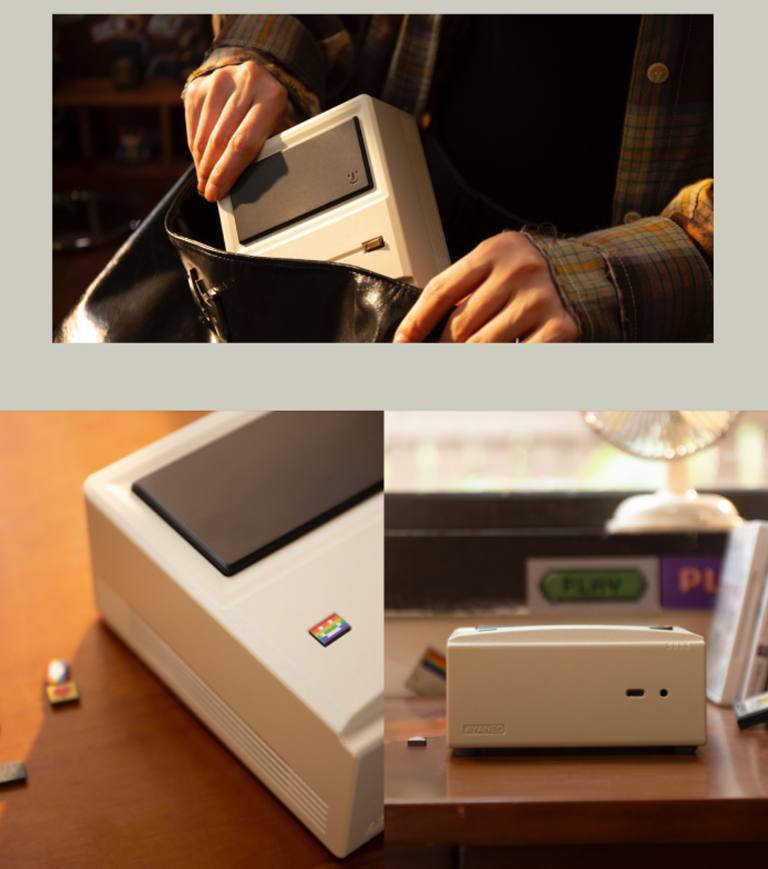
Ayaneo, a brand mostly known for producing handheld gaming devices, has announced a new product that pays tribute to Apple’s classic Macintosh computer from the 1980s, officially known as AM01. Much like several throwback devices prior to this, such as the Atari 2600+ and Sega Megadrive Mini 2, the company’s latest release is presented as a miniature version of the machine that it’s based on. Just don’t expect it to run any iteration of Apple’s macOS, though.

According to Ayaneo, its new AM01 machine is actually a mini PC that’s running on AMD Ryzen processors and, depending on configuration, also comes with Windows 11 Home preinstalled. It measures at just over 5 inches in width and height, 2.5 inches thick, and weighs slightly over 486g. The company adds that you can also personalize it with magnetic-based decorations, where you’ll be able to swap out the not-Macintosh badge on the bottom left for something else. Oh, it’s also worth noting that the miniature display on the AIO tribute product is non-functional, but you can decorate it with a bunch of stickers that are included in the package.

Specifications-wise, Ayaneo is offering the compact PC in multiple configurations which either features just an AMD Ryzen processor, or together with RAM and storage. The AMD Ryzen 3 3200U option will come with 8GB RAM and 256GB storage, while the Ryzen 7 5700U APU variant is available on its own or with 32GB RAM and 1TB SSD. The company notes that the AM01 is expandable up to 64GB of dual-channel DDR4 RAM and 2TB of M.2 solid state storage.


In terms of connectivity, the Ryzen 3 3200U model will feature WiFi 5 and Bluetooth 4.2 support, while the Ryzen 7 5700U version has WiFi 6 and Bluetooth 5.2. Regardless of model, the AM01 also comes with a SATA 3.0 interface that supports 2.5-inch SDD or HDD, one USB-C 3.2 Gen1 port, three USB 3.2 Gen2 ports, one USB 2, a 3.5mm headphone jack, a gigabit Ethernet port, DisplayPort 1.4, and HDMI 2.0 ports.


While it does appear to be portable, the machine actually runs on DC power and does not feature an internal battery. Ayaneo adds that the AM01 can output video in 4k at 60fps and it’s compatible with dual-screen setups.


The mini PC starts at US$149 (~RM692) for the AMD Ryzen 3 3200U option, but will retail at US$199 (~RM924) once it officially debuts next month. On the other hand, the Ryzen 7 5700U configuration starts at an early bird price of US$219 (~RM1,017) for processor only, and up to US$379 (~RM1,760) together with 32GB RAM and 1TB SSD. Those interested can pre-order the device now via Ayaneo’s official Indiegogo store page, while shipping is available worldwide.

Monday, July 25, 2022

AMD Supposedly Prepping Noise Suppression Technology

Rumour has it that AMD is supposedly working on an AI-based Noise Suppression feature that could be introduced in the near and immediate future. The alleged feature was first spotted on an official YouTube video on the brand’s channel, but has since been set to private.

Thanks to the quick hands of some fans online and through the magic and convenience of Reddit, a snippet of that video that “officially” shows off the alleged noise suppression technology. Again, it’s short and last for all but 40 seconds, but for the most part, it’s a sign that AMD is stepping up its game in the area of communication, as well as challenging a similar technology from its direct rival, NVIDIA.

We are, of course, talking about NVIDIA’s RTX Voice technology that the GPU maker launched close to two years ago, back when the pandemic was at its peak, virtually forcing a good chunk of the global population to work from home, until the vaccines became more widely available.

 Returning to AMD’s Noise Suppression technology and based on what we can see, the CPU and GPU maker is clearly working on something that works almost like RTX Voice, but with more tweaks and features made for Red Team, obviously. In other words, the feature should deliver a two-way noise reduction, cutting down on ambient sounds for both input and output.


Because AMD’s Noise Suppression allegedly uses AI-based algorithms to nullify these sounds, it could technically silence even construction work happening next door, thus ensuring a clear, crisp conversation between you and whoever else is on the other side.

As for its delivery vehicle: if AMD really is taking a page out of NVIDIA’s playbook, it could release its AI-based noise cancellation technology through the next major Adrenalin software drivers for its Radeon GPUs. The only other question is whether or not the brand will make Noise Suppression available only to RDNA2 cards, or if older Radeon GPU generations will benefit from the features. Although, all things considered, the latter seems unlikely, and that’s primarily due to these GPUs lacking certain internal components.

Wednesday, July 20, 2022

Modder Successfully Creates AMD FSR 2.0 Mod For Cyberpunk 2077

AMD’s 2nd generation FidelityFX Super Resolution (FSR 2.0) has been available to the masses for several months now and compared to its predecessor, it’s a world of improvement. But while the technology is being fielded in a handful of AAA titles, the one game that hasn’t been updated to support it (yet) is Cyberpunk 2077. Impatient with its developer to bring it up to date, one modder has taken the initiative and made a mod for it.

The modder, who goes by the handle PotatoOfDoom1337, posted their FSR 2.0 mod for the game on the NexusMods forums, along with files and instructions on how to use it. As with all mods, PotatoOfDoom1337 also warns that the mod is still a “proof of concept” and that anyone who chooses to test it out should, and will, expect bugs.

AMD-FSR-1.0

AMD-FSR-2.0

As for the game’s performance running with FSR 2.0, PotatoOfDoom1337 says that they ran the game at 4K upscaled on an NVIDIA GeForce GTX 1080, in which the mod doubled the average frame count to 45 fps. On that note, a YouTuber by the name of MxBenchmarkPC also made a video comparison between FSR 1.0 and FSR 2.0, albeit with an RTX 3080 and Intel Core i7-10700F.


Once again, this FSR 2.0 workaround is a mod and not an official fixture for the game. That itself is something that has to be done from CD Projekt Red’s (CDPR) end which, at this time, the developer hasn’t said if and when it plans on adding the new upscaling algorithm available.

Sunday, January 16, 2022

AMD RAMP Technology For DDR5 Could Give Intel XMP 3.0 Run For Its Money

Intel may have taken the lead on the DDR5 memory frontier with the launch of its 12th generation Alder Lake CPUs, but that may change once AMD’s Socket AM5, 600 series motherboards, and Ryzen 7000 series CPUs launch later this year. This includes the launch of its Ryzen Accelerated Memory Profile, or RAMP for short.

RAMP is expected to succeed AMD’s A-XMP that currently serves as the default memory-overclocking software for all DDR4-based chipsets right now. RAMP was first listed on HWInfo’s v7.17 beta release notes, in which it says the technology had been added as preliminary support to the software. More to the point, it is highly likely that the software was created by AMD as a response and direct rival to Intel’s 3rd generation Extreme Memory Profile (XMP 3.0) memory overclocking profile when, once again, its Ryzen 7000 “Raphael” CPU series makes it to market.

While brief in its presentation and announcement, AMD’s Socket AM5 is set to be a new milestone for the chipmaker, in more ways than one. Its arrival will mark the second time the tech brand will drop the Pin Grid Array (PGA) CPU layout in favour of the Land Grid Array (LGA) format, the first time it adopted the format having started with its Ryzen Threadripper HEDT CPU lineup. Specifically, the new Socket AM5 will also be based on a new LGA1718 design, as well as be the first AMD chipset to support the DDR5 memory standard PCIe Gen5 standard.

At the time of writing, there is no further information about RAMP but if AMD were to maintain the status quo, the new memory technology could mean that currently existing XMP DDR5 memory will also be compatible with it. At the same time, AMD might just allow manufacturers to make RAM modules that cater to their technology, exclusively. Having said that, do remember that this is all just speculation and as such, do take this news with a grain of salt. 

Wednesday, December 1, 2021

AMD Announces Partnership With MediaTek With Development Of RZ600 Series Wi-Fi 6E Modules

AMD and MediaTek recently confirmed their partnership with each other by announcing that they are currently developing a new series of Wi-Fi 6E modules, dubbed the RZ600 series. The new Wi-Fi modules are expected to appear in next-generation Ryzen-powered laptops, as well as desktop PC components, starting in 2022 and well into the future.

The RZ600 Series Wi-Fi 6E modules will comprise two models: the RZ616 and RZ608, and both modules will house MediaTek’s Fliogic 330P chipset. Specs-wise, both modules will support the latest Wi-Fi 6E 2×2 and the latest Bluetooth 5.2 connectivity standards. What sets the two apart lies in the supported channels: the RZ616 module will support the new 6GHz spectrum at 160MHz channel bandwidths, with PHY rates of up to 2.4Gbps. The RZ608 module, on the other hand, supports the 6GHz spectrum at bandwidths up to 80MHz, and just half the maximum PHY rate of the RZ616, at 1.2Gbps.

On top of that, the new RZ600 series modules are small and M.2-ready, with the RZ616 available in two sizes, 2230 and 1216, while the RZ608 is only available in the 2230 configuration.

We’ve mentioned in the past that this isn’t the first AMD and MediaTek have gotten into bed together. To that end, the RZ608 module has already been around for a while and was ultimately rebranded as the MediaTek MT7921K. On that note, it is possible that the RZ608 module being listed here is an updated version of the original that only supported Wi-Fi 6 and not Wi-Fi 6E.

Also, in the case of MediaTek, the semiconductor maker has been around the block with several other major technology brands, including NVIDIA and Google.

Friday, October 8, 2021

AMD Ryzen Processors Facing Performance Issues On Windows 11

Windows 11 has finally been released to the public not too long ago. However, if you happen to own a PC running on an AMD Ryzen processor, it is advisable that you hold off from upgrading to the new platform for a while longer. The company has recently acknowledged issues that are affecting its chips when running the new operating system, with dips of up to 15 percent  in performance during certain instances.

According to AMD’s support page, both the company and Microsoft have found two main issues which, thankfully, are software-based rather than hardware related. This means that the problems can be remedied with a future update for Windows 11, so AMD Ryzen owners can still breathe a sigh of relief.

It turns out that Windows 11 may cause the L3 cache latency to triple, which causes a drop of three to five percent in performance when running most affected applications. This is more apparent when running games, especially those – as AMD puts it – that are “commonly used for eSports” – with performance seen to dip down around 10 to 15 percent.

The second is AMD’s “preferred core” technology, which Windows 11 is also reported to be having issues with. For the uninitiated, the tech shifts threads over to the fastest core on a processor in order to boost frequencies. AMD says that those on Ryzen CPUs with more than eight cores above 65W TDP will encounter performance drops on the new operating system, especially with CPU-reliant tasks.

AMD is assuring users that a software fix for both issues are currently under development, and are expected to be released sometime later in October. Suffice to say, it’s best to stick with Windows 10 until the solutions are made available if you’re running a Ryzen-equipped system.

Friday, October 1, 2021

AMD And MediaTek Reportedly Considering Joint Venture

It is being reported that AMD is in talks with MediaTek, with both parties seemingly interested in the idea of a partnership. Specifically, the collaboration could help AMD gain an edge over its CPU rival, Intel, the realm of 5G connectivity.

According to a report by DigiTimes (paywall), the partnership could enable MediaTek to integrate its own SoC and 5G technology into AMD’s own chips. While not wildly popular as its rivals in terms of chip preference, MediaTek’s 5G technology is still regarded to be one of the best in the mobile industry.

It shouldn’t come as a surprise to anyone in the know that this isn’t the first time AMD has dipped its toes into the mobile components pool. As it stands, the chipmaker already has an arrangement with Samsung, whereby the GPU segment of the Korean tech giant’s upcoming Exynos SoC will house at least six Graphics Compute units, powered by AMD’s Radeon RDNA 2 GPU architecture. This also isn’t the first time AMD and MediaTek have collaborated. Prior to this, both companies worked together to create the AMD RZ608 Wi-Fi chip, which ultimately got rebranded as the MT7921K.


On the other hand, this isn’t MediaTek’s first tryst with a GPU maker either. Back in April this year, NVIDIA licensed out its Ampere GPU IP to the Taiwanese semiconductor maker, for the purpose of creating a reference system and SDK for Google Chrome OS and Linux-based PCs. Then in July, during the annual Game Developers Conference, NVIDIA showed off a MediaTek and GeForce RTX 3060-powered Chromebook, running Wolfenstein Youngblood.

Tuesday, September 14, 2021

AMD Radeon Software Adrenalin 21.9.1 Bring Auto-Overclock, Windows 11 Support


AMD’s latest Radeon Software Adrenalin drivers, version 21.9.1, is now live and as with all GPU drivers, it comes pack with several updates. Included in the new update is a new Auto-overclocking feature, and support for Microsoft’s Windows 11.

The support for Windows 11 is pretty much self-explanatory for Radeon users who are part of the Microsoft Windows Insider Program. With Adrenalin 21.9.1, you effectively gain access to the full suite of Radeon-related features, including Radeon boost, Radeon Anti-Lag, and Radeon Image Sharpening. In addition, the new drivers will also allow users to use the AMD Link app with the Windows 11 insider build.

Moving on, the new Radeon Auto-Overclock is the latest addition to AMD’s Radeon Software and is easily accessible via program’s Tuning tab. The feature is a one-button does all, conveniently located in the Tuning Control section and as the name suggests, clicking the button will automatically adjust the performance of your Radeon GPU and Ryzen CPU. Do note that, as per AMD’s blog, the Auto-Overclocking feature will only function with Radeon RX 6000 Series GPUs and Ryzen 5000 Series CPUs.


Last but not least, the Adrenalin 21.9.1 drivers also carry FidelityFX Super Resolution (FSR) support for several titles, which includes Resident Evil Village, Chernobylite, and Arkane’s newly launched title, Deathloop, among many others.

Upcoming Samsung Exynos 2200 SoC To Ship Out With Six AMD RDNA2 Compute Units

Back in June this year, AMD made its partnership with Samsung official by announcing that the latter’s next flagship Exynos System on Chip (SoC) would be powered by the former’s RDNA2 GPU technology, and that there is still a possibility of a launch for it this month. On that note, one of the internet’s most prominent leaksters, Ice Universe, recently dropped some information regarding the Exynos 2200 SoC and its GPU cores.

To our surprise, Ice Universe didn’t post the information on Twitter like they usually do; instead, the leakster’s post was made via the popular Chinese social media platform, Weibo. The post, which is no longer available, included a very simple diagram of what looks to be the layout of the Exynos 2200. At the top-right of the diagram are six squares, vertically lined up, that supposedly represents the six RDNA2 GPU Compute Units (CPUs) that will handle all matters pertaining to graphics fidelity.

Beyond that, there isn’t much else to go on about the post, nor is there any additional details about its performance. That said, there are leaks about the RDNA2-powered SoC; one of the most recent leaks was also posted by Ice Universe, with the AMD GPU scoring 8134 points on UL’s 3DMark Wild Life test. However, it should also be noted that in that benchmark, the CPU portion of that SoC used Cortex-A77 processors, which is quite old when compared to the Cortex-X1 core. Used in the current Exynos 2100 SoC.


As it is with all leaks and rumours, we highly recommend that you take this news with a large grain of salt until an official statement has been made.

Tuesday, August 31, 2021

Cloud Mining Company Wins Chinese Court Case; Regains More Than 485000 AMD Radeon GPUs

Genesis Mining, An Iceland-based cloud mining outfit, recently won a lawsuit in a Chinese court, against a Chinese hosting provider, Chuangshiji Technology Limited. By decree of China’s Supreme Court, the defendant was ordered to return the Radeon RX 470 8GB GPUs it seized from Genesis Mining and by all, we mean all 485681 units.

Genesis Mining’s legal woes began in 2018, when it took Chuangshiji Technology Limited to court, over multiple monetary issues with the latter. The lawsuit, which stretched over a span of several years, was filed in 2019, after the defendant began withholding said RX 470 GPUs, presumably purchased by Genesis Mining. The Genesis lawsuit specifically demanded that Chuangjishi hand over more than 560000 GPUs, along with 60000 ASIC miners after the company terminated its agreement with the company.

Naturally, things didn’t go according to plan for Genesis; Chuangjishi refused to comply and instead, began selling its ill-gotten gains, all without Genesis’ consent.


Sadly, Genesis’ victory in the Chinese court is a Pyrrhic one; while the Icelandic cloud-based mining company may have won back its nearly half a million RX 470 GPUs, China’s recent crackdown on cryptominers and their farms means that the company will have to consider two alternatives: shift its operations out of China and into a country where cryptomining isn’t banned or find new homes for them, the latter being an arduous task, given the age of the RX 470 and its GPU core.

That said, selling them to actual gamers might actually net Genesis a tidy profit, especially given the ongoing chip and GPU shortage that is happening around the world.

Saturday, August 21, 2021

Alleged MSI Delta 15 Laptop With AMD Radeon RX 6700M GPU Leaks

Leaked information of an MSI Delta 15 with an AMD Radeon RX 6700M discrete GPU have reportedly made their way on to the internet. The leaks first appeared on the Chinese news site, Zhihu and seems to detail the synthetic performance of the AMD discrete GPU, as well as its expected specifications.

As per Videocardz, the 6700M will be a water-down version of AMD’s Navi 22 GPU, have 2304 Stream Processors, 10 GB GDDR6 running through a 160-bit memory bus, and possibly be available in three TGP variants: 80W, 110W, and 135W. In this instance, the GPU in question seems to be the 110W version. Additionally, the GPU seems to be paired with an AMD Ryzen 9 5900HX.


Moving on, the Zhihu post also seems to be benching the 6700M-powered Delta 15 against a Razer Blade 14 Ryzen, fitted with an 80W NVIDIA GeForce RTX 3070 GPU. Overall, the Radeon GPU appears to outperform its Team Green rival by an average of 9%, with the highest gains in performance seen with Hitman 2.

Of course, one important note to bear in mind about the real-world benchmarks is that only a handful of these games are DXR-capable and judging from the framerates, it is likely that these numbers were obtained without the feature turned on. As such, it is unclear how the 6700M will perform with the feature turned on.


As these things usually are, MSI has not released any official statement about the Delta 15, nor has AMD actively confirmed the existence of the Radeon RX 6700M GPU. So, take this news with a grain of salt.

Monday, July 19, 2021

AMD Ryzen Threadripper 5000 Series CPUs Rumoured For August Launch


After a long period of silence, rumours about AMD’s next-generation Ryzen Threadripper 5000 series CPUs have finally begun appearing once more. The most recent rumour now suggests that the HEDT CPU lineup could launch as early as next month.

According to MoePC, the new AMD Ryzen Threadripper 5000 series CPU goes under the codename “Chagall” and there are several unsubstantiated rumours to it. For a start, the Chinese site claims that the number of cores in each Threadripper 5000 series CPU remain unchanged. Of course, what is known is that the CPU architecture in the new HEDT lineup will be upgraded from Zen 2 to the current 7nm Zen 3 CPU architecture. With that, the top-of-the-line CPU in the series should offer up to 64-cores and 128-threads.

One other rumour is that the Chagall might also feature a slightly larger Inter-Chip Global Memory Interconnect (xGMI), up from 16GT/s to 18GT/s. This is similar to AMD’s EPYC 7003 server CPU series, which goes by the codename “Milan”.

Again, these are merely just rumours and unverified details. Therefore, until an official announcement from AMD is made, we highly recommend that you take this report with a large grain of salt.

Saturday, June 19, 2021

AMD “big.LITTLE” Processor Fabrication Patent For Ryzen 8000 Series Discovered


It appears that AMD may be shifting the paradigm of its chip-making process for future Ryzen CPUs for the next decade. The company reportedly filed a patent in the US, detailing its use of the big.LITTLE design, otherwise known as heterogeneous computing.

For the record, the big.LITTLE processor concept has been a mainstay in mobile devices for several years now. That said, the main reason behind its existence is for better power consumption and as such, it isn’t widely applied to CPUs used in modern desktops.

In the case of AMD, the CPU and GPU maker’s patent, codenamed Strix Point, was filed back in 2019 and appears to be associated with its “Zen 5” based architecture. More importantly, the patent addresses a Zen 5 APU and features smaller cores, referred to as Zen4D in the filings.


Needless to say, the document is lengthy but apparently does not provide a detailed description of how AMD intends to execute the big.LITTLE CPU design in future Ryzen CPUs. To that end, we could see the CPU manifest itself in the form of AMD’s Ryzen 8000 series lineup, which is also expected to be based on an entirely new 3nm die lithography.

In any case, we’ll just have to wait and see what transpires over the next several years.

Tuesday, June 1, 2021

AMD Launches New Ryzen 7 5700G And Ryzen 5 5600G APUs


AMD’s Computex 2021 keynote kicked off with several key product announcements. Chief among them is the addition of two new Ryzen desktop APUs: the Ryzen 7 5700G and Ryzen 5 5600G.

Starting with the Ryzen 7 5700G, the CPU portion of the APU houses an 8-cores, 16-threads processor that features a base and boost clock of 3.8GHz and 4.6GHz. In addition, it has an L2 and L3 Cache of 4MB and 16MB respectively.

Naturally, because it’s an APU, the 5700G also comes equipped with integrated 8 Compute Units (CUs), Vega-powered Radeon cores, running at a boost clock of 2GHz.

Moving on, the 5600G is very clearly an APU aimed towards the mid-range market. Its CPU uses a 6-cores, 12-threads build, has a base and boost clock of 3.9GHz and 4.4GHz, respectively. As for its graphics cores, the Vega-based Radeon integrated GPU houses 7CUs running at a clockspeed of 1.9GHz. Oh, and it has a 3MB L2 and 16MB L3 Cache.


As with all current-generation Ryzen processors, both the Ryzen 7 5700G and Ryzen 5 5600G are based on AMD’s Zen 3 CPU architecture and are made using the 7nm TSMC die lithography. Both APUs will be available globally from 5 August onwards, with pricing starting at US$259 (~RM1068) for the 5600G and US$359 (~RM1480) for the 5700G.

AMD Radeon RX 6000M Series Mobile GPU Now Official; Features Up To 12GB GDDR6 Memory


Beside its latest Zen 3-powered Ryzen APUs, today’s keynote also saw the official announcement of AMD’s new Radeon RX 6000M mobile graphics series for laptops. Much like its desktop counterparts, the new mobile GPU series are based on the brand’s current 7nm, RDNA2 architectures.

In total, the RX 6000M comprises three different GPUs; sitting pretty at the top is the RX 6800M, while the RX 6700M dominates the middle ground, and last but not least, we have the RX 6600M covering base for the entry-level.

As you’ve no doubt guess, the RX 6800M is the most powerful of the trio, sporting 12GB GDDR6 graphics memory, 40 Compute Units (CUs) and Ray Accelerators, a game clock of 2.3GHz at full whack, and a 96MB Infinity Cache. Again, as it is an AMD product , the GPU also supports both Smart Access Memory (SAM) and Smartshift when paired with an AMD Ryzen 5000 series mobile CPU.

In terms of raw gaming performance, the 6800M isn’t quite set up to dominate the 4K realm, but to AMD’s credit, it is setting realistic expectations, aiming for max graphics settings at 1440p with this mobile GPU, which is more than plenty for us.

As to which laptop will be the first to showcase the 6800M, that honour goes to ASUS’ ROG Strix G15 “AAA” Edition gaming laptop. In addition to the 6800M, the laptop is also fitted with AMD’s Rzyen 9 5900HX CPU, both of which are also kept cooled through the use of Liquid Metal and vapour chamber technology.

Moving on, the RX 6700M serves as the halfway mark of the three mobile GPUs. Specs-wise, the mobile GPU has 10GB GDDR6 memory, 36 CUs and Ray Accelerators, an 80MB Infinity Cache, and a 2.3GHz game clock. Whereby the 6800M is designed to enable gamers to play their favourite triple-A title at 1440p resolution at their highest graphics settings, the 6700M unsurprisingly takes it down a notch. By allowing gamers to still game at 1440p, but at either the second or third highest graphics settings of each respective games.


Last on the list is the entry-level RX 6600M. On paper, this mobile GPU ships out with 8GB GDDR6 memory, 28 CUs and Ray Accelerators, a 32MB Infinity Cache, and a game clock of 2.18GHz. Whereas the 6800M is designed to enable laptops to maintain high framerates at 1440p and with the graphics settings maxed out, the 6600M is targeted at the gamer that is perfectly content with gaming at Full HD resolution. While still maintaining max graphical settings for their favourite title.


The AMD Radeon RX 6800M and RX 6600M are available starting today. While the 6800M is available via the ASUS Strix G15 “AAA” Edition, the RX 6600M will first be available via the HP Omen 16. At the time of writing, there is still no word regarding the availability of the 6700M.

AMD FidelityFX Super Resolution Gets Launch Date; Arriving 22 June


Besides the Zen 3-powered APUs and new Radeon RX 6000M series GPUs for laptops, one of the more important announcements of AMD’s Computex 2021 keynote was the progress of its FidelityFX Super Resolution (FSR) upscaling technology. More to the point, the company also provided a key detail many gamers have been looking forward to: a release date for FSR.

As a quick primer, FSR is to AMD what NVIDIA’s DLSS upscaling feature is to its RTX technology. Unlike DLSS, though, FSR doesn’t require the use of proprietary and specifically designed core for the task.

Again, like DLSS, FSR will have four quality presets for gamers: Ultra Quality, Quality, Balance, and Performance. Naturally, Ultra Quality will retain as many pixels at the cost of frames, while running an FSR supported title at the Performance preset will guarantee higher frame rates, albeit at the cost of details.


To our surprise, AMD says that FSR will not only work on its hardware, but also on NVIDIA’s GeForce products. In the case of the keynote, the company showcased the GeForce GTX 1060 running with FSR, with the video demo showing the card supposedly gaining 41% more framerates with the feature enabled.

AMD’s FidelityFX Super Resolution will be available on 22 June and the feature will be applicable across the board for all Radeon GPUs. To reiterate, the feature will be available on not just AMD’s Radeon RX 6000 series GPUs, but also its last-generation Radeon RX 5000 Series, Radeon RX 500 series, as well as all Ryzen CPUs fitted with Radeon graphics cores.

Friday, May 7, 2021

AMD Reportedly Selling Defective Xbox Series X CPUs In China

It’s being reported that AMD has begun selling off what could be defective Xbox Series X CPUs, as part of mini-ITX gaming PCs in China. According to Tom’s Hardware, the CPUs are the chipmaker’s 4700S processor, which do not come equipped with its RNDA2 GPU graphics cores.

The discovery of the gaming PC was picked up by popular leakster 188号 (@momomo_us), who found the machine fitted with the AMD 4700S being advertised on TMall, the country’s popular online retail store. One important point to note is that the CPU is devoid of the Ryzen branding, which adds fuel to the fact that the CPU is a custom processor, tailored and made specifically to the requirements of one of its client. In this case, all arrows are pointing towards Microsoft.

Specs-wise, the 4700S is believed to be an eight-core Zen 2 processor with SMT, has 12MB L3 cache, and runs on a base and boost clock of 3.6GHz and 4GHz, respectively. As for the specs of the ITX gaming PC, the TMall listing indicates that the system comes built with an AMD Radeon RX 550 and up to a 480GB SSD or 2TB HDD.


The list also says that the system comes with 16GB GDDR6 memory, which is the same amount of memory as the Xbox Series X. However, a quick Google translate suggests that this could merely be a mistake and that the seller is very likely indicating the amount of system memory on the pre-built PC.

At this point, it is unclear if AMD intends to sell the 4700S as a separate product to consumers in the future or simply continue selling it as OEMs. To that end, it is highly unlikely that the CPU or the Xbox Series X will be officially making their way to our shores anytime soon.

Xiaomi Shows Off Physical Concept Of Vision Gran Turismo

At the very tail end of last month, Xiaomi unveiled the Vision Gran Turismo. The car was revealed as a digital hypercar, and one that’s made...