Showing posts with label NVIDIA. Show all posts

Wednesday, December 14, 2022

Alleged NVIDIA GeForce RTX 4070 Specifications Surfaces

As the rumours of NVIDIA’s Geforce RTX 4070 Ti continue to pile up, there’s actually been little or next to no news about the non-Ti version of the card. Up until now, that is.

The specifications of the alleged GPU were leaked by prominent hardware leakster, kopite7kimi (@kopite7kimi). According to Kopite, the card will be using a slightly watered-down version of the PG104 – similar to the one used by the RTX 4070 Ti – and from what is being listed, the same 12GB GDDR6X graphics memory, rather than the original 10GB that it was speculated to ship out with.

Additional details from Kopite’s tweet suggest that the RTX 4070 will feature 5888 CUDA cores, which is significantly lower than the previously rumoured 7168; a 192-bit memory bus that, again, is identical to its more powerful Ti sibling; a 36MB L2 Cache; and a TDP of 250W, which is 35W less than the Ti variant. Unfortunately, the tweet does not specify its base or boost clock, although those numbers could be closer to the RTX 3070, if we’re looking at trends and speculations.

And that’s all there is about the RTX 4070 by Kopite. Again, any and all news regarding the RTX 4070 has been dry, with the current focus of rumours being squarely on the imminent arrival of the Ti-based card. For another matter, there is also no specific timeline as to when the non-Ti card will launch, although if we were to look at NVIDIA’s habit and trend, it could make its debut within three months of each other, seeing how the RTX 3060 made its debut at around the same time frame from its Ti-powered sibling last year.


In a roundabout way about its performance, there is also AMD’s RDNA3-based Radeon 7000 series, or rather, what team Red would introduce as a contender to NVIDIA’s own RTX 4070 Ti and non-Ti variant. Technically speaking, the RX 7900 XTX and XT are meant to bump heads with the RTX 4080, but we’re going to have to wait for the reviews to see if that really is the case.

Monday, July 25, 2022

Full NVIDIA AD102 GPU Allegedly Runs Control At Over 160 FPS In 4K

A recent leak about a full-fat NVIDIA AD102 Ada Lovelace GPU suggests that the top-tier GPU can and will run rings around the current king-of-the-hill, the GeForce RTX 3090. How fast is the card, you ask? Apparently, it can run Remedy’s Control at 4K resolution and above the 100 fps mark.

Now, to be clear, this rumour about the AD102 isn’t to be confused with the non-Ti variant of the supposed RTX 4090 that has been making its rounds online. By comparison, the full-fat AD102 GPU ships out with as many as 18432 CUDA cores, which is approximately 12% more CUDA cores than what the RTX 4090 is expected to ship out with.

Getting back on point, and according to a Twitter user that goes by the handle AGF (@XpeaGPU), the AD102 GPU was able to run the game Control at 4K resolution, with the framerates sustaining themselves beyond the 160 fps mark. Further, those framerates were also achieved with ray-tracing and DLSS enabled, but not without its own set of drawbacks. In order to achieves those numbers, the GPU was also reported to have pulled more than 800W off the wall.

By comparison, the RTX 3090 at the same resolution and ray-tracing parametres turned on would yield approximately half the number of frames. With our RTX 3090 Founders Edition, our framerate in-game hovered between 60 and 74 fps.

The arrival of this AD102 rumour is interesting, given that just yesterday, we posted a report about another rumour regarding the RTX 4090 and how it is expected to be nearly 70% faster than the RTX 3090. However, those performance numbers were supposedly pulled off an as-of-yet unconfirmed 3DMark Time Spy Extreme benchmark and as such, should be treated with the usual consumption of salt.

For another matter, there are other missing variable that can render claims about the AD102’s prowess unreliable at this point. For starters, the source doesn’t specify the exact game settings the GPU was running Control with, nor did they say if the Lovelace GPU is actually using a new generation of Tensor Cores. Much like Ampere and its 2nd generation Tensor Cores.

Second, there aren’t any additional details about the AD102’s specs, not even its TDP or clockspeeds.

Wednesday, January 19, 2022

NVIDIA Requests Temporary Suspension Of GeForce RTX 3090 Ti Production

NVIDIA seems to have made a sudden request to all of its board partners, asking them to halt the production of its soon-to-be announced GeForce RTX 3090 Ti graphics card. Effectively, this also means that NVIDIA’s original plan of launching the card later this month is clearly not happening.

The news was initially reported by TweakTown, whom got the news from their source. However, when asked why the GPU maker requested to “pause production” of its AiB partner’s custom-cooled RTX 3090 Ti, the source wasn’t clear. However, thanks to Videocardz, we now know that NVIDIA’s 11th hour request seems to stem from issues with the card’s BIOS and hardware but nothing else beyond that point.

The RTX 3090 Ti was first announced during CES 2022 earlier in the month, albeit briefly. At the time, the company confirmed what earlier rumours had speculated about the card: it would still retain the same 24GB GDDR6X memory, but clocked at a faster 21Gbps and required a much higher 450W TDP, conducted through a new 16-pin Microfit PCIe MOLEX connector.

In any case, we’re just going to have to wait on Team Green for further updates on the RTX 3090 Ti.

Wednesday, October 6, 2021

NVIDIA Rumoured To Launch GeForce RTX 3090 SUPER In January 2022

Back in September, a leak sprung forth from NVIDIA’s rusty pipes, alleging that the GPU brand was already preparing to launch a “SUPER” class lineup of Ampere-powered GeForce RTX 30 series graphics cards. Recently, a new rumour is hinting that NVIDIA could launch its RTX 3090 SUPER as early as January next year, along with a couple of other cards.

Rumours of NVIDIA’s alleged launch plans first came to light via a Tweet from user hongxing2020 (@hongxing2020), who claims that the RTX 3090 SUPER, which is obviously an updated model of the current RTX 3090, will be the first card of the SUPER lineup to be announced next year. In addition to that, hongxing2020 also claims that NVIDIA will launch two more cards: an RTX 3070 Ti with 16GB GDDR6X memory and a resurrected RTX 2060 from the Turing era, but one with 12GB GDDR6 memory.

Stating the obvious yet again, the RTX 3070 Ti 16GB is clearly expected to be placed above the current RTX 3070 Ti, seeing how it has double the graphics memory. As for the 12GB variant of the RTX 2060: if the tweet rings true, then it serves as a confirmation of a rumour that first made its way online at the start of the year.

Of course, as with all rumours and leaks, we do suggest that you take hongxing2020’s tweet with a liberal sprinkling of salt, especially since it is missing the more important information pertaining to the other SUPER cards, including the RTX 3080 SUPER and RTX 3060 SUPER.

Friday, October 1, 2021

NVIDIA Rumoured To Relaunch GeForce RTX 2060 With Double The Graphics Memory


Back at the start of this year, a rumour began circling online that NVIDIA was planning to resurrect its Turing-powered GeForce RTX 2060, with one difference: instead of 6GB GDDR6, the revived card would instead have 8GB GDDR6. Recently, a new rumour is now suggesting that the amount of graphics memory has increased again.

According to sources close to Videocardz, NVIDIA is supposedly planning on making an RTX 2060 with as much as 12GB of GDDR6 memory, which is just as much as the non-Ti version of the Ampere-based RTX 3060. The card, goes by the model number PG161 and uses the same TU106-300 GPU as the original RTX 2060, save for the “KX” name at the end of the GPU ID.

First announced during CES 2019, the RTX 2060 has long been considered an entry-level GeForce card for the Turing GPU range. The card was popular amongst many gamers, mainly for its price-to-performance ratio and the fact that, like its brethren, it was capable of performing real-time ray-tracing, when and where applicable. Production of the card was quietly discontinued by NVIDIA last year, just as the company announced its current Ampere-based RTX 30 series graphics card.


NVIDIA’s supposed decision to resurrect the RTX 2060 has also been seen as the GPU brand’s way of tackling the ongoing shortage of its RTX 30 series GPUs. Moreover, its CEO, Jen-Hsun Huang, has also said that the shortage is likely to last well into 2022.

Wednesday, September 22, 2021

NVIDIA Reportedly Begins Selling Repurposed GA104 GPUs As GeForce RTX 3060 Cards

NVIDIA repurposing its higher-tier GPUs for lower-tier graphics card models isn’t groundbreaking news, by any measure of the definition. The GPU maker usually does this whenever it has a surplus of GPU dies in question and the higher-ups in the company decide to sell them to AIBs, who then sell them to customers directly.

Recently, a discovery by Twitter user Matthew Smith (@T4CFantasy) showed that NVIDIA has begun selling its GA104 GPUs in the shape and form of GeForce RTX 3060 cards. As a quick recap, the RTX 3060 shifted out with a GA106 GPU but that said, both GA104 and GA106 GPUs actually have similar designs when it comes to their pin layouts. Also, it was the RTX 3070 and RTX 3060 Ti that originally shipped out with the GA104 GPU, thus making this the first GA104-powered RTX 3060 with more than 8GB GDDR6 graphics memory.

On paper, the GA104-powered RTX 3060 still retains the same 3584 CUDA cores, as well as the same 12GB of GDDR6 graphics memory and 192-bit memory bus. However, to ensure that the card’s performance still falls within the parameters of an entry-level or mid-range card, approximately 42% of the GPU’s potential will be disabled. Versus the 7% of disabled cores in a GA106-driven RTX 3060.

As for when and where the card will be made available, there are no specific dates but Videocardz speculates that the GA104-based RTX 3060 could make its way into the North American and European markets first, before other countries in Asia (except China) begin receiving it. 

Thursday, August 26, 2021

NVIDIA Shows Off RTX On ARM Using A MediaTek Chromebook CPU Paired With RTX 3060

If you are a gamer or PC hardware enthusiast, you most probably are well-aware of what NVIDIA RTX technologies are all about especially real-time ray tracing. Aside from having the appropriate GeForce RTX graphics cards, you also generally need a capable x86-64 processor too in order to utilise them but NVIDIA is now working to bring the RTX tech to ARM-based processors as well.

At the ongoing Game Developers Conference, the company has unveiled two demonstrations of RTX on ARM including one that utilises Wolfenstein: Youngblood. According to NVIDIA, both demos were run on a system that is equipped with a MediaTek Kompanio 1200 processor and a GeForce RTX 3060 GPU.


NVIDIA pointed out that there were five key RTX technologies that were being showcased in these demos including DLSS as well as RTX Direct Illumination, RTX Global Illumination, RTX Memory Utility, and NVIDIA Optix AI-Acceleration Denoiser. However, the company noted that MachineGames and Bethesda Softworks have no plans to put out the ARM version of Wolfenstein: Youngblood that was used for the demo as a commercial release though.

Considering that the Kompanio 1200 is essentially a Chromebook processor, what NVIDIA is trying to achieve here is indeed pretty interesting as it may lead to a future whereby an ARM-based device could become a decent gaming PC. That could be a fairly fruitful future for NVIDIA beyond its role as a GPU company since ARM is about to become a part of NVIDIA soon, although the acquisition deal has been met with resistance by a lot of parties including the UK government.

NVIDIA GeForce RTX 3090 Super GPU With 21Gbps GDDR6X Memory Reportedly In The Works

As NVIDIA reportedly preps its next-generation GPU architecture, Ada Lovelace, rumours have surfaced that the GPU brand plans on sending off its current Ampere lineup with one last hurray. That hurray, by the way, is rumoured to come in the form of a GeForce RTX 3090 Super.

Rumours of the RTX 3090 Super first came to light via prominent leakster Greymon55 (@greymon55), who said that the card was going to ship out with 10753 CUDA cores, which is 256 CUDA cores more than the current RTX 3090. Additionally, they also said that the card would require upwards of 400W of power to run, which clearly exceeds the current 350W TGP of the RTX 3090.

Less than a day after that rumour, another popular leakster, kopite7kimi (@kopite7kimi), posted more information about the RTX 3090 Super, saying that the card TGP was higher at 450W. Further, the card also would not have an NVLink unlike the RTX 3090, because SLI is pretty much dead at this point. On that note, it doesn’t appear that the card’s 24GB GDDR6X memory is getting increased, but until its launch, that is still up for change.

Another interesting plot point is that the RTX 3090 Super is expected to run on a new GA102-350-A1 architecture, along with GDDR6X memory running at 21Gbps. Again, for context, the GDDR6X on the currently existing RTX 3090 run at 19.5Gbps, which is already extremely fast. Even more interesting, though, is that kopite7kimi says that NVIDIA plans on launching the RTX 3090 Super before the year is out.

As exciting as this news may sound to us, it should also be noted that these rumours do not mention or affirm if NVIDIA also plans on releasing other Super variants of other RTX 30 series GPUs, including the RTX 3060, RTX 3070, and RTX 3080. That said, the chances of that happening for the latter two models are exceedingly slim, seeing how the company just recently launched the “Ti” versions of said cards.

If these rumours actually do become reality, it is also likely that NVIDIA’s AiB partners will have no choice but to fit their own custom-cooled versions of the GPU with no less than three 8-PIN PCIe power ports in order to run the card. That, or adopt the 12-pin power connector that NVIDIA uses on its Founders Edition cards.

On that note and as always, NVIDIA has neither confirmed nor denied the existence of such a card, as is the brand’s policy. So, take this news with a liberal sprinkling of salt.

Monday, August 16, 2021

New NBMiner Update Reportedly Enables Better Mining Performance For LHR-limited NVIDIA Cards

NBMiner, a software used for cryptomining, recently released a new tool that is supposedly capable of enabling as much as 70% of the original mining performance of a Lite Hash Rate (LHR) version of an NVIDIA GeForce RTX 30 series graphics card.

As some of you know, NVIDIA’s relationship with cryptominers has always been delicate; the group has undeniably been one of the GPU maker’s biggest contributor to GPU sales, hoarding every GPU they can get their hands on, while leaving consumers and actual, bonafide gamers that really just want to game, empty-handed.

Make no mistake, NVIDIA has tried its darndest – bless them – to alleviate the GPU shortage in recent times, first by creating mining-specific GPUs, followed by current release of LHR-based GPUs. In regards to the latter, the company did have a couple of hiccups with the execution of the limiter, the most prominent being the dummy plug bypass employed by miners with their RTX 3060 cards.


To be clear, the NBMiner tool doesn’t “unlock” the performance of the LHR cards. What it does do is allow the miner to make adjustments to the value that is used, to determine the GPU’s maximum unlockable hashrate. In this case, the developer of the tool recommends that miners use 68% specifically, therefore enabling the LHR GPU to mine Ethereum at 68%. And not at NVIDIA’s 50% limited hashrate.

At this point, it is hard to say if NBMIner’s tool will entice miners to pick up LHR cards, considering that it still isn’t the full 100% hashrate efficiency of the card. But, as pointed out by Videocardz, 68% is still a lot better than 50%.

Xiaomi Now Has Its Own Robotic Dog: Powered By NVIDIA and Intel

Some think of quadrupedal robots as a marvel of science and engineering but there are those who feel that they are the stuff of nightmares. Whatever you think of them, you most probably would be surprised to know Xiaomi has decided to come out with its own four-legged robot.

Revealed alongside the new Mix 4 phone, it is hard not to be reminded of the Boston Dynamics’ Spot when we saw Xiaomi CyberDog for the first time. Powered by NVIDIA Jetson Xavier NX, the CyberDog also comes with servo motors developed by Xiaomi itself that are said to have a maximum torque of 32N⋅m and 220rpm maximum rotation speed.


Xiaomi also claimed that the CyberDog has a maximum walking speed of 3.2m/s and is able to perform complex actions such as backflips. The robot also carries a variety of sensors including touch sensors, a 13MP AI interactive camera, a 2MP ultra wide-angle camera, an ultrasonic sensor, six microphones, and a GPS sensor alongside Intel RealSense D450 Depth module, 8GB RAM, 16GB eMMC storage, and 128GB solid state drive.

All the hardware that Xiaomi has equipped into CyberDog allows it to have autonomous object tracking, obstacle avoidance, and navigation. Designed to carry a payload of up to 3kg, the robot is also able to follow its owner and can also be controlled via the accompanying remote control or smartphone app.


Running on Ubuntu 18.04 and Robot Operating System (ROS) 2, Xiaomi has also added three USB-C ports and one HDMI port to allow developers to craft their own add-on hardware or software for CyberDog. Comes standard with a 5.2Ah 112.3Whr battery, the 14kg quadrupedal robot has a battery life of around 1 hour.

In terms of pricing, Xiaomi is selling the CyberDog for RMB9,999 (~RM6,522) although only 1,000 units are being made available at launch.

Sunday, August 1, 2021

Amazon New World MMO Beta Reportedly Bricks Nvidia GeForce RTX 3090 Cards

Amazon is in a bit of hot water with its New World MMO beta. There have been reports of the game bricking Nvidia GeForce RTX 3090 graphics cards. Overall, it’s a bizarre issue for the MMO, especially since it looks to only affect the top-of-the-line cards.

Affected players have been sharing their misfortune on Reddit. A number of cases saw their card getting fried as soon as they enter the New World lobby. Windows Central reports that since the menu screen doesn’t have an fps cap, the game ends up rendering over 9000 fps. And because of this, the usual tricks like V-sync and fps caps are not working, as they only kick in during gameplay.


On Reddit and the New World forums, the vast majority of those having issues are those using the EVGA branded  RTX 3090 cards. Though other brands are not necessarily safe, as one report involved a Gigabyte GeForce RTX 3090. And on that note, it’s not exclusive to the 3090 either as there is at least one mention of a 3080 and a 2080 Super. Other cards, like a 1060, were suffering from other issues like “100% memory leak”, even if their cards did not get bricked.

Amazon has since responded to the issue. Though the tone of the statement makes it sound like hand-waving. It essentially boils down to “it’s not the fault of our game, but we’ve capped frame rates on our menu screen to reassure players”. Meanwhile, EVGA has acknowledged the problem and is looking into it.

Sunday, June 20, 2021

NVIDIA To Cease GPU Driver Support For Windows 7 And 8 By October 2021

Despite being several years old, NVIDIA is still releasing GPU driver updates for older Microsoft operating systems including Windows 7, 8 and 8.1. However, this will no longer be the case once October 2021 rolls in, as announced by the company via a newly published support page on its website.

“Effective October 2021, Game Ready Driver upgrades, including performance enhancements, new features, and bug fixes, will be exclusively available for systems utilizing Windows 10 as their operating system,” NVIDIA wrote. “Critical security updates will be available on systems utilizing Windows 7, Windows 8, or Windows 8.1 through September 2024.”


Seeing that current games and applications are only compatible with the current generation Windows systems, NVIDIA’s (and even Microsoft’s) decision to cease support for the older platforms shouldn’t be an issue to most users. That is, provided that they have already upgraded to the popular Windows 10 system, which will soon hit its six-year-old mark late next month.

Tuesday, June 1, 2021

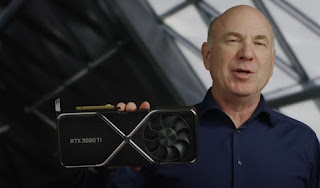
NVIDIA GeForce RTX 3080 Ti And RTX 3070 Ti Now Official; Both Arriving This Month


After months of speculation and rumours, NVIDIA has finally let the cat out of the bag on its new GeForce RTX 3080 Ti and RTX 3070 Ti graphics cards. Announced during its Computex 2021 keynote earlier, the two cards serve as a step-up to the currently existing RTX 3080 and RTX 3070 graphics cards.

Starting with the RTX 3080 Ti, as per the initial reports, the card comes with 12GB GDDR6X, 34 Shaders-TFLOPS, 67 RT-FLOPS, and 273 Tensor-TFLOPs. Additionally, the card also has 10240 CUDA Cores, a 19Gbps memory clock, as well as a 384-bit memory bus.


In terms of performance, NVIDIA says that the card is 1.5x more powerful and faster than its last generation RTX 2080 Ti. That power does come with a higher TGP consumption of 350W, which is 30W more than the RTX 3080. Elsewhere, the card has a boost clock of 1665MHz, 112 ROPs, and a memory bandwidth of 912GB/s.

The GeForce RTX 3080 Ti will be available from 3 June onwards, with an official SRP of US$1199 (~RM4946).


Next on the list is the RTX 3070 Ti. Aesthetically, the card’s cooler shroud definitely looks different from the RTX 3070; rather than use the same dual front-facing fan design, NVIDIA has opted to use the inverted dual-axis flow through design, originally introduced with the RTX 3080 and RTX 3090.

Specs-wise, there’s not a whole lot of detail about the RTX 3070 Ti besides what was showed on screen, but the card is definitely getting 8GB GDDR6X graphics memory, and not the standard GDDR6. Additionally, the card will have 22 Shader-TFLOPS, 42 RT-TFLOPS, and 174 Tensor-TFLOPs. In terms of performance, NVIDIA says the card is 1.5x more powerful than the RTX 2070 Super, and approximately 20% faster than the current RTX 3070.


As for availability, the GeForce RTX 3070 Ti is slated for 10 June and will have an SRP of US$599 (~RM2471).

Monday, May 17, 2021

ASUS Launches ROG Zephyrus M16 Laptop With Intel 11th Gen CPU, NVIDIA GeForce RTX 30 Series GPU


ASUS officially revealed its latest ROG Zephyrus laptop lineup recently, which includes both new and refreshed models. Among the latest additions, one gaming laptop that stood out is a redesigned ROG Zephyrus M16.

Cutting to the chase, one of the highlights of the new M16 is its larger screen-to-body ratio display that measures 16-inches, and is crammed into a 15.6-inch body. Moreover, it offers a four-sided, narrow bezel panel that in turn provides a display ratio of 16:10. Adding on to that, the display has a maximum resolution of 2560 x 1600 pixels, plus a maximum refresh rate of 165Hz and 3ms GTG response time. Oh, it’s also Pantone Validated and has a maximum brightness level of 500 nits.

On a side note, the M16’s display also sports a super-slim 2MP webcam, which is nothing short of a feat, given how limited space already is on the panel.


Underneath the hood, the M16 is fitted with the latest 8-core Intel 11th generation Core i9-11900H CPU, a choice between an NVIDIA GeForce RTX 3060 or RTX 3070, up to 32GB DDR4 RAM, and up to 2TB of NVMe Gen4 storage. Powering it all up is a massive 90WHr, 4-cell battery.

As for heat dissipation, both the CPU and GPU are connected by six heat pipes, which are cooled by Arcflow fans. Each equipped with 84 blades and feature ASUS’ self-cleaning Anti-Dust 2.0 system. Last but not least, despite all that hardware, ASUS has managed to keep the weight of the laptop under 2kg. Specifically, it weighs in at 1.9kg.


As for how much the ASUS ROG Zephyrus M16 costs, the brand has yet to specify that detail. However, ASUS will be releasing two SKUs of it, one at the end of June, while the higher-tier SKU will be made available at the end of July.

Saturday, May 15, 2021

NVIDIA Launches GeForce RTX 3050 Series GPUs For Laptops


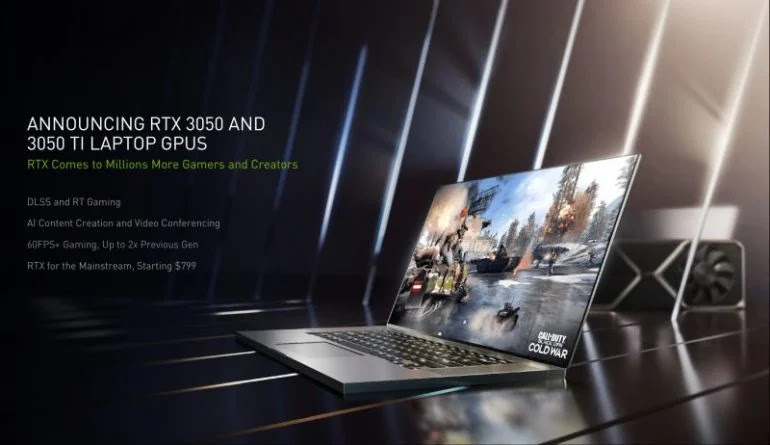
After months of speculations and wild rumours, NVIDIA is finally breaking its silence and making the GeForce RTX 3050 series official. As per earlier reports, the series comprises two GPU models, the RTX 3050 Ti and RTX 3050, and will only be available as laptop GPUs.

Specs-wise, both the RTX 3050 Ti and RTX 3050 are based on NVIDIA’s Ampere architecture and feature 4GB GDDR6 graphics memory. Additionally, both cards utilise a 128-bit memory bus and like all RTX 30 series GPUs, they are able to make full use of the PCIe 4.0 interfaces.

As they are part of NVIDIA’s RTX family, both the RTX 3050 Ti and RTX 3050 are also capable of real-time ray-tracing and also support the GPU maker’s DLSS anti-aliasing technology.


There are, obviously, parametres that set both cards apart from each other; the RTX 3050 Ti comes with 80 Tensor Cores, 20 RT Cores, and a maximum boost clock of 1695MHz. For the RTX 3050, the GPU has 64 Tensor cores, 16 RT Cores, and a maximum boost clock of 1740MHz.

NVIDIA’s GeForce RTX 3050 GPUs should be available starting this month, with the GPU maker’s brand partners launching their latest gaming laptops that are also being launched right now. To that end, these laptops are also being paired with Intel’s latest 11th generation Tiger CPU lineup.

Friday, May 7, 2021

NVIDIA Releases GeForce Driver 466.27 With New Anti-Ethereum Limiter

NVIDIA released its latest GeForce driver version 466.27 just yesterday. The driver ahead of next week’s launch of Metro Exodus Enhanced Edition, but more importantly, it marks the brand’s second attempt at implementing its anti-Ethereum limiter for the GeForce RTX 3060.

As a quick recap, NVIDIA announced that the RTX 3060 family of graphics cards would feature a limiter that would dampen the card’s mining performance for the cryptocurrency. By doing this, it hoped that it would deter cryptominers from buying the card in bulk and leaving bonafide gamers empty-handed, as a result.

Unfortunately for NVIDIA, the GPU maker made a boo-boo less than a month after the RTX 3060 was launched, when it released a GeForce driver without the anti-Ethereum code, thus allowing miners to mine the cryptocurrency with total abandon. Among other creative methods, that is.


With the new driver version, NVIDIA is breathing new life into its anti-Ethereum miner code and based on its rather ambiguous blog post, it sounds as though driver version 466.27 is expected to be the minimum driver version for all GeForce RTX 30 series cards that ship out from mid-May onwards.

As to whether or not the new driver update will actually turn miners away from NVIDIA’s GeForce RTX 30 series cards and, alternatively, turn them towards the brand’s CMP lineup, only time will tell.

Saturday, May 1, 2021

UK Government Officially Blocks NVIDIA Acquisition of ARM


Back in January this year, regulators based in the UK announced that it was investigating the takeover of its Cambridge-based semiconductor maker, ARM, by the US-based GPU maker, NVIDIA. As of today, that acquisition has officially been halted by the country’s Crown.

As of yesterday, the UK’s Secretary of State issued a public interest intervention notice (PIIN), citing that such an acquisition was grounds for national security concerns. Specifically, it brings up a Section 42 within the country’s Enterprise Act 2002; the act states that the government may suspend any acquisition of a UK-based facility if there is reasonable doubt that two or more enterprises will cease to be distinct; there is fear that the purchasing entity will bring the acquired enterprise under their ownership and therefore, erasing what makes them unique; and if the value of the company being acquired has a turnover value that exceeds £1 million (~RM5.76 million).

NVIDIA announced its plans to purchase ARM from the Softbank Group (SoftBank) back in September last year, agreeing to purchase the semiconductor maker for a handsome sum of US$40 billion (~RM 164 billion). In its decision to acquire the chipmaker, the GPU brand promised that it would not put a crimp into ARM’s open-licensing model and customer neutrality, of which it counts AMD, Apple, Samsung, and Google as some of its major clients.

Sadly, NVIDIA’s word wasn’t enough of a promise and like clockwork, several tech giants inevitably began expressing concern about the potential acquisition and while UK-based regulatory bodies began investigating the deal and the possible repercussion it could have on the semiconductor industry, as a whole.

Sunday, April 18, 2021

NVIDIA Partners Up With MediaTek; Licenses Out Ampere IP To Create New Gaming SDK


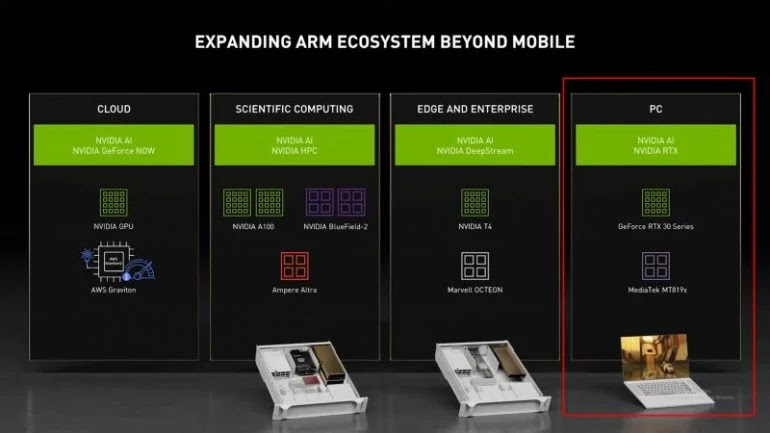
Apart from NVIDIA’s announcement of its Omniverse, its CEO, Jen-Hsun Huang also mentioned that it was expanding its reach to several avenues of the ARM ecosystem, through a series of partnerships and licensing out its technology. Of the lot, one announcement that stood out was its decision to license out the GeForce RTX 30 Series’ Ampere IP to MediaTek.

As Huang briefly stated, the Ampere IP would be paired with the Taiwanese SoC maker’s MT8199x chipset, and be used to create a reference system and SDK for Google’s Chrome OS and Linux-based PCs. It is unclear if this partnership will help NVIDIA re-enter the smartphone market once more, but for now, its partnership with Amazon Web Services’ (AWS) Graviton2 CPU is what is expected to drive “Android gaming” to the cloud.

For that matter, NVIDIA’s decision to partner up with a mobile chipset maker isn’t the surprising part; its rival, AMD, already partnered up with Samsung two years prior, with the former promising to license out its RDNA graphics technology to the Korean tech giant’s Exynos chipset. There are even some alleged benchmarks of said chipset’s performance with an AMD GPU, although that still remains verified till now.


What is surprising, though, is NVIDIA’s decision to partner up with a chipmaker like MediaTek. While it has been hailed as the third-largest chip vendor for the third quarter of last year, it has also come under fire in the past for purposely “modifying” its own chipsets, enabling it to cheat in certain benchmarks like UL’s PCMark app.

In any case, Huang did not say when a MediaTek chipset running with NVIDIA’s Ampere GPU technology would be arriving.

Wednesday, March 31, 2021

NVIDIA Quietly Rebadges GeForce RTX 3080 Ti GA102-250 GPU To GA102-300 For RTX 3090


It appears that NVIDIA is quietly rebadging its GA102-250 GPU that was originally intended for the upcoming GeForce RTX 3080 Ti, to a GA102-300. Not only that, but the GPU is also reportedly now being repurposed to its RTX 3090 graphics card.

The discovery was picked up by German-site HardwareLuxx, who discovered the rebadging of the GA102-250. As a quick primer, the GA102-250 was supposed to offer specs that are nearly identical to the RTX 3090; its CUDA core count was rated at 10240, which is just 256 cores shy from what NVIDIA’s top-tier card has. To that end, plans for the GPU has been pushed aside and the GPU maker already has a GA102-225 GPU for the RTX 3080 Ti instead.

Further proof of NVIDIA’s rebadging was also provided by a HardwareLuxx member, who showed off a picture of the GPU attached to a Founders Edition RTX 3090. As you can see from the image, the GA102-250 has been struck off, with the GA102-300 GPU code having been etched just below it.


Production of the RTX 3080 Ti has been in development limbo; the halfway-point GPU was initially slated for an April launch, but has since been reportedly pushed back to May. Moreover, it is still unclear if the card will ship out with 12GB or 20GB GDDR6X graphics memory, the latter having been leaked by a product listing by ASUS earlier this year.

Thursday, March 18, 2021

US Court Throws Out Cryptomining Lawsuit Against NVIDIA


Back in 2018, NVIDIA was hit by a class-action lawsuit. It alleged that the GPU maker made false and misleading statements about the state of the cryptocurrency market at the time, to its shareholders. Earlier this month, a US court ruled in favour of NVIDIA on the case.
The lawsuit was dismissed by a US District Court Judge based in the Northern District of California at the behest of NVIDIA, on the grounds that it was lacking evidence to prove the plaintiff’s claim. Specifically, the lawsuit accuses NVIDIA of under-reporting its revenue generated from the cryptocurrency surge of 2018 by around US$1.13 billion (~RM4.65 billion). Not only that, the lawsuit also says that the company hid those profits by claiming that approximately 70% of its GPU sales were “gaming revenue”. When it was actually gained from GPU mining.


The 2018 cryptocurrency surge eventually dwindled, but not before Bitcoin peaking at RM82000. Fast forward to today, and digital coin now has an average worth of RM230000 and in response to the new surge, NVIDIA announced that it was launching its Cryptocurrency Mining Processor (CMP), a GPU lineup dedicated entirely to mining not Bitcoin, but the second most lucrative cryptocurrency on the market, Ethereum.

Xiaomi Shows Off Physical Concept Of Vision Gran Turismo

At the very tail end of last month, Xiaomi unveiled the Vision Gran Turismo. The car was revealed as a digital hypercar, and one that’s made...